last night during a small discussion with friends after our trading session, the conversation suddenly shifted from meme coins and market charts to AI.
one friend asked a simple question that honestly stayed in my mind for hours: “if AI becomes the biggest industry in the world, who actually owns the data powering it?” everyone had different answers, but the deeper we talked, the more we realized how little attention people give to the ownership side of artificial intelligence. that’s when the topic of openledger came up, and the entire discussion changed direction.
most AI projects today focus heavily on model performance, automation, or agent capabilities. every week there’s another headline about smarter AI, faster reasoning, or companies racing toward AGI. but behind all those systems sits something much more valuable: data. datasets are the real fuel of AI, yet the people contributing information, translations, research, conversations, and community knowledge rarely receive recognition or economic rewards. one of my friends who works with multilingual content explained how years of manually verified datasets often end up being absorbed into larger systems without proper attribution. the creators disappear while the platforms profit. honestly, that imbalance feels like one of the biggest hidden problems in the AI economy today.
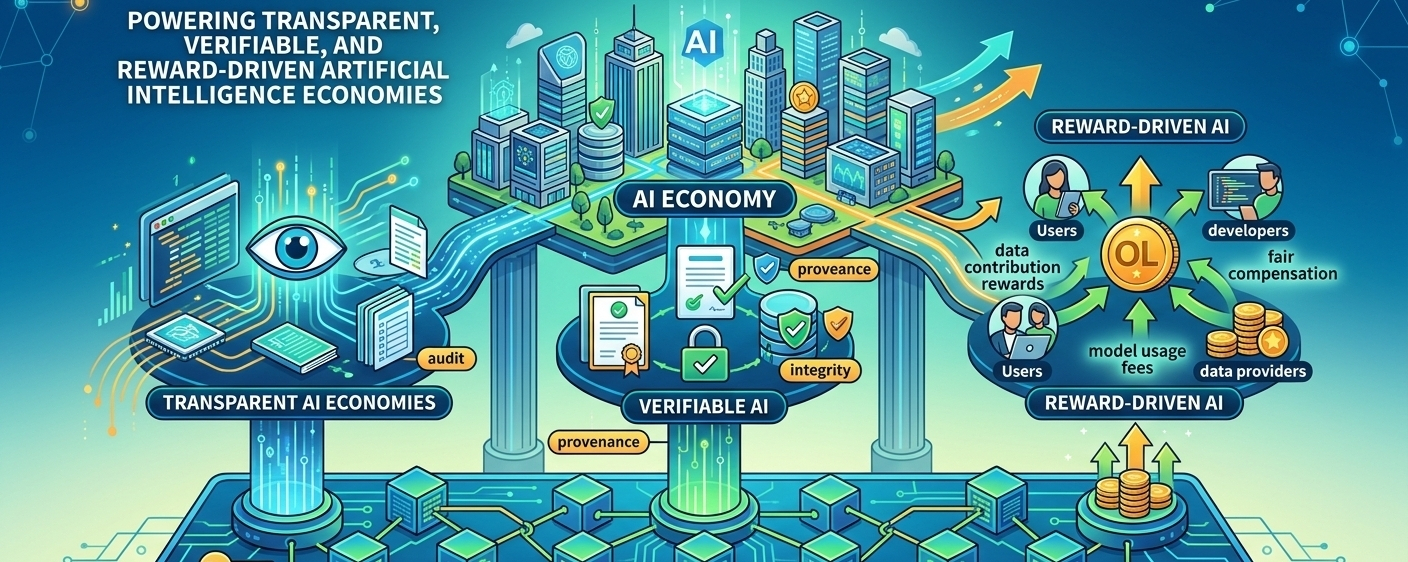
that’s why OpenLedger feels different compared to most projects entering the AI crypto space. instead of only trying to build another flashy AI application, they’re focusing on the infrastructure layer that tracks ownership, attribution, and value distribution. the concept that caught my attention most is their Proof of Attribution system. it creates a framework where datasets, AI models, and agents can be verified on-chain, allowing contributors to prove participation in the intelligence economy. in simple words, it transforms data from invisible labor into a measurable digital asset. and that changes everything.
during our discussion, we started comparing this shift to earlier internet revolutions. before cloud computing exploded, very few people cared about server infrastructure. before decentralized finance became massive, blockchain rails looked boring to most traders. but eventually those underlying systems became the foundation for trillion-dollar ecosystems. AI infrastructure could follow the same path. while the market currently focuses on hype cycles, chatbots, and speculative narratives, projects like OpenLedger are quietly building the systems that could support transparent AI economies in the future.
another thing i respect is that OpenLedger approaches scalability differently. many blockchain projects talk about decentralization but struggle with real-world efficiency once activity increases. OpenLedger’s modular structure and integration-focused architecture suggest they understand that AI ecosystems require both verification and speed. attribution systems only matter if they can operate at scale without making costs impossible for contributors or developers. solving that balance is extremely important if decentralized AI is going to compete with centralized tech giants over the next decade.
by the end of the conversation, everyone agreed on one thing: the next AI war may not only be about who creates the smartest model. it could become a battle over who owns the datasets, verifies the information sources, and distributes the rewards fairly across contributors. that’s a much bigger conversation than people realize today. and honestly, that’s the main reason OpenLedger keeps standing out to me in the crowded AI crypto landscape. they aren’t just building another AI narrative they’re trying to build the ownership layer that the future AI economy may eventually depend on.