

This week brings together a few of the themes that have been building across the ecosystem for some time.
As we enter the cooldown phase for the next Tezos protocol upgrade, we’re focusing on the awesome community members who are contributing in their own way through tools that help preserve the growing archive of art, collections, and cultural history being created on Tezos.
That focus on permanence and preservation extends beyond software as well. In New York, artists, curators, and collectors recently gathered for Open Worlds at the Museum of the Moving Image, while a new commission by Linda Dounia and Rhea Myers is now on display as part of the ongoing MoMI x Tezos Foundation partnership.
This week's stories highlight something that has always been part of Tezos. Protocol upgrades provide the foundation, builders create the tools people rely on, and artists continue to explore new ways of using the technology itself as a creative medium.
 Community Spotlight: Building For the Culture
This week, we're turning the spotlight toward a group of community-built tools that help preserve the growing archive of art and culture on Tezos.
Every collection tells a story, and as that history continues to grow, so does the importance of keeping the media, metadata, and context behind those works accessible for years to come. Media files need to remain accessible, metadata needs to stay intact, and collectors need confidence that the history attached to an artwork will still be available years from now.
This week, Tezos highlighted several community-built tools designed to help do exactly that. While each approaches the challenge differently, they all share the same goal: making it easier to preserve artwork and metadata for the long term.
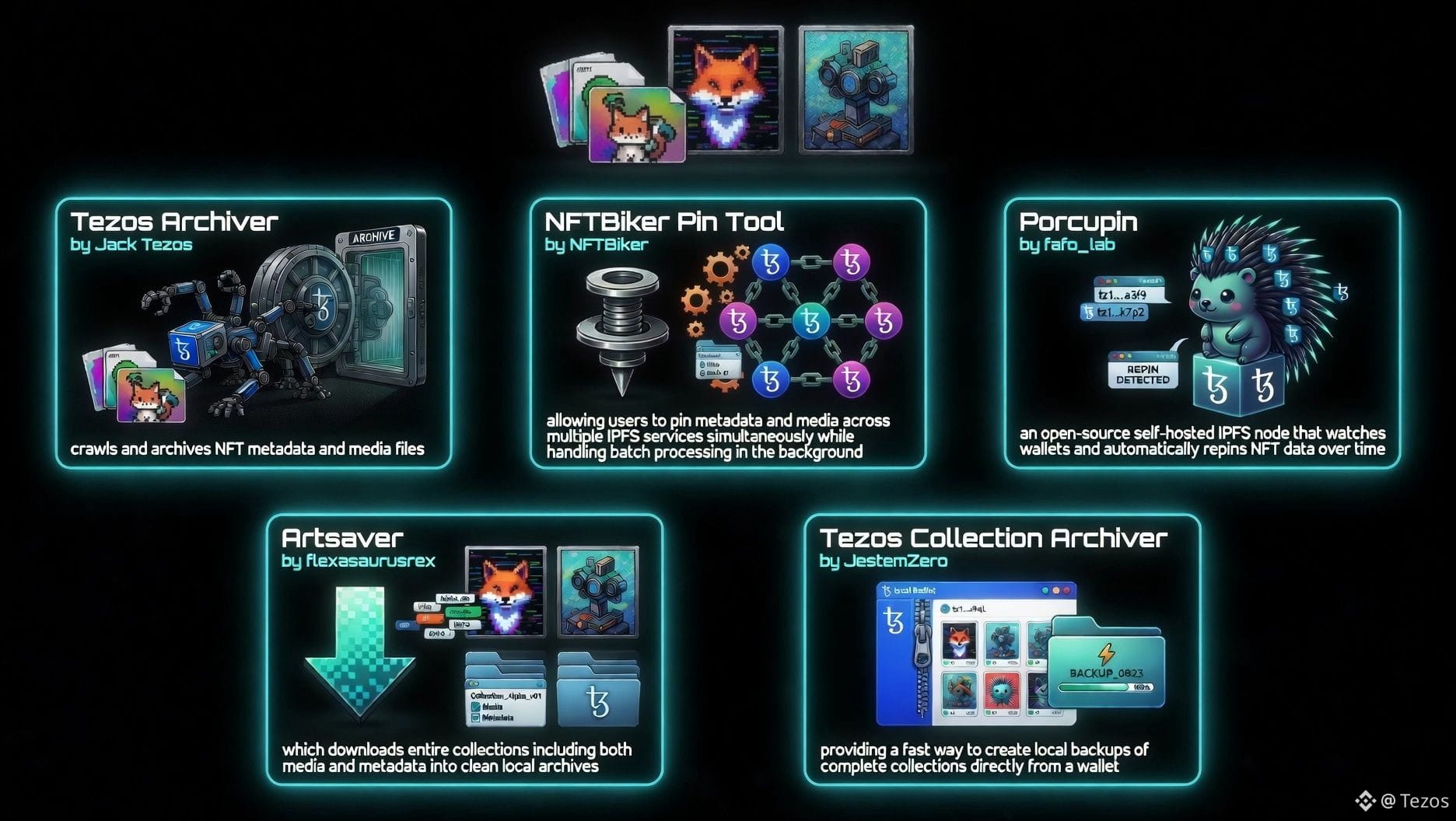
Some of the tools available today include:
• Tezos Archiver by Jack Tezos, which crawls and archives NFT metadata and media files
• NFTBiker Pin Tool by NFTBiker, allowing users to pin metadata and media across multiple IPFS services simultaneously while handling batch processing in the background
• Porcupin by fafo_lab, an open-source self-hosted IPFS node that watches wallets and automatically repins NFT data over time
• Artsaver by flexasaurusrex, which downloads entire collections including both media and metadata into clean local archives
• Tezos Collection Archiver by JestemZero, providing a fast way to create local backups of complete collections directly from a wallet
What stands out is that none of these tools were developed as part of a coordinated initiative. They emerged from members of the community identifying a need and building practical solutions around it.
That speaks to something about the ecosystem as a whole. Collecting, creating, and preserving digital art are all part of the same process. The artwork itself matters, but so does ensuring the files, metadata, and context surrounding it remain accessible over time.
As more collections are created and more history accumulates on-chain, tools like these become an increasingly valuable part of the ecosystem's foundation. They help ensure that the cultural record being built today remains available for future collectors, researchers, artists, and communities to explore.
 Tezos Upgrade Tracker: Cooldown Phase
While the community continues building tools around art preservation, governance has also reached another checkpoint this week.
The Ushuaia proposal has successfully completed the Exploration phase after reaching both quorum and supermajority support from participating bakers. With that milestone now behind it, the proposal advances into the 10-day Cooldown phase before entering its final Promotion vote.
Thank you to all the bakers who took part in the process and helped move the proposal forward.
Ushuaia continues the direction established by recent protocol upgrades, focusing on scaling infrastructure, improving the experience for rollups, and preparing the network for future cryptographic requirements.
Among the key features proposed are:
• A 15x increase in Data Availability Layer bandwidth, expanding capacity from approximately 0.66 MB/s to 10 MB/s
• Dynamic DAL attestations, reducing the time required for data confirmation
• Greater flexibility for rollup environments to evolve through governance mechanisms
• Early groundwork for quantum-resistant tz5 accounts
• Experimental support for protocol-native liquid staking infrastructure through sTEZ
The proposal also continues the Tezos X journey by expanding the data capacity available to execution layers and future applications. As more builders begin experimenting with Tezos X Previewnet and increasingly data-intensive workloads, these protocol-level improvements provide additional room for applications to scale.
For now, the proposal enters its cooling-off period, giving bakers and the wider community time to review the upgrade before the final Promotion vote begins. If approved in the next phase, Ushuaia will move one step closer to activation later this year.
You can follow the proposal's progress on Agora as it advances through governance.
This Week in the Tezos Ecosystem
 Open Worlds Celebrates Art on Tezos at MoMI
From preserving art through community-built tools to experiencing it in person, the conversation around art on Tezos continued this week at the Museum of the Moving Image in New York.
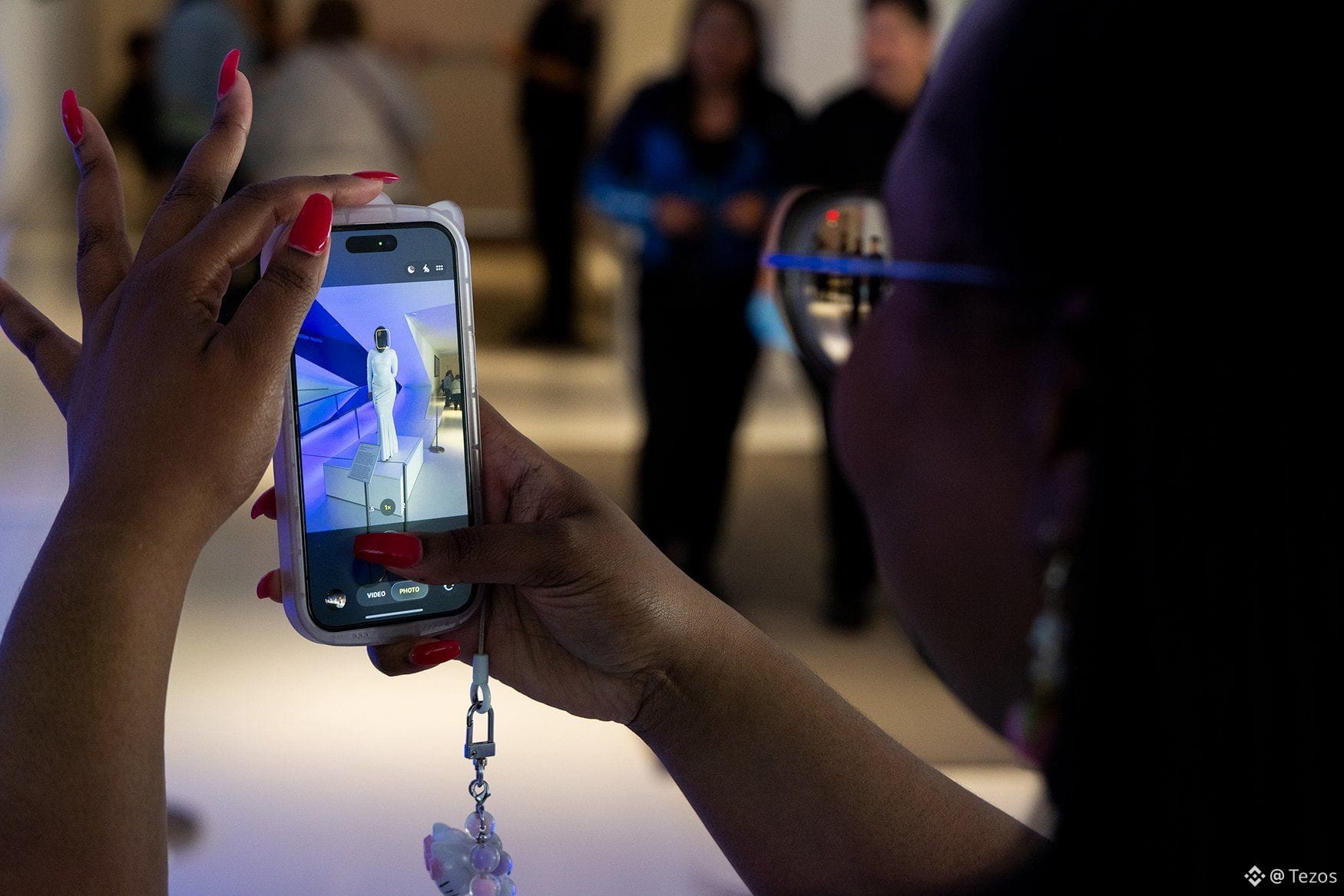
Open Worlds: An Afternoon of Digital Art Encounters brought together artists, collectors, and members of the community for an afternoon that explored different approaches to creativity, performance, and generative art. Hosted by the Museum of the Moving Image in partnership with Art on Tezos, the event highlighted three artists whose practices approach technology from very different perspectives.
Visitors had the opportunity to meet and hear from:
• Travess Smalley, whose work explores generative image systems and computational art, including a talk and signing for his Pixel Rugs publication
• OONA, whose performances examine themes of technology, identity, and gender through the lens of digital culture
• Edgar Fabián Frías, a multidisciplinary artist and educator whose practice brings together performance, psychology, spirituality, and contemporary media
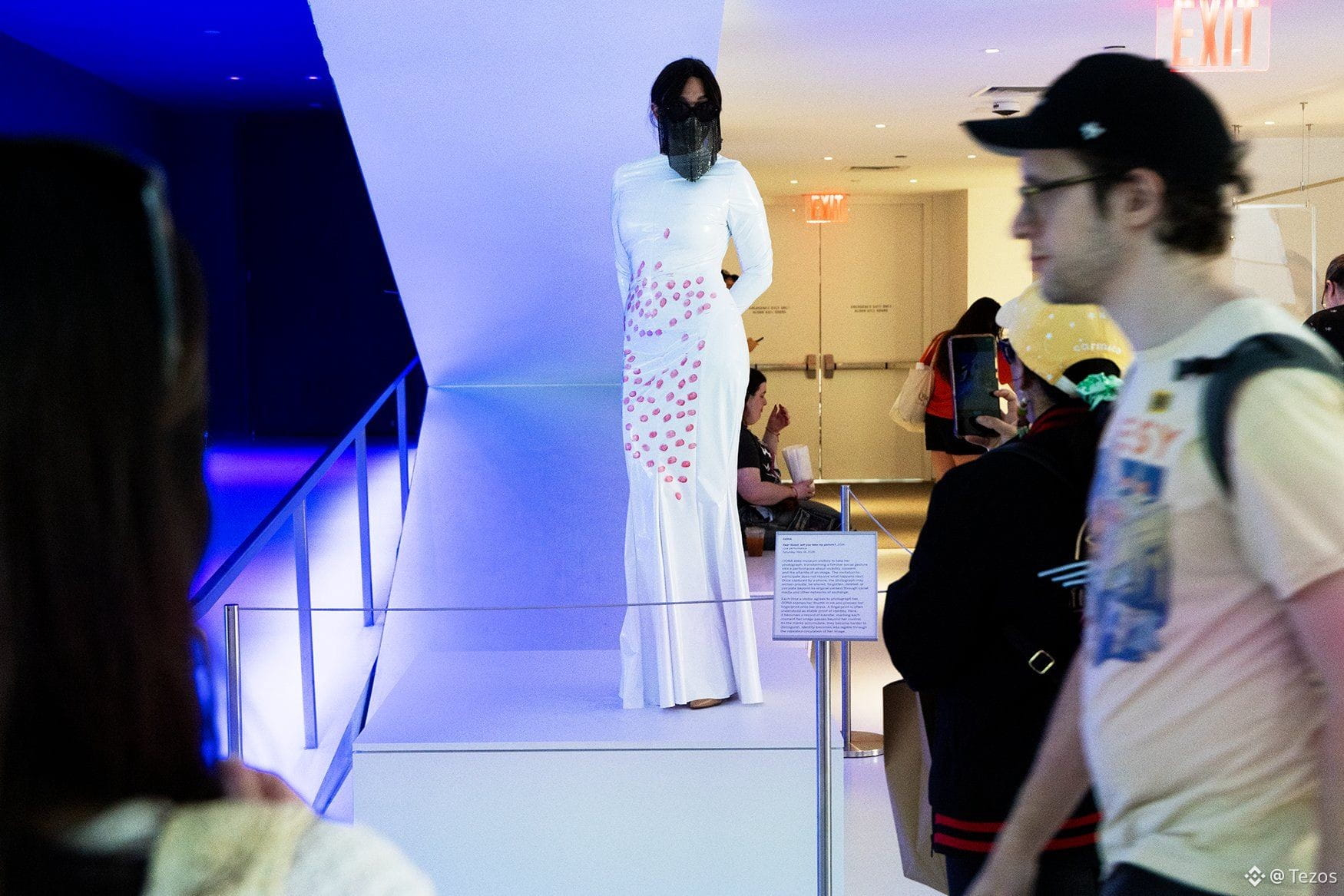
Events like Open Worlds continue to demonstrate how the Tezos art community extends far beyond the digital realm. Artists, curators, institutions, and collectors are creating opportunities to experience these works together, adding context, dialogue, and human connection to the creative ecosystems being built online.
A big thank you to everyone who attended, participated, and helped bring the afternoon to life.
Tezos Spring Events
To Be Perceived, Against Evil Opens at MoMI
As conversations around preservation, digital culture, and creative expression continue across the ecosystem, a new commission is now on view in New York as part of the ongoing partnership between the Museum of the Moving Image and the Tezos Foundation.
To Be Perceived, Against Evil brings together the work of Linda Dounia and Rhea Myers in an installation that explores visibility, privacy, memory, and what it means to remain partially unknowable in an increasingly data-driven world.
Inspired by the writings of Édouard Glissant and his concept of the "right to opacity," the work asks a simple but powerful question: what deserves to remain unseen, untranslated, or protected?
Visitors encounter the piece through the Media Wall, which initially appears obscured. As people move through the space, their presence is transformed into encrypted branching data that interacts with Tezos smart contracts. Collective participation gradually reveals portions of the artwork while deliberately preserving areas that remain hidden.
The themes run deeper than the technology itself. For Linda Dounia, opacity connects to her research with the Serer community in Senegal, where sacred trees carry histories of ancestry, memory, and creation. For Rhea Myers, the concept speaks to personal autonomy and the ways systems often expect identity to be fully legible and constantly exposed.
The result is an artwork that uses blockchain as a creative material rather than simply a delivery mechanism, continuing a theme that has emerged throughout the MoMI × Tezos programming series.
Visitors can also collect a free process image accompanying the commission through objkt.com, offering a glimpse into the development of the work alongside the installation itself.
To Be Perceived, Against Evil is now open and will remain on view through August 2 at the Museum of the Moving Image.
 🔴 Now Streaming: Inside TzEL and the Future of Private Payments on Tezos
This week on TezTalks Radio, we’re joined by Arthur Breitman, co-founder of Tezos, for a deep conversation about TzEL, an experimental project exploring private, post-quantum payments on Tezos testnet.
At the center of the discussion is a deceptively simple question: If blockchain data can remain public forever, what does privacy actually mean over time?
Rather than treating privacy as a momentary concern, this episode looks at the long-term reality of encrypted transaction data that may still exist decades from now and what happens if future cryptographic assumptions change.
The conversation moves through private payments, post-quantum cryptography, rollups, the DAL, and the engineering realities of turning research ideas into working systems.
This is one of the clearest conversations yet on how Tezos infrastructure, rollups, governance, and long-term adaptability connect together underneath the surface.
Now streaming on YouTube.
Powered by beehiiv