
I didn’t find $OPEN through some deep research thread. It was more random than that. I was just scrolling, half paying attention, seeing the usual AI-token language pass by again. Data, models, agents, rewards, attribution. The kind of words that start sounding important and empty at the same time when you see them too often.
At first, I almost skipped it.
OpenLedger looked like another project trying to place itself inside the AI infrastructure trade. And maybe that sounds harsh, but this market has made me suspicious of clean narratives. Everyone says they are building the missing layer. Everyone says users will finally own something. Everyone says contributors will finally get paid. After a while, you stop reacting to the promise and start watching the mechanics.
That is where $OPEN became more interesting to me.
The public story is easy to understand. AI needs data. It needs models. It needs agents. It needs people and systems feeding it useful inputs. OpenLedger wants to make those contributions visible, traceable, and payable through blockchain incentives. On paper, that makes sense. Actually, more than that, it touches a real problem. AI has been eating value from everywhere, while the people behind that value often disappear from the final equation. So yes, the idea of giving contributors a way to be recognized and rewarded is not some empty pitch. There is something real under it.
But I kept getting stuck on one question.
Who benefits first?
That question changes the whole feeling of the project for me. Because when a token economy says it is built for contributors, I immediately want to know whether contributors are actually the center of the system or just the most emotionally useful part of the story. There is a difference. A big one.
Contributors can bring data, activity, attention, testing, belief, and energy. They can make the network look alive. They can help create the supply side before demand is fully there. But until real buyers show up, until real AI demand starts paying into the system, those contributors are mostly waiting. Waiting for usage. Waiting for reward value. Waiting for the token to mean something beyond market movement.
And that waiting is not free.
Retail takes risk through price. Contributors take risk through time. Builders take risk by choosing the ecosystem before it is proven. The foundation takes risk too, but it also has the most control over the direction. That is why I do not like reading these projects only through their public message. The real story is usually hidden in the order of risk. Who gives first? Who waits longest? Who has the cleanest exit? Who needs everyone else to keep believing?
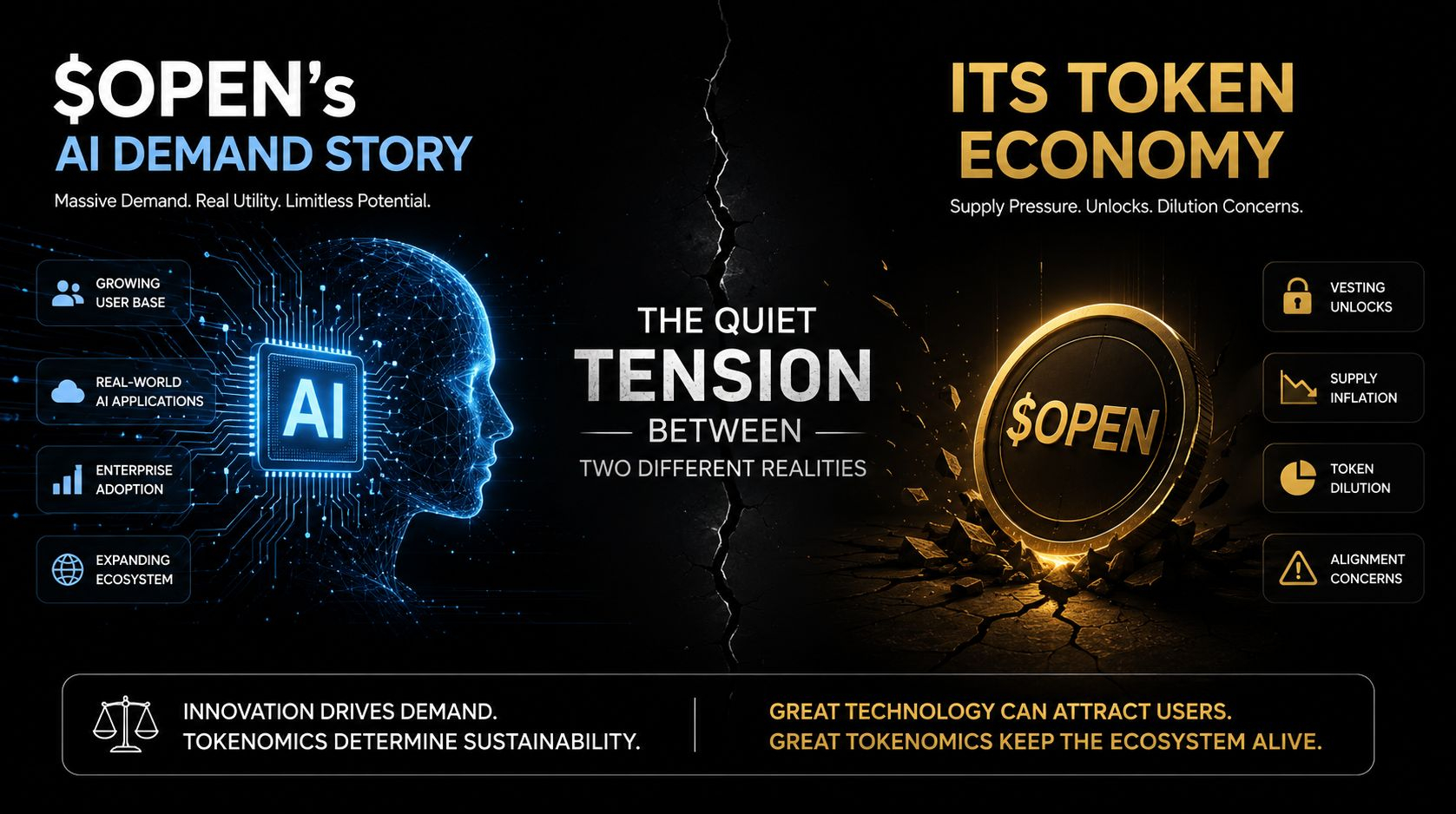
With $OPEN, the interesting part is the link between AI demand and blockchain incentives. But that link is not magic. It has to be fed by real demand. Someone has to actually need the data, models, or agents badly enough to pay for them. If that demand comes from open participation, great. If it comes mostly from enterprises or more controlled channels first, that is also possible, maybe even more realistic. But then the story becomes different. It is no longer just “contributors finally get rewarded.” It becomes “the project needs serious demand first, and the public contributor economy has to wait for its place inside that demand.”
That is not automatically bad. It is just less romantic.
And maybe that is what kept bothering me. The marketing makes the system feel open and fair, but the economics may be more protective and selective underneath. The token has to do more than reward people. It has to hold attention. It has to support confidence. It has to make the network feel active before the full demand loop is proven. It has to keep people close enough to care while the deeper business side develops.
That is a lot to ask from one token.
So I do not look at open as a simple “AI plus blockchain” story. I see it more like a stress test. Can blockchain incentives actually pull useful supply into an AI economy without turning everything into farming noise? Can contributors earn because their work is genuinely valuable, not just because the system needs activity? Can the token become a real settlement layer for demand, instead of just a symbol people trade while waiting for demand to arrive?
These are the questions that make the project worth watching, but they are also the questions that stop me from sounding too convinced.
Because every system looks fair before pressure arrives. The real shape only appears when money starts moving. When demand comes in, who gets paid first? The contributors who helped build the value? The market makers protecting liquidity? The early holders managing exits? The foundation trying to keep the machine stable? The enterprise side buying access quietly while the public side celebrates participation?
That is where the truth will be.
Maybe Open does manage to connect AI demand with real contributor rewards. Maybe it becomes one of the few projects where attribution is not just a nice word on a website, but something that actually changes who earns from AI. I can see why that would matter. I can see why people are watching.
But I am still not fully sold.
Right now, what I see is a project with a clean public promise and a much messier economic question underneath. It says it wants to reward the people and systems that help AI grow. Fine. But the market will eventually ask the colder version of that question: when value appears, does it flow outward to the contributors, or inward to protect the system first?
@OpenLedger #OpenLedgers #OpenLedger $OPEN