
The first time I seriously looked at the infrastructure behind modern AI systems, I stopped thinking about models for a moment and started thinking about labor.
Not computational labor. Human labor.
The more advanced AI became, the more invisible its contributors seemed to get.
People usually talk about artificial intelligence as if it emerges fully formed from a handful of elite labs and breakthrough architectures. That framing is convenient, but incomplete. Behind every capable model sits a long chain of fragmented human contribution: data collection, annotation, evaluation, refinement, reinforcement feedback, model tuning, edge-case correction, infrastructure maintenance, domain expertise, and continuous testing. Most of this work disappears into the background the moment the system becomes commercially useful.
That disconnect keeps bothering me because it reveals something deeper about the current AI economy. The systems are decentralized in effort, but centralized in recognition.
And that imbalance is becoming harder to ignore.
What stands out to me is that AI has quietly created one of the largest invisible production layers in modern technology. Millions of people contribute value to intelligent systems in indirect ways, often without ownership, traceability, or meaningful participation in the upside created from their work. Data flows in. Models improve. Companies scale. But attribution remains thin and uneven.
The problem is not only ethical. It is structural.
Modern AI depends on contribution density. The more feedback, context, correction, and specialization a system receives, the stronger it becomes. Yet the infrastructure for recognizing those contributions remains surprisingly primitive. Most systems still treat contributors as disposable inputs rather than persistent participants in an evolving intelligence network.
That design choice made sense in earlier stages of AI development when speed mattered more than transparency. Centralized control accelerated deployment. Closed systems simplified coordination. Efficiency came first.
But scale changes the equation.
As AI systems become increasingly integrated into finance, healthcare, research, education, logistics, governance, and everyday decision-making, questions around provenance and accountability become unavoidable. Where did the data come from? Who improved the model? Which feedback loops shaped the outcome? What incentives influenced optimization?
These questions are no longer philosophical side discussions. They are operational concerns.
And this is where I think a meaningful shift is starting to happen.
Projects building at the intersection of AI and decentralized infrastructure are not simply trying to “put AI on blockchain.” That phrase often oversimplifies the problem and misses the real point entirely. The deeper objective is creating systems capable of remembering contribution itself.
That distinction matters.
I keep coming back to the idea that intelligence without attribution creates unstable ecosystems. Not immediately, but gradually. When contribution becomes invisible, incentives weaken. When incentives weaken, participation quality declines. Eventually the system starts extracting more value than it distributes.
The result is concentration without sustainability.
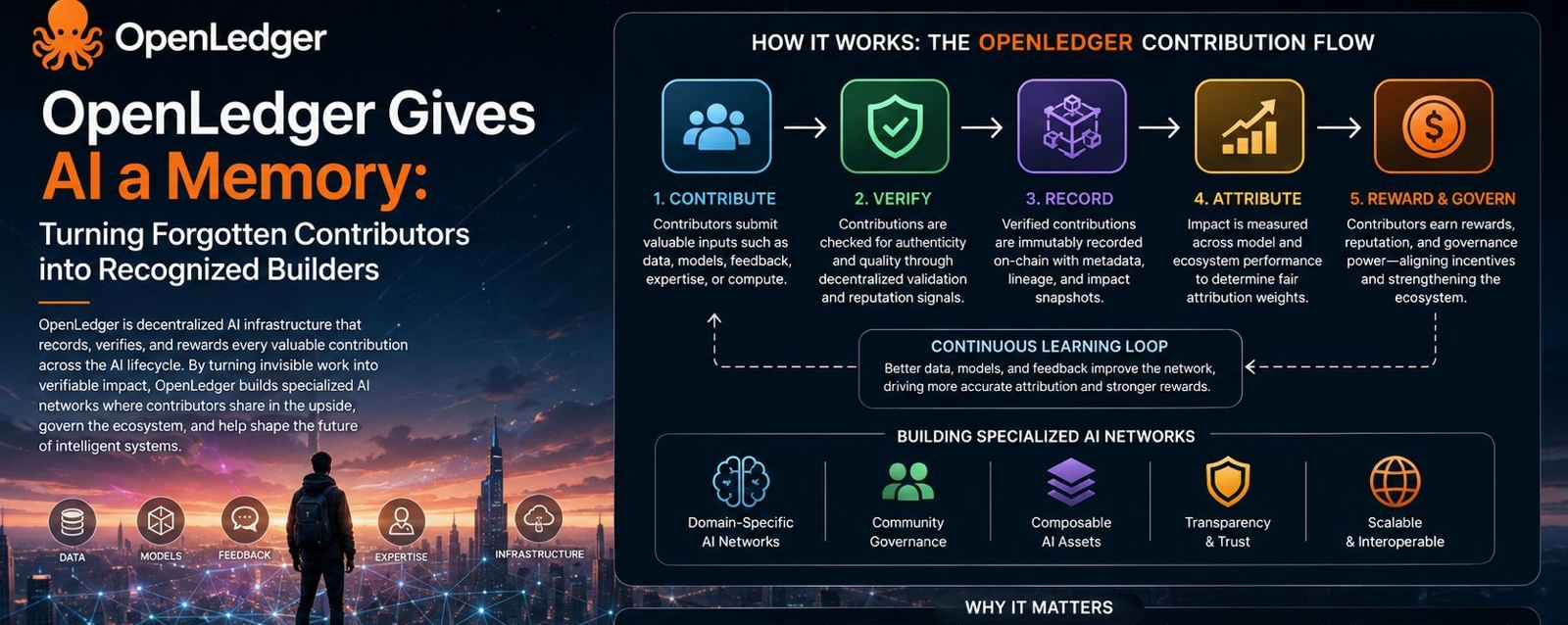
What newer decentralized AI frameworks are attempting to solve is not just ownership in the financial sense, but visibility in the systemic sense. They are trying to create environments where contributions can be recorded, verified, weighted, and rewarded across the lifecycle of intelligent systems.
In theory, that sounds straightforward. In practice, it is extremely difficult.
AI development is messy. Contributions are rarely linear. One dataset may improve a model marginally while another dramatically changes performance under niche conditions. Human feedback can be subjective. Domain expertise is uneven. Attribution models themselves introduce complexity because intelligence emerges collectively rather than from isolated actions.
There is no perfect ledger for creativity or cognition.
Still, imperfect visibility may be better than structural blindness.
This is one reason projects like OpenLedger have started attracting attention inside the decentralized AI conversation. What interests me is not the marketing narrative around “AI ownership,” which many projects now repeat, but the attempt to build infrastructure around verifiable contribution and specialized AI ecosystems.
That is a more serious problem space.
The idea behind these systems is relatively simple at a conceptual level: contributors provide valuable inputs to AI networks, whether through data, models, expertise, inference infrastructure, or evaluation mechanisms, and the network records those contributions in ways that can later influence rewards, reputation, or system governance.
Simple concept. Complicated execution.
Because the moment contribution becomes measurable, new tensions emerge.
Transparency improves trust, but excessive transparency can reduce privacy. Incentive systems encourage participation, but poorly designed incentives also attract manipulation. Open ecosystems accelerate experimentation, but they can fragment quality control. Decentralization distributes power, yet coordination becomes harder as systems grow.
Every infrastructure decision creates trade-offs.
This is why I think the most important conversations in decentralized AI are no longer about ideology. They are about mechanism design.
How do you reward useful contributions without encouraging spam? How do you verify authenticity without recreating centralized gatekeepers? How do you preserve openness while maintaining model integrity? How do you measure value in systems where outcomes are probabilistic rather than deterministic?
These are not easy engineering problems. They are economic and behavioral problems disguised as technical architecture.
And the industry is still early in understanding them.
What I find particularly interesting is the growing shift toward specialized intelligence networks rather than generalized AI monopolies. For years, the dominant assumption in AI was that larger centralized models would eventually absorb most useful functions. Bigger datasets. Bigger compute. Bigger infrastructure advantages.
But reality is becoming more nuanced.
Specialized systems often outperform generalized systems in high-context environments because they understand narrower domains more deeply. Financial analysis, medical diagnostics, scientific research, legal interpretation, supply-chain optimization — these are areas where context quality matters as much as scale itself.
That changes the economics of AI contribution.
Suddenly, niche expertise becomes valuable infrastructure.
And once expertise becomes infrastructure, attribution becomes economically important again.
This is where decentralized coordination starts making practical sense. Not because decentralization is automatically superior, but because distributed intelligence requires distributed participation models. A network built from many contributors cannot sustainably function if only a small layer captures most of the long-term value.
Eventually the imbalance creates friction.
We have already seen versions of this dynamic across the internet economy. Social platforms scaled through user-generated content while concentrating monetization. Open-source ecosystems powered billion-dollar companies while many maintainers struggled financially. Data became one of the world’s most valuable assets while the people generating behavioral data rarely understood its value at all.
AI risks repeating the same pattern at a far larger scale.
Only this time, the outputs are not entertainment feeds or advertising systems. They are increasingly becoming cognitive infrastructure itself.
That raises the stakes considerably.
I do not think decentralized AI frameworks will magically solve every issue surrounding fairness, attribution, or ownership. Some problems are deeply human and unlikely to disappear through infrastructure alone. Power still concentrates. Capital still matters. Technical barriers still exist. Governance remains difficult.
But I do think the direction matters.
Because once systems begin recording contribution with greater fidelity, new forms of participation become possible. Reputation systems become portable. Incentives become more transparent. Specialized contributors gain visibility. Smaller participants gain leverage they previously lacked inside closed ecosystems.
The invisible layer starts becoming visible.
And visibility changes behavior.
People contribute differently when systems acknowledge their role. Communities coordinate differently when incentives feel legible. Networks evolve differently when value flows are observable rather than opaque.
This may ultimately become one of the most important shifts in the next phase of AI infrastructure — not merely making models smarter, but making the ecosystems around them more accountable, traceable, and participatory.
Smarter intelligence is not enough on its own.
The structure surrounding intelligence matters too.
What I keep coming back to is a simple idea: the future AI economy will likely be shaped less by who builds the largest model and more by who builds the most sustainable contribution network around intelligence itself.
That is a very different competition.
And for the first time, the invisible economy behind AI is starting to come into view.