
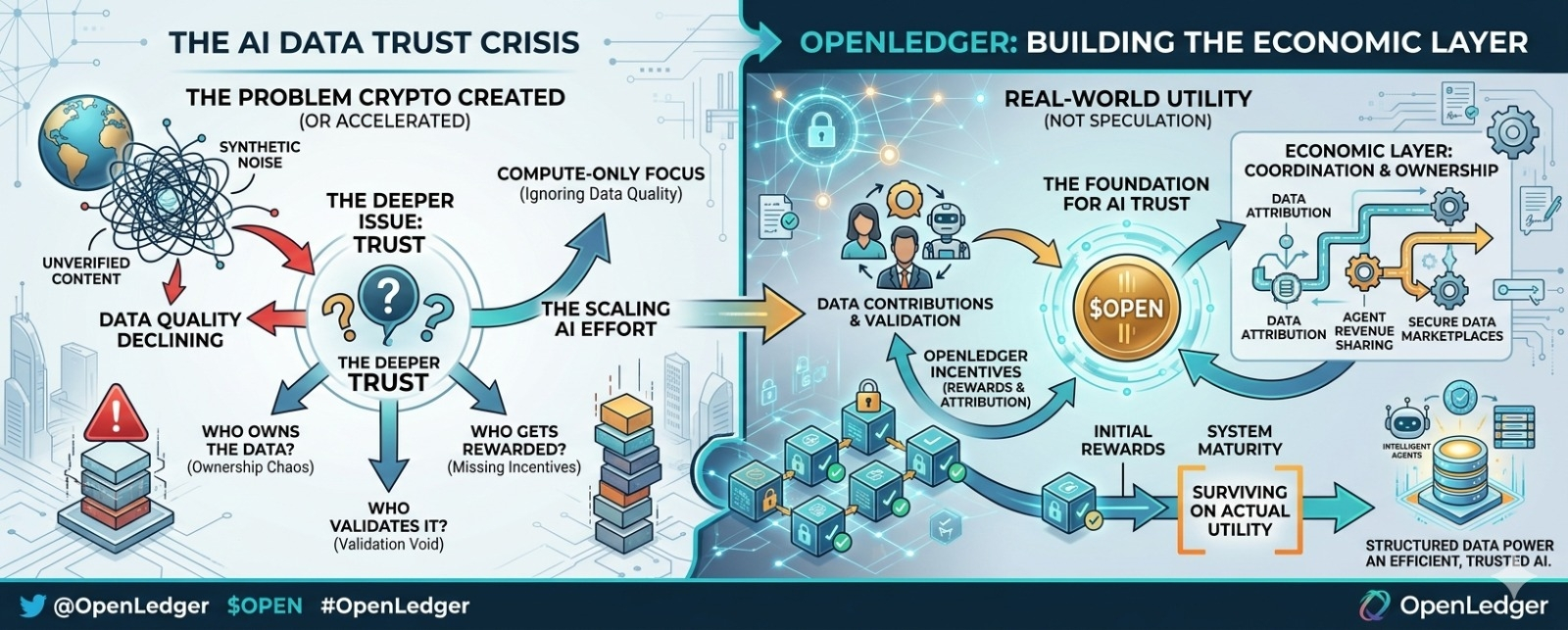
I’ve been thinking a lot about how quickly AI systems are becoming dependent on data they can’t properly verify anymore. The internet is already crowded with synthetic content, recycled information, and automated engagement pretending to be real activity. And somehow the market still acts like scaling AI is only a compute problem.
It isn’t.
The deeper issue is trust. Who owns the data? Who validates it? Who gets rewarded when AI agents generate value using information collected from thousands of invisible contributors? Most systems still don’t answer that clearly. They just move faster and hope nobody questions the structure underneath.
That’s partly why @OpenLedger keeps pulling my attention back. Not because it promises another AI narrative, but because it’s trying to build an economic layer around ownership and coordination before the entire ecosystem becomes flooded with unusable noise.
Still, I’m careful about projects like this. Crypto has a habit of turning important ideas into temporary speculation machines. Once liquidity arrives, behavior changes. Networks stop optimizing for usefulness and start optimizing for extraction. Real participation becomes harder to separate from farming.
So the real test for OpenLedger probably won’t happen during growth. It’ll happen later, when rewards normalize and the system has to survive on actual utility instead of momentum. That’s usually the moment where infrastructure either becomes necessary or disappears quietly.
For now, I’m just watching how the foundation holds under attention.