Open Coin and Proof of Attribution sound, at first glance, like just another attempt to wrap an existing idea in token-shaped language. But the underlying problem they’re pointing at is real enough that you can’t dismiss it with a slogan.
AI systems don’t “use” data in any human-readable sense. They absorb it, smear it across parameters, and later regenerate behavior that looks like reasoning. Somewhere inside that process, value is created. Useful output, better predictions, fewer errors. The uncomfortable question is simple: who actually caused that improvement to exist?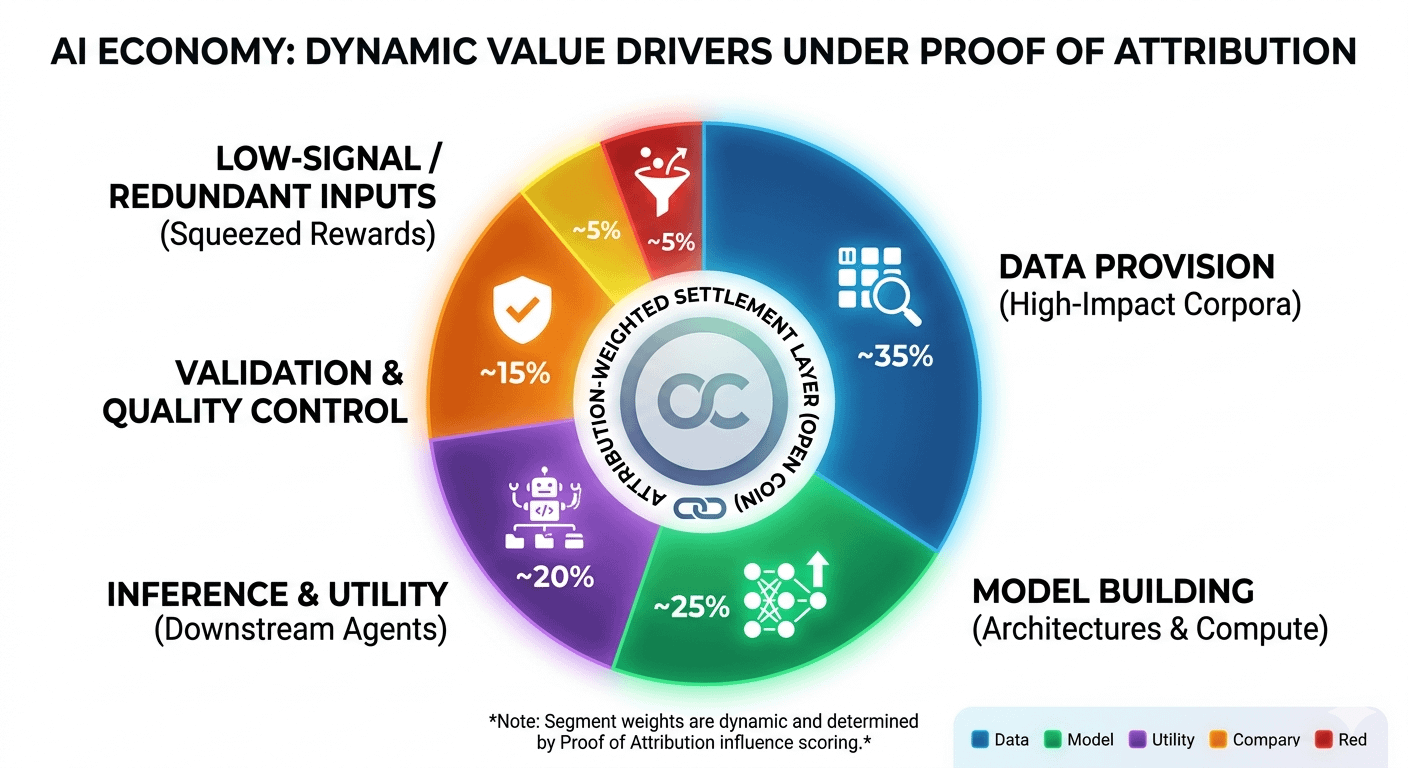
Proof of Attribution is an attempt to make that question answerable without pretending the model is interpretable in a classical sense.
It’s a cryptographic accounting layer stitched onto the AI pipeline. Not glamorous. More like infrastructure plumbing than philosophy. The goal is to bind data contributions to downstream model behavior in a way that can be verified, not assumed. If a dataset shaped an output, the system should be able to prove it. Not vaguely. Not probabilistically hand-waved. Actually trace it in a way external parties can audit.
That’s the theory, anyway.
Open Coin, in this framing, isn’t really a “coin” in the traditional sense. It behaves more like a coordination substrate for an AI economy that doesn’t fit cleanly into existing payment models. There are too many moving parts now for flat compensation to survive without distortion.
Data providers feed training corpora. Model builders assemble architectures and adapters. Agents generate downstream utility. Validators try to keep the whole thing from collapsing into nonsense. And yet, in most real-world systems, these roles are financially flattened. You contribute once, get paid once, and everything that happens after that is somebody else’s upside.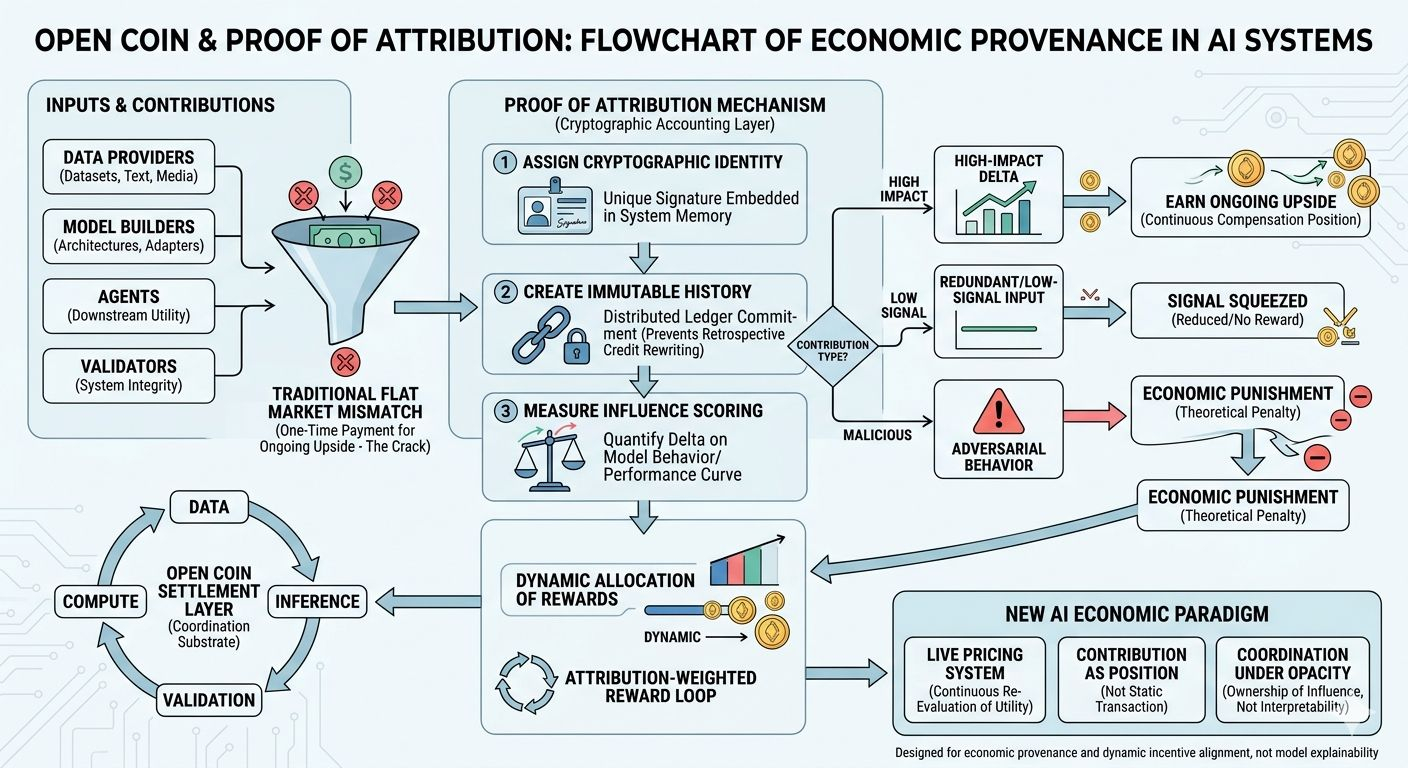
That mismatch is the crack Proof of Attribution tries to widen, intentionally.
The mechanism itself rests on a few tightly coupled ideas, though calling them “pillars” makes it sound more stable than it is.
First, every meaningful data contribution gets a cryptographic identity. Think of it less like tagging a file and more like embedding a persistent signature into the system’s memory of that data. When a model produces an output, the system can attempt to reconstruct which inputs had measurable influence. Not because the model is transparent, but because the surrounding metadata trail is engineered to be.
Second, those contribution records are not meant to be editable after the fact. Once something enters the system, it’s locked into an immutable history—usually via distributed ledger commitments or equivalent cryptographic structures. This matters less for ideological decentralization and more for preventing retrospective rewriting of who “deserves” credit after value has already been extracted. In practice, this is where most systems either become credible or quietly turn into black-box accounting with extra steps.
Then comes the part everyone actually cares about: money
Not all data is equal. Anyone who has trained a model knows this intuitively. Some datasets pull the entire performance curve upward. Others just inflate size. A few actively degrade outcomes but survive because nobody is measuring the right signals. Proof of Attribution tries to quantify that delta through influence scoring—an attempt to estimate how much a specific contribution actually moved the model’s behavior.
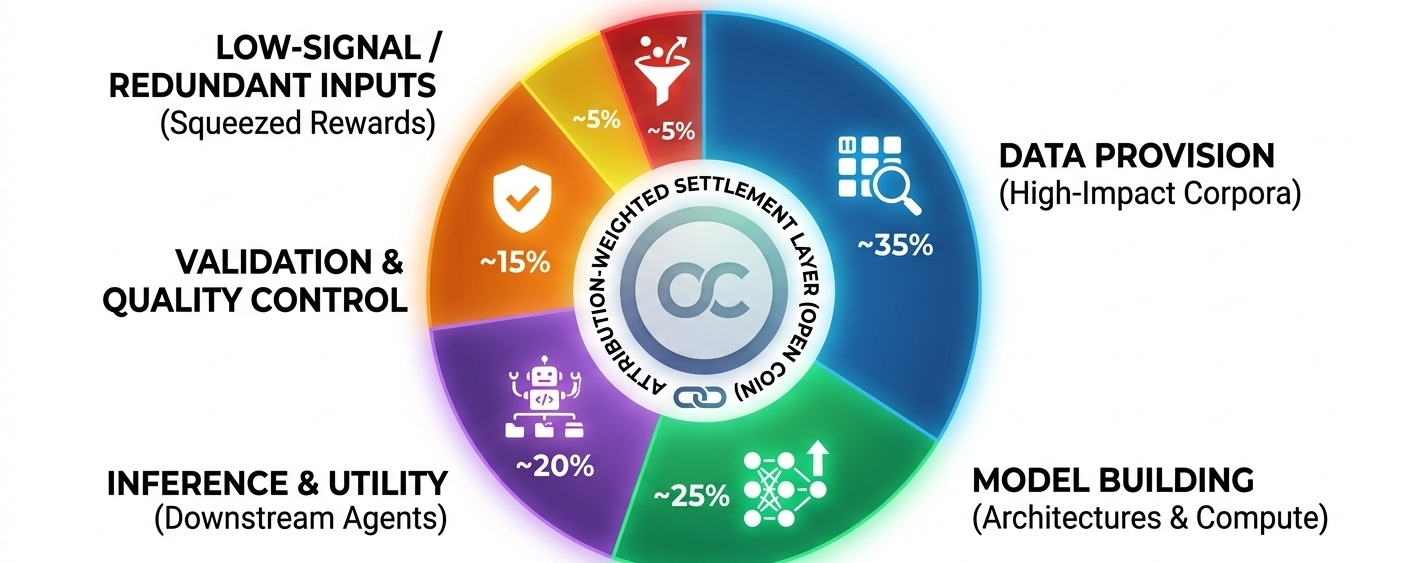
Once you accept that premise, reward allocation stops being flat. It becomes weighted, dynamic, and inevitably political. High-impact data earns ongoing upside. Redundant or low-signal inputs get squeezed. And malicious contributions, in theory, get economically punished rather than just filtered out silently.
That last part sounds clean on paper. In practice, adversarial behavior in data systems tends to evolve faster than the metrics used to detect it.
Still, the direction is clear: continuous compensation instead of one-time payment. Data stops being a static commodity and starts behaving more like a yield-bearing input into a constantly updating system.
The real motivation behind all of this isn’t transparency for its own sake. It’s coordination under opacity.
Modern AI models are not interpretable in any satisfying way. You don’t “see” the reasoning. You observe outputs and infer behavior statistically. Without attribution, everything collapses into a single indistinguishable mass of contribution. That works fine until you need to distribute value at scale without turning the system into a trust bottleneck.
Proof of Attribution doesn’t solve interpretability. It sidesteps it. Instead of explaining how a model thinks, it tries to track what fed into its behavior and how much each piece mattered.
There’s a subtle but important difference there.
If this infrastructure works, even partially, it changes how AI economies settle. Data contributors are no longer detached suppliers. They become ongoing participants in downstream value creation. Models become economic surfaces where influence accrues over time instead of disappearing after ingestion.
And yes, that shifts incentives in ways that are hard to ignore. Data markets stop being static repositories and start behaving like live pricing systems, constantly re-evaluating utility. Contribution becomes a position, not a transaction.
Open Coin, in that environment, isn’t the product. It’s the settlement layer for all that motion—data, compute, inference, and validation all feeding into a single feedback loop of attribution-weighted reward.
The uncomfortable part is that none of this removes the opacity of AI systems. It just wraps economic structure around it. You still don’t fully know why a model produces a given output. You just know, with increasing precision, which upstream inputs were responsible for making that behavior more likely.
That distinction matters more than it sounds like it should.
Because once intelligence becomes something you can’t fully inspect but can partially account for, the system stops being about understanding and starts being about ownership of influence.
Proof of Attribution is, in that sense, less about credit and more about control over how credit is computed in the first place.
And Open Coin is what happens when that computation becomes valuable enough to finance.