The People AI Remembers Last
There is something strangely incomplete about the way modern AI is discussed.
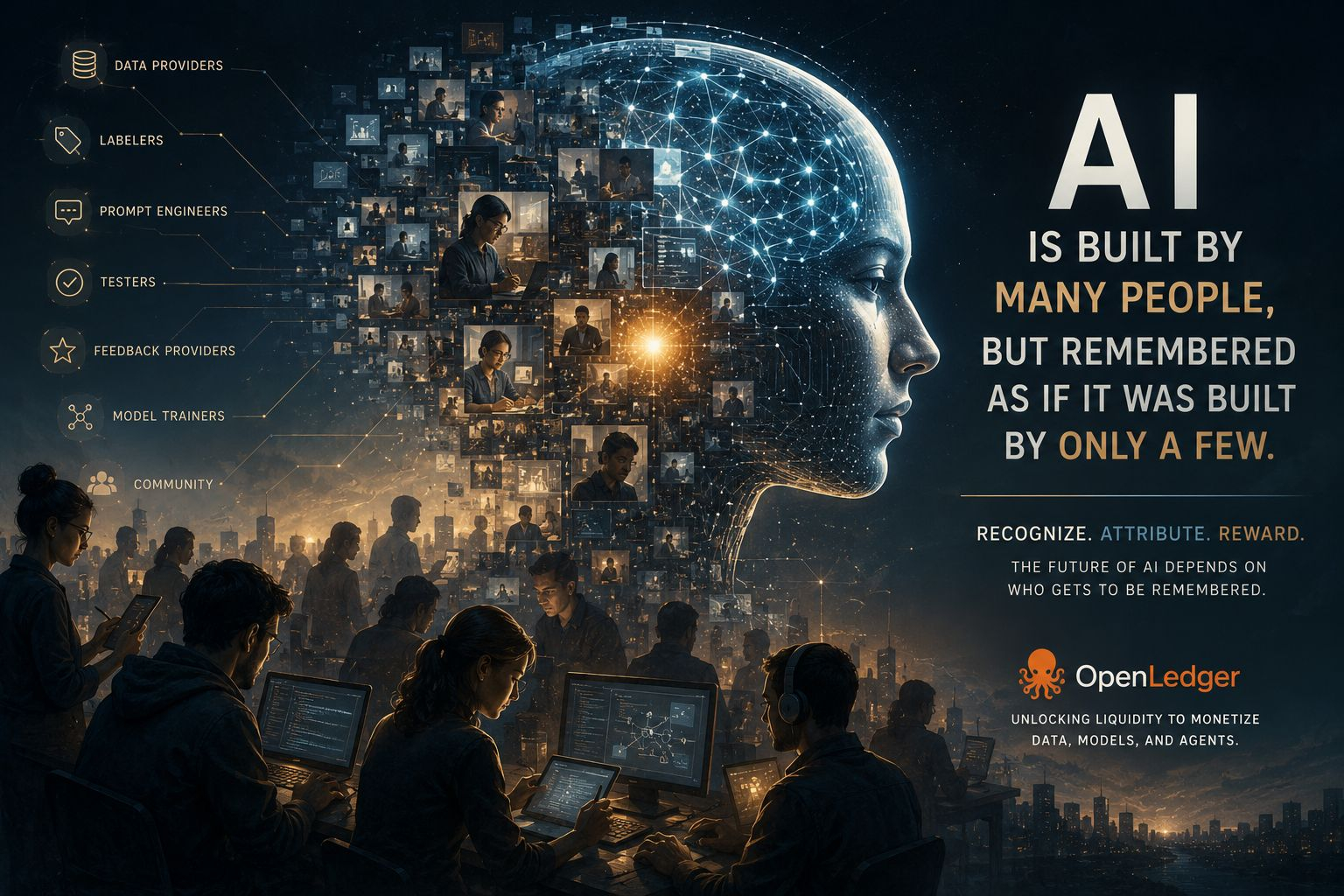
When people talk about artificial intelligence, they usually talk about companies. A handful of founders. A famous lab. A model release. Sometimes a single engineer becomes symbolic enough to represent an entire era of technological progress. History has a habit of compressing enormous collective effort into a few recognizable names. It happened in industrial revolutions, in computing, in the internet age, and now it is happening again with AI.
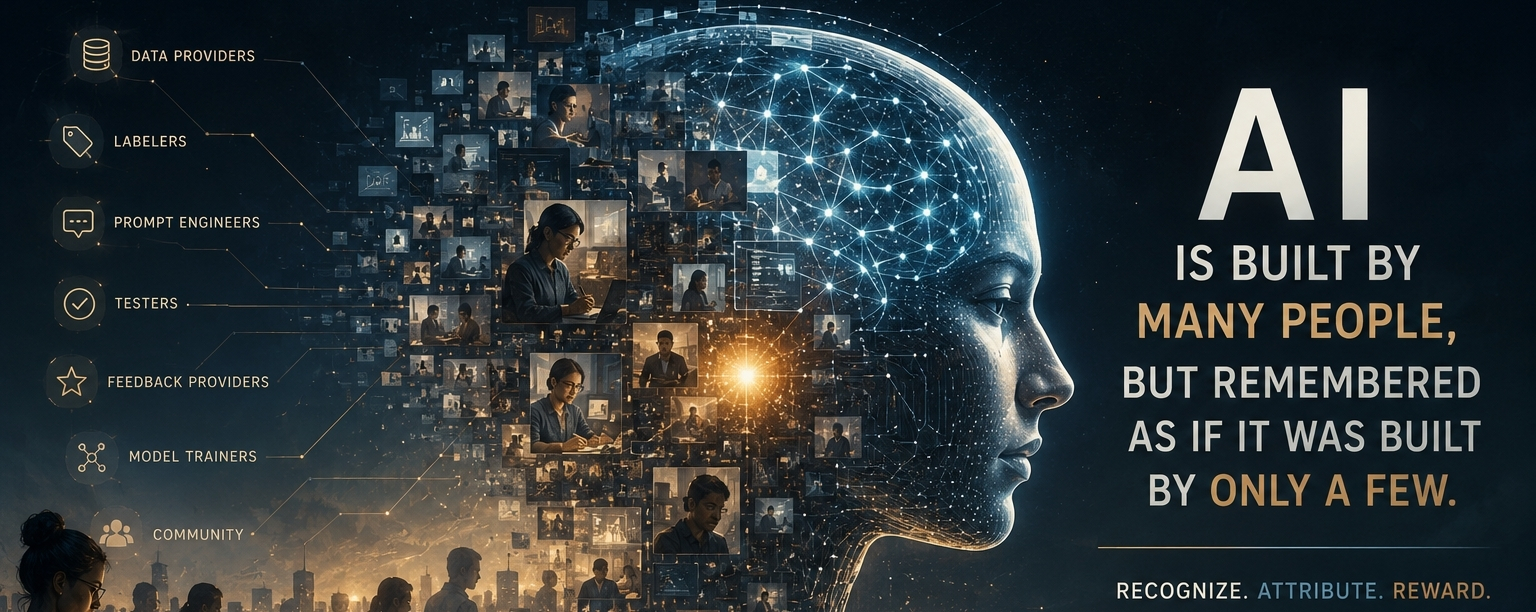
But AI was never built by only a few people.
It only looks that way from a distance.
Up close, the picture becomes harder to simplify. Behind every polished model exists an enormous invisible workforce made up of people most users will never know. Some organized. Some anonymous. Some paid poorly. Some unpaid entirely. Millions of tiny contributions stitched together quietly beneath the surface.
Someone labeled edge cases in a dataset for weeks without anyone remembering their name.
Someone corrected harmful outputs repeatedly until the system became slightly safer.
Someone spent hours refining prompts so models could better understand tone, nuance, or context.
Someone filtered corrupted data.
Someone reported hallucinations.
Someone translated language pairs that improved multilingual performance.
Someone tested failures no company presentation would ever mention.
And most importantly, millions of ordinary users unknowingly contributed behavioral feedback simply by interacting with these systems every day.
The strange thing is that all of this labor matters immensely, yet almost none of it remains visible once the product succeeds.
AI absorbs contribution the way large cities absorb individual footsteps. Quietly. Permanently. Without memory.
That may become one of the defining tensions of the next decade.
Not intelligence itself.
Not compute.
Not scaling laws.
Memory.
Specifically, contribution memory.
For years, centralized AI systems made this imbalance feel normal. Companies owned the infrastructure, the models, the data pipelines, the interfaces, and eventually the narrative itself. In fairness, centralization did accelerate progress. Closed systems move faster. Decisions become easier when a small group controls the architecture, funding, and deployment strategy.
But speed came with a hidden cultural cost.
The more centralized AI became, the more invisible contributors became too.
At some point, society started treating AI as if intelligence simply emerged from data centers fully formed, disconnected from the countless humans shaping it underneath. The language around AI reinforced this illusion. Models were described almost mythologically, as though intelligence appeared through pure engineering brilliance alone.
Yet intelligence systems are deeply social creations.
They are trained on human language, human correction, human preference, human disagreement, human culture, and human judgment. Even the idea of “alignment” quietly depends on collective human input. AI systems do not become useful in isolation. They become useful through continuous interaction with people who teach them — directly or indirectly — what usefulness even means.
And that creates an uncomfortable economic question.
If intelligence is increasingly built through distributed human contribution, who owns the value generated from it?
The current answer is still relatively simple: mostly the platform owners.
But people are beginning to notice the imbalance.
You can already feel the shift happening culturally. Users are becoming more aware that their interactions carry value. Artists are questioning training practices. Writers are questioning attribution. Data contributors are questioning compensation. Communities are questioning extraction models that collect participation endlessly while remembering almost nobody individually.
The internet normalized invisible contribution years ago. Social platforms became trillion-dollar ecosystems fueled largely by unpaid attention, unpaid content, and unpaid behavioral data. AI appears to be extending that structure into something even larger.
Except this time, the contribution is not just attention.
It is intelligence shaping intelligence.
That changes the emotional weight of the conversation.
People do not necessarily expect fame from participation. Most contributors understand that no system can individually celebrate millions of micro-actions. But increasingly, people do want acknowledgment. Traceability. Proof that their work mattered. Some form of participation record that survives after value is created.
This is where blockchain becomes interesting again — not as speculation, not as token obsession, and not as another cycle narrative trying to attach itself to AI for attention.
The more meaningful possibility is much quieter than that.
Blockchain may matter because it remembers.
At its core, a blockchain is simply a transparent historical ledger. A system designed to preserve sequence, attribution, provenance, and verification across participants who may not fully trust one another. Early crypto ecosystems focused mostly on financial coordination: payments, asset transfers, DeFi, NFTs, trading infrastructure. Those systems optimized for ownership and movement of value.
But collaborative AI introduces a different challenge entirely.
The problem is not just transferring assets.
The problem is tracking contribution.
Who provided data?
Who refined outputs?
Who improved model behavior?
Who validated results?
Who contributed specialized knowledge?
Who shaped the intelligence indirectly over time?
Traditional infrastructure was never designed to answer these questions clearly because centralized systems did not need to answer them. Internal databases were enough as long as users accepted opacity.
That acceptance may not last forever.
Projects like OpenLedger are interesting precisely because they approach AI from this structural angle instead of treating AI purely as a marketing category. What stands out is not the promise of decentralization itself — crypto has overused that word for years — but the attempt to build systems where participation inside AI ecosystems becomes traceable, attributable, and potentially rewardable.
That does not automatically solve fairness. Technology rarely solves human imbalance cleanly. New systems often recreate old power structures in different forms. There is also a real possibility that parts of the AI-blockchain narrative become overwhelmed by speculation long before meaningful infrastructure matures. Crypto history gives plenty of reasons for skepticism there.
Still, the underlying direction feels important.
Because the future AI economy will likely depend on far more collaborative input than current narratives admit.
As AI systems become increasingly multimodal, personalized, and adaptive, the amount of human refinement required may expand rather than shrink. Intelligence does not become socially useful simply because models grow larger. It becomes useful because humans continuously shape it toward context, relevance, safety, trust, and cultural understanding.
In other words, the future of AI may rely on millions of people contributing small pieces of invisible labor simultaneously.
And invisible labor eventually creates resentment when systems refuse to remember it.
That may become the philosophical dividing line between older internet platforms and future AI ecosystems.
The old internet extracted participation.
The next phase may require accounting for participation.
Not perfectly. Not romantically. But honestly.
Because beneath all the excitement around artificial intelligence sits a very human reality: people want to matter inside the systems they help build. They want more than silent extraction. More than anonymous contribution disappearing into black boxes owned by a few institutions.
They want memory.
Not ego-driven recognition. Not celebrity.
Just evidence that collective intelligence truly belongs to the collective.
And perhaps that is where blockchain becomes more than finance infrastructure. Perhaps it becomes historical infrastructure — a way of preserving the human fingerprints behind machine intelligence before they disappear entirely beneath corporate narratives and polished interfaces.
AI will continue becoming smarter. That part feels inevitable now.
The harder question is whether the systems surrounding AI will become fairer, more transparent, and more capable of remembering the people who quietly shaped the intelligence along the way.
Because the next era of AI may not be defined only by how powerful intelligence becomes.
It may be defined by whether the future finally learns how to remember everyone who helped create it.