

One pattern I keep noticing in technology markets is that people tend to obsess over the visible layer of a system while quietly underestimating the infrastructure beneath it.
It happened with the internet itself. Most people saw websites and apps. Very few initially cared about cloud architecture, payment rails, data centers, or content delivery systems. But over time, those invisible layers ended up capturing enormous strategic importance because they controlled coordination rather than attention.
AI feels similar right now.
Most conversations still revolve around outputs. Which model is smarter. Which agent is faster. Which company ships the best interface. The visible competition is consuming all the oxygen.
But what keeps standing out to me is that AI may eventually become less about intelligence itself and more about the economic systems surrounding intelligence.
That changes the conversation quite a bit.
Because once AI becomes operational infrastructure rather than novelty software, the biggest bottlenecks may no longer be model quality alone. They may involve ownership, data rights, attribution, liquidity, incentives, and coordination between contributors who do not fully trust each other.
And honestly, that gets uncomfortable fast.
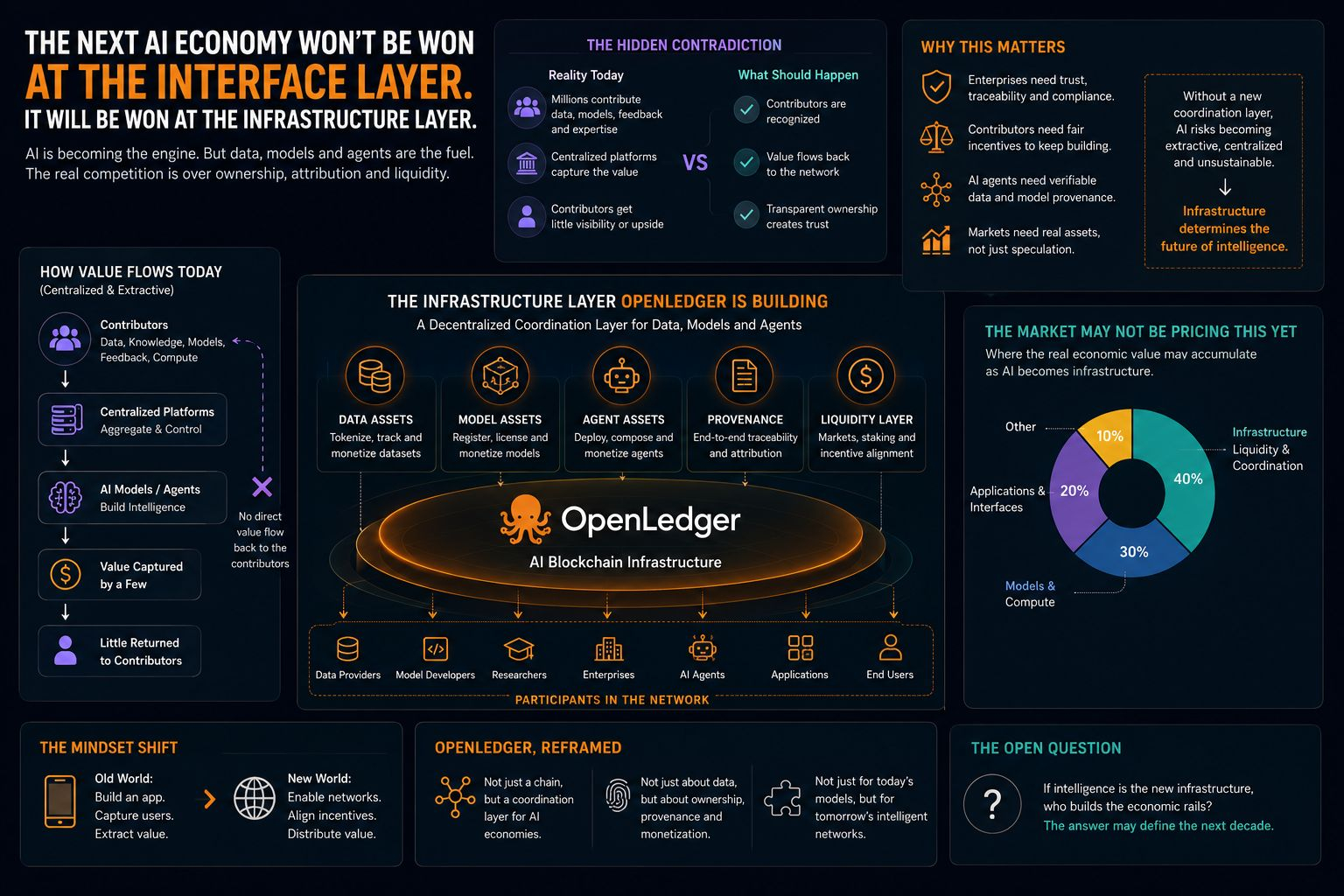
The current AI economy runs on a strange contradiction. The systems creating the most value are often built from highly distributed human input, yet the economic structure around those systems remains extremely centralized.
Millions of people contribute data, behaviors, feedback loops, annotations, niche expertise, open-source tooling, and operational knowledge. Enterprises contribute proprietary workflows and internal intelligence. Communities continuously refine information in public.
Then large systems absorb that value, abstract it into intelligence, and redistribute very little visibility back toward the edges where the value originated.
The market talks constantly about model scaling.
But maybe the harder problem is contribution scaling.
How do you sustain an AI economy where contributors increasingly realize they are supplying the raw material without maintaining meaningful ownership over downstream value creation?
I keep wondering whether this eventually becomes one of the defining infrastructure tensions of AI.
Because data is not behaving like a passive commodity anymore. It is starting to behave more like productive capital.
And once that happens, the incentive structure changes.
People and organizations begin asking different questions. Not just “How useful is this AI system?” but also “What happens to the value generated from my data, my workflows, my models, or my operational intelligence after it enters the network?”
That question becomes especially important for enterprises.
A lot of corporations want AI adoption, but they also operate inside environments shaped by compliance, liability, intellectual property concerns, and competitive asymmetry. The moment operational data becomes economically important, trust around infrastructure suddenly matters much more than interface quality.
Maybe that is part of the reason infrastructure-oriented AI projects keep appearing despite the market’s obsession with consumer-facing applications.
Underneath the hype cycle, there is still an unresolved coordination problem.
Who owns intelligence once it becomes composable?
What if AI models are no longer standalone products but continuously evolving systems built from thousands of interconnected contributors, datasets, agents, and feedback mechanisms?
Traditional software economics start looking incomplete in that environment.
And this is roughly where projects like OpenLedger become conceptually interesting to me.
Not necessarily because of the branding around AI blockchains. That phrase alone is already becoming overloaded. What matters more is the infrastructure direction sitting underneath it.
OpenLedger seems to be positioning itself around a very specific assumption: that future AI systems may require transparent economic coordination layers around data, models, and agents themselves.
That sounds abstract at first, but maybe it is not.
If AI increasingly depends on distributed contribution, then liquidity around those contributions becomes strategically important. Not only financially, but operationally. The system needs ways to measure participation, preserve provenance, distribute incentives, and maintain traceability across increasingly complex intelligence networks.
Otherwise the ecosystem starts drifting toward extraction rather than participation.
And systems optimized purely for extraction usually become fragile over time.
That fragility may not show up immediately. Early-stage markets often reward efficiency aggressively before they reward sustainability. But eventually contributors become more selective. Enterprises become defensive. Regulators become curious. Questions around ownership and accountability become unavoidable.
The bigger question may not be whether AI becomes more powerful.
It probably will.
The bigger question is whether the infrastructure surrounding AI evolves fast enough to handle the economic consequences of collective intelligence production.
That feels like a much more difficult challenge.
What also interests me about OpenLedger is that it sits at an unusual intersection between AI infrastructure and liquidity infrastructure. Most projects tend to focus on one side or the other. Either they build AI tooling without meaningful economic coordination, or they build token systems detached from real operational utility.
OpenLedger appears to be attempting something more structurally ambitious: treating datasets, models, and agents as networked economic assets rather than isolated software products.
Maybe that works.
Maybe it does not.
But I think the market may not be fully pricing the importance of that direction if AI economies continue maturing.
Because once intelligence itself becomes modular, portable, and composable, value no longer sits only inside finished applications. Value starts flowing through the relationships between contributors, inference systems, datasets, enterprise usage, and machine-driven coordination.
That creates entirely new infrastructure pressures.
It also creates governance problems.
If models continuously learn from distributed environments, who becomes responsible for errors? Who controls licensing? How do regulators interpret ownership when outputs are generated from overlapping layers of public and proprietary contribution? What happens when AI agents begin transacting or coordinating autonomously across networks?
These questions sound theoretical today, but infrastructure markets tend to form long before regulatory clarity arrives.
That is usually how technological transitions happen.
The internet scaled before digital policy frameworks fully existed. Social media scaled before societies understood the implications of algorithmic amplification. Cloud computing scaled before most enterprises became fully comfortable outsourcing infrastructure dependency.
AI may follow the same pattern.
And if that happens, projects focused on the coordination layer rather than the consumer layer could become more important than they currently appear.
Still, skepticism feels necessary here.
A lot of crypto infrastructure projects correctly identify future tensions but fail to create sustainable adoption. Technical architecture alone does not guarantee ecosystem behavior. Incentives can distort quickly. Liquidity systems can become speculative rather than productive. Decentralization narratives often sound cleaner in theory than in operational reality.
I think that uncertainty matters.
Because the real test for projects like OpenLedger is not whether they can attach blockchain terminology to AI infrastructure. The real test is whether they can create systems where contributors, enterprises, developers, and autonomous agents actually prefer coordinating inside the network rather than outside it.
That is a much harder problem than launching a protocol.
But maybe that is also why it matters.
What keeps standing out to me is that AI may ultimately force markets to rethink ownership itself. Not ownership of software in the traditional sense, but ownership of contribution, context, behavioral intelligence, and machine-generated value flows.
And maybe infrastructure projects sitting closest to that tension end up mattering far more than people currently expect.
Or maybe the market is still too early to understand what it is even looking at.
@OpenLedger
