
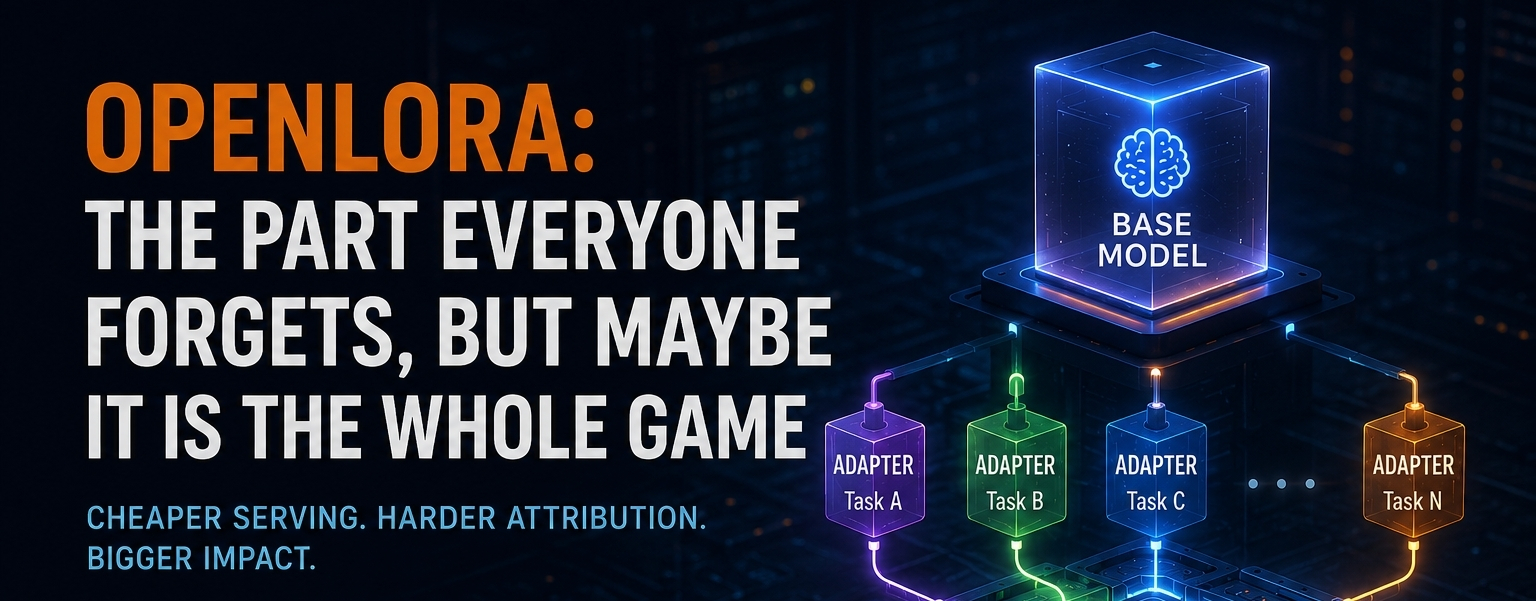
When people talk about OpenLedger, they usually talk about the obvious things first. Data ownership. Revenue sharing. Token value. The big vision. The kind of stuff that sounds easy to explain in a tweet.
But the more I look at it, the more I feel the real story is somewhere quieter.
OpenLoRA does not get much attention, but it might be the most important part of the whole system. Not because it is flashy, but because it decides whether the idea can actually work in the real world.
At first, the concept behind OpenLedger makes sense. You build specialized models for different tasks, connect them to valuable data, and reward the people who helped create that value. Simple enough on paper.
But there is always a catch.
Serving those models is expensive.
That is the part people usually skip over. It is easy to imagine a world with many small, specialized AI models. It is much harder to pay for all of them to stay live at the same time. If every model needs its own dedicated GPU just to answer requests, the economics can fall apart very quickly.
This is where OpenLoRA becomes important.
It is trying to make that long-tail model economy possible by reducing the cost of serving. Instead of loading a full heavy model for every use case, it keeps one base model and swaps in small adapters when needed. That sounds like a technical detail, but it is actually a big deal. It is the kind of thing that can decide whether the whole system is practical or just theoretical.
And honestly, that part is smart.
It shows real engineering thinking. It shows someone actually cared about cost, not just the story. Without something like this, the idea of payable AI would probably stay beautiful in theory and painful in practice.
But there is another side to it.
The same thing that makes serving cheaper also makes attribution messier.
That is the part people do not talk about enough.
In a simple setup, value is easier to trace. One model, one dataset, one output. You can more or less explain where the result came from. But once you move into a shared serving system, things stop being so clean. Now the output is coming from the base model, the adapter, batching logic, memory movement, and runtime behavior all at once.
So when a request gets answered, who really created that value?
That question sounds small, but it is not.
If the base model is doing most of the heavy lifting, how much reward should go back to those contributors? If the adapter is what makes the model actually useful for a specific task, how much belongs there? And once multiple adapters are being swapped in and out dynamically, how do you keep the reward logic fair without pretending the system is simpler than it really is?
That is where the tension starts.
The cheaper and more efficient the serving becomes, the harder it gets to say exactly who contributed what. Efficiency and perfect attribution do not naturally go hand in hand. In fact, they often work against each other.
Latency makes it even more complicated.
When the system is moving adapters between memory and VRAM, using batching, and trying to keep performance high, the clean line between one call and one contribution starts to blur. That does not make the design bad. It just means the system is more complicated than the neat version people like to describe.
And maybe that is the real point.
OpenLoRA is not the glamorous part of the project. It is not the headline. It is not the easy narrative. But it may be the thing that decides whether the entire economic model holds together or falls apart.
Because in the end, this is not just about models. It is not just about tokens. It is not even just about AI.
It is about whether a system can stay cheap enough to run, while still being honest enough to reward people fairly.
That is a hard problem. Probably harder than most people realize.
So when I look at OpenLedger, I do not just think about the token price or the branding. I think about whether this serving layer can actually carry the weight of the whole idea. Because if OpenLoRA works, the rest has a real chance. If it does not, then the whole structure starts to feel fragile very fast.
That is why I think OpenLoRA matters more than people assume.
Not because it sounds exciting. Because it is the part that has to actually work.
