


Everyone is probably underestimating how boring OpenLedger’s EVM bridge sounds, and that might be exactly why it matters.
I’ve lost count of how many times I’ve wanted to test something on a new chain, then stopped halfway because the bridge flow felt annoying. Wrong wallet network. Gas on one side but not the other. Token sitting somewhere useless. A pending transaction that makes you question your life choices. Traders talk about narratives like they move cleanly from one chain to another, but actual users don’t move that cleanly. Most people quit when the steps feel heavier than the opportunity.
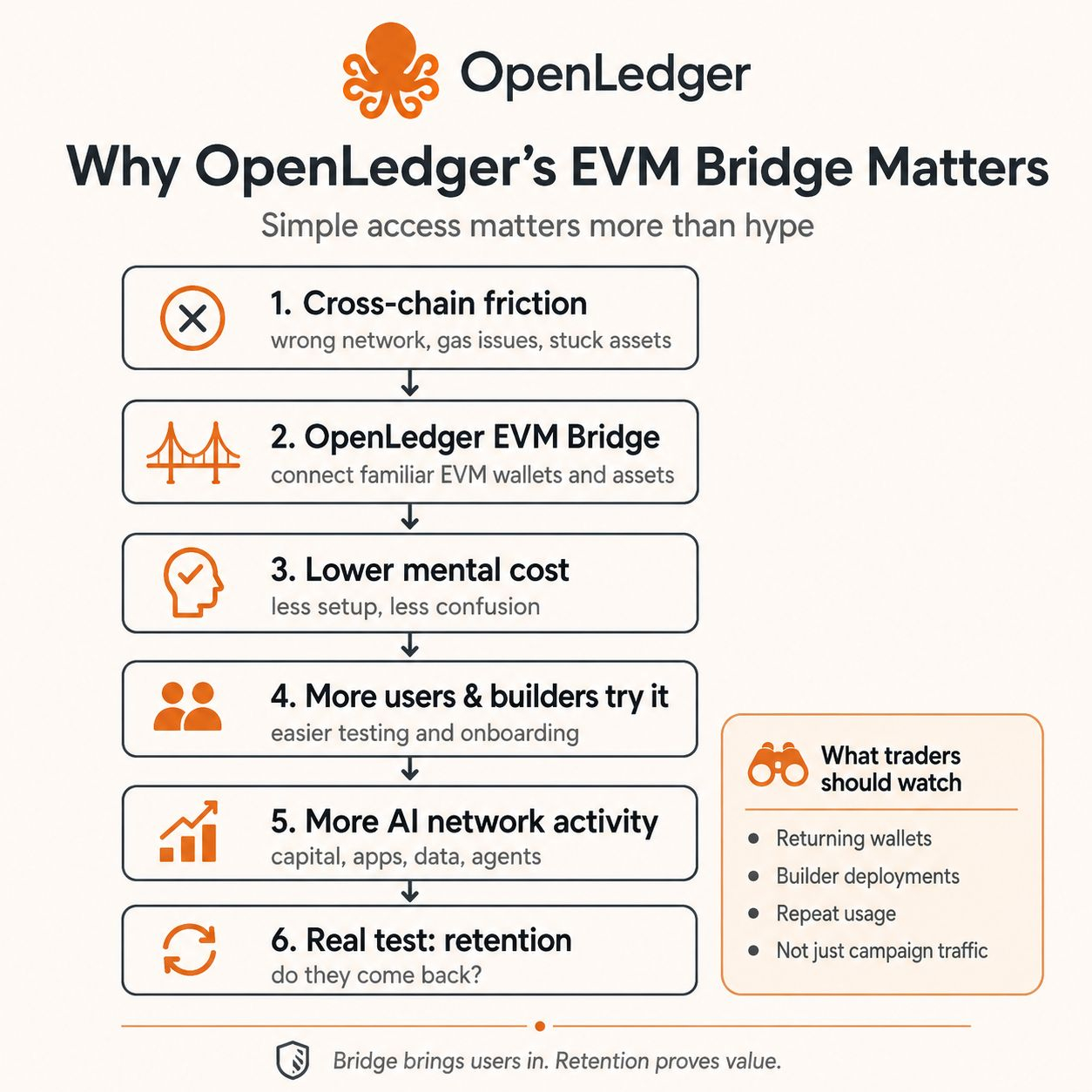
That’s the specific angle I’m watching with OpenLedger’s EVM bridge. Not “bridge means price goes up.” That’s lazy. The real question is whether OpenLedger can make cross-chain access simple enough that users and builders don’t treat it like a one-time experiment.
OpenLedger already positions itself as EVM-compatible infrastructure, saying it follows Ethereum standards and lets users connect wallets, smart contracts, and L2 ecosystems. That matters because EVM is where a huge amount of existing crypto behavior already lives. Wallet habits, contract standards, developer tools, testing flows, liquidity routes, all of it. When a project asks people to leave that comfort zone completely, adoption gets harder before the product even gets tested. OpenLedger’s official site leans directly into that EVM compatibility angle.
Now here’s the thing. I don’t think cross-chain users care about bridges in a technical way. They care about whether their capital, identity, and actions can move without turning into homework. A bridge is only valuable if it reduces the mental cost of participation. For OpenLedger, that’s important because its whole AI blockchain idea depends on more than traders buying OPEN on an exchange. It needs contributors, builders, AI agents, model activity, data flows, and actual on-chain usage. If those users are trapped in one isolated corner, the project feels smaller than the story it’s trying to tell.
That’s what surprised me a bit. I first looked at OpenLedger from the AI data and attribution side. The “who gets paid when AI uses data?” question is interesting. But the bridge angle made me think more practically. A strong AI network still needs routes in and out. Without that, even a good idea can become a closed room.
The market numbers make this more interesting, but also more uncomfortable. Binance showed OPEN around $0.2025, with about $58.9M market cap, $37.8M in 24-hour volume, and roughly 290.8M circulating supply at the time checked. That gives OpenLedger enough liquidity to be visible, but not enough size to be treated like a proven infrastructure winner. It’s still small enough that real adoption could matter, and also small enough that weak sentiment can hit hard.
Other venues showed slightly different numbers. Bybit listed OPEN around $0.1873, with about $40.37M market cap, $9.97M in 24-hour volume, and 215.5M circulating supply. That kind of discrepancy doesn’t automatically mean something is wrong, but it does remind me to be careful with small-cap token data. When circulating supply and market cap differ across platforms, I don’t treat one screenshot as gospel. I look at the range and ask what the market is really telling me. Right now, it’s telling me OPEN is liquid enough to trade, but still not mature enough to ignore data quality and volatility risk.
The bull case is simple. If OpenLedger’s EVM bridge helps users bring capital and activity from familiar EVM environments into its AI network, the project has a better chance of turning attention into repeat usage. A bridge can widen the entry door. More importantly, it can make builders less hesitant to experiment because they don’t need to rebuild every habit from scratch. If OPEN is sitting around a $40M to $60M market cap while the project proves real cross-chain usage, that leaves room for repricing. Not because a bridge magically creates demand, but because easier access can feed more transactions, more app testing, and more reasons to hold or spend the token.
But I’m not going to pretend bridges are risk-free. Bridges are also one of the most painful areas in crypto history. Users worry about security. Traders worry about liquidity fragmentation. Builders worry about whether anyone actually crosses over after launch week. I get frustrated when projects announce infrastructure and then act like the hard part is done. It isn’t. The hard part starts after the bridge is live, when the project has to prove people return.
That’s where the Retention Problem becomes the center of my OpenLedger thesis. A bridge can bring users in. It cannot make them stay. If traders bridge once for a campaign, collect a reward, and disappear, then the chart may get a temporary volume spike but the network learns nothing useful. If builders test once and leave because there’s no strong user base, then EVM compatibility becomes a nice technical checkbox instead of a demand engine.
For traders, retention is the difference between a catalyst and a real trend. A catalyst gets people to click. Retention gets them to come back next week without being bribed. That’s what I’d watch with OpenLedger. Are wallets returning? Are developers deploying? Are AI-related actions increasing? Are users moving value because they need OpenLedger, or because they’re chasing an event?
My honest frustration is that crypto traders often price the announcement before checking the behavior. I’ve done it too. I’ve bought into infrastructure narratives that sounded clean, then realized later that nobody was actually using the rails. With OpenLedger, I like the EVM bridge direction because it attacks a real pain point. Cross-chain users are tired. Builders are picky. Nobody wants extra friction unless the reward is obvious.
Still, I’m cautious. OPEN’s past high near $1.85 shows how far sentiment can stretch when attention is hot, but the current range also shows how much air can come out when the market stops paying for future promises. That tension is exactly why I’m watching usage more than slogans.
So my take is this: OpenLedger’s EVM bridge is a big deal only if it turns cross-chain access into repeat behavior. If it becomes a road people actually travel, OPEN gets more interesting. If it becomes another bridge people test once and forget, then the market will move on fast.
Would you rather trade OPEN as an AI narrative token, or wait until the bridge shows real user retention first?
