
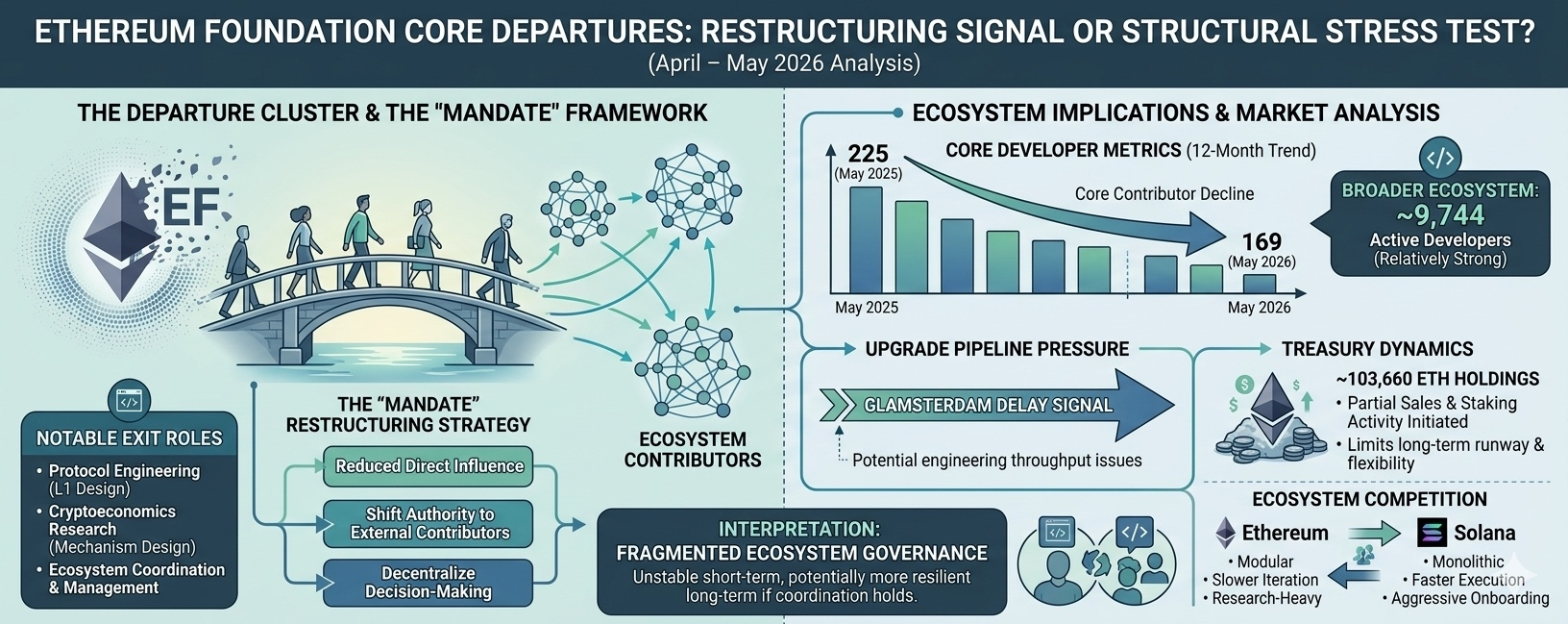
Between April and May 2026, reports emerged of multiple senior contributors leaving the Ethereum Foundation (EF), triggering renewed debate around Ethereum’s governance model, development structure, and long-term decentralization narrative. While the EF frames these exits as part of a planned restructuring under its “Mandate” framework, market observers interpret the timing and concentration of departures as potentially more significant.
This analysis breaks down the situation across governance, developer metrics, funding constraints, and ecosystem implications.
1. What Actually Happened: The Departure Cluster
According to the compiled report, at least six notable contributors exited or transitioned out of the Ethereum Foundation within a short window. These roles were concentrated in:
Protocol engineering (L1 design and execution)
Cryptoeconomics research (mechanism design and incentives)
Ecosystem coordination and management roles
Notable exits include long-term contributors involved in:
Beacon Chain development phase coordination
Protocol Guild ecosystem organization
Security initiatives and L1 research leadership
This clustering matters more than raw headcount because these roles sit close to Ethereum’s core protocol evolution pipeline, not peripheral ecosystem work.
2. Structural Context: The “Mandate” Restructuring
The EF has attributed these departures to a broader internal restructuring strategy called the “Mandate” framework.
Key stated goals:
Reduce direct Foundation influence over protocol development
Shift authority toward external ecosystem contributors
Improve decentralization of decision-making
In theory, this aligns with the long-term ethos of Ethereum: minimizing centralized control over its base layer.
However, restructuring at protocol-core level often creates a short-term paradox:
The more decentralization is pursued internally, the more coordination pressure shifts outward.
This tension is central to understanding current community concerns.
3. Developer Base: Decline or Rotation?
The report highlights mixed signals in developer metrics:
Core developers:
225 (May 2025) → 169 (May 2026)
Net decline over 12 months
Short-term movement:
Recent monthly rebound in core developer count (reported +63%)
Broader ecosystem developers:
~9,744 active developers across Ethereum ecosystem
Interpretation:
This suggests a rotation rather than collapse, where:
Foundation-aligned contributors decrease
External ecosystem developers remain relatively strong
However, the decline in core protocol contributors is more sensitive than total ecosystem numbers because it directly impacts:
Upgrade timelines
Consensus design iteration speed
Security review bandwidth
4. Upgrade Pipeline Pressure: The Glamsterdam Delay Signal
One of the more important downstream effects mentioned is a delay in the “Glamsterdam” upgrade timeline.
While delays in Ethereum upgrades are not uncommon, repeated or clustered delays typically indicate:
Reduced engineering throughput at core layer
Increased coordination complexity
Prioritization shifts inside EF
In systems like Ethereum, upgrade cadence is not just technical—it is a proxy for organizational health.
5. Treasury Constraints: The Hidden Pressure Layer
Another under-discussed factor is EF treasury dynamics:
Reported holdings: ~103,660 ETH
Partial staking activity initiated
Partial sales executed to external counterparties
While EF remains well-capitalized in absolute terms, the trend matters:
Why treasury reduction matters:
Limits long-term runway for grants and research funding
Increases sensitivity to ETH price cycles
Reduces flexibility during extended bear markets
This introduces a subtle but real constraint on staffing stability and long-term research depth.
6. Ecosystem Competition: Solana and Developer Gravity
The report notes that Ethereum ecosystem developer share is now being challenged by Solana.
Key structural difference:
Ethereum: modular, research-heavy, slower iteration
Solana: monolithic, faster execution cycles, aggressive developer onboarding
Even if Ethereum retains the largest ecosystem base, developer momentum is increasingly competitive, especially in:
Consumer applications
High-frequency DeFi infrastructure
Social and gaming ecosystems
This matters because developer mindshare often leads price cycles by 12–24 months.
7. Is This “Decentralization” or “Breakup”?
The answer depends on how the data is interpreted.
Case for “Healthy decentralization”:
EF explicitly reducing internal control
Ecosystem developer base remains large
Rotation may reflect maturity phase transition
Core protocol increasingly distributed across teams
Case for “Structural stress”:
Concentrated departure of senior protocol engineers
Declining core developer count over 12 months
Upgrade delays suggest execution slowdown
Treasury contraction limits institutional stability
Neutral synthesis:
This is best described as a transition from foundation-led coordination to fragmented ecosystem governance, which is inherently unstable in the short term but potentially more resilient in the long term—if execution continuity holds.
8. Market Implications: Why Traders Care
Even though Ethereum is a decentralized protocol, markets still price:
Upgrade certainty
Developer retention
Ecosystem growth velocity
Institutional confidence
Historically, similar phases in large L1 networks have led to:
Increased volatility
Narrative-driven price cycles
Short-term underperformance vs faster-moving competitors
In this context, ETH’s reported price weakness and extended drawdown align with a broader “confidence repricing” phase rather than a single catalyst event.
Conclusion
The Ethereum Foundation’s recent personnel shifts should not be interpreted as a single directional signal. Instead, they represent a multi-layer transition phase:
Organizational restructuring under decentralization goals
Core developer rotation and possible attrition
Competitive pressure from faster-iterating ecosystems
Treasury and execution constraints shaping internal priorities
The critical question going forward is not whether Ethereum is decentralizing—but whether it can maintain coordination efficiency while doing so.
That balance, more than any single resignation wave, will define Ethereum’s next cycle.