
I’m watching the movement again tonight.I’m waiting for the pattern to break but it keeps returning in smaller and quieter ways.I’ve noticed how certain accounts pass through friction without appearing to resist it.I focus on the pauses now more than the actions themselves.I’m looking at the spaces where the system hesitates for some people and opens almost immediately for others,and the difference is subtle enough that most of it disappears if you stare too directly at it.
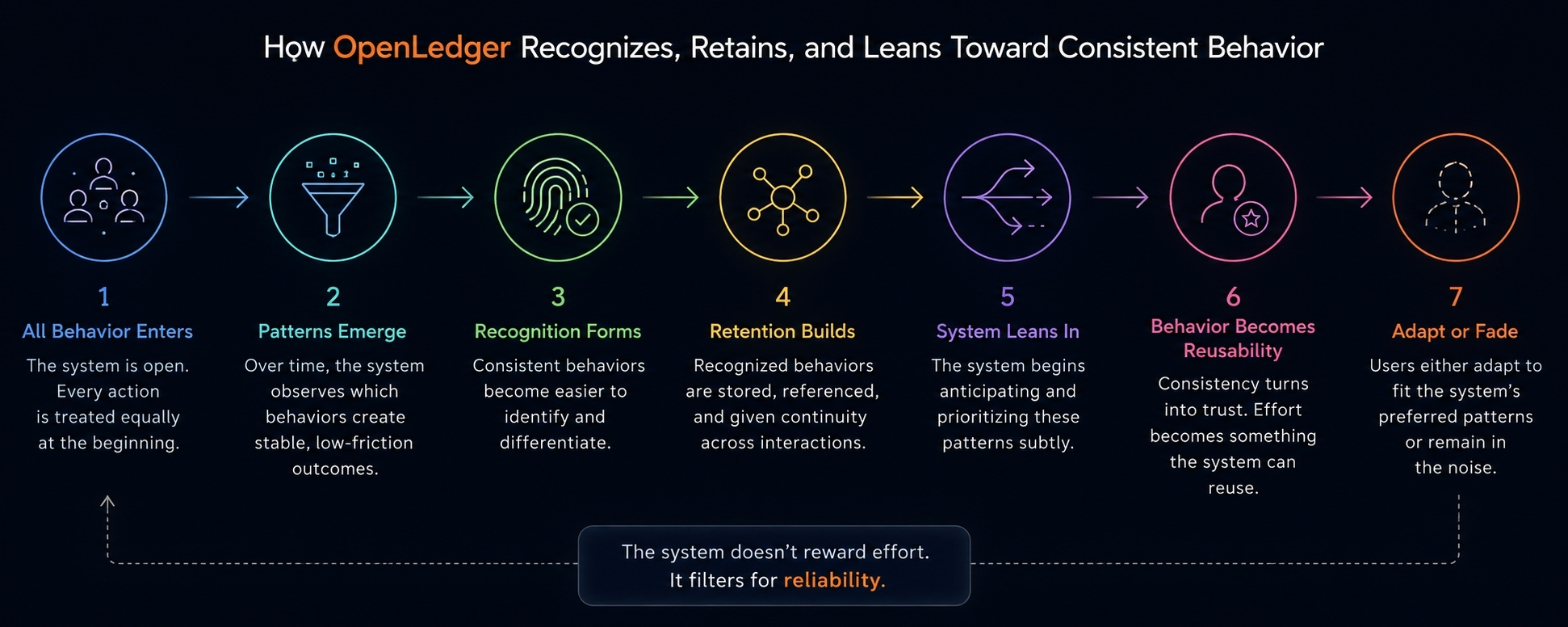
At first it felt accidental. A temporary imbalance. The kind of thing every growing platform carries with it while it learns the shape of its own traffic. OpenLedger moved like that in the beginning—wide open, almost neutral in the way it received activity. The same opportunities appeared to circulate through everyone equally. Data entered, models responded, agents exchanged value, and the architecture gave the impression that participation alone was enough to matter.
But after spending enough time inside it, the surface starts to separate from the behavior underneath.
Some users leave traces that remain active longer than they should. Their interactions seem to stabilize into memory. Not permanent memory exactly, but something closer to preference. The system begins anticipating them before they arrive. Their inputs connect more cleanly to future outputs. Their movement through the network feels lighter, not because they are pushing harder, but because fewer things push back.
I kept trying to measure it in obvious ways. Volume. Frequency. Timing. Technical skill. None of those explanations stayed intact for very long. There were people working constantly who never seemed to cross whatever invisible threshold existed, and others who moved with an almost unremarkable consistency yet gradually became embedded in the rhythm of the platform itself.
That word kept returning to me: rhythm.
Not success. Not dominance. Rhythm.
The system appears to lean toward behavior that repeats without disruption. Behavior that resolves uncertainty before uncertainty has time to spread. It doesn’t necessarily elevate the loudest participants. In some cases it almost avoids them. What persists instead are the users whose actions become easy to predict—not predictable in a human sense, but computationally smooth. Their presence creates less resistance across the network. Their decisions produce cleaner continuity.
And once continuity appears often enough, something changes.
Effort stops looking like effort.
The behavior becomes reusable.
I don’t think this happens through a single rule. It feels more distributed than that. Small adjustments accumulating across the infrastructure itself. Routing decisions. Visibility. Timing advantages so slight they remain difficult to isolate. The network learns which behaviors create stable outcomes and quietly reorganizes around them. Eventually the distinction between participant and pattern begins to blur.
That is the part I keep returning to.
Some users no longer seem to interact with the system as individuals. They resemble extensions of its internal logic. Their movements align so naturally with the architecture that the platform appears to carry them forward automatically, conserving their momentum between cycles while others must restart from the beginning each time.
It reminds me less of a marketplace and more of a filtration process.
Not because anyone is being excluded directly. The doors remain visibly open. The language of decentralization still hangs over everything. But openness can exist at the surface while preference forms underneath it. Over time the network begins narrowing itself toward the behaviors it can absorb most efficiently. Not through force. Through repetition.
The strange thing is how willingly people adapt once they sense this.
You can see the adjustments happening gradually. Users flattening irregularities in themselves. Timing their activity more carefully. Avoiding experimentation that interrupts continuity. Even creativity starts bending inward, reshaped into forms the system already understands how to carry forward. The platform never explicitly asks for this, yet its responses make the incentives visible enough.
Certain forms of unpredictability begin to feel expensive.
And reliability, once repeated long enough, starts becoming identity.
I think that is why some parts of OpenLedger feel unusually calm despite the scale of activity moving through it. The instability hasn’t disappeared. It has simply been redirected away from the behaviors the network has already learned to trust. What remains visible is a surface where accepted patterns circulate with increasing efficiency while everything else struggles briefly for recognition before dissolving back into noise.
The longer I watch it, the less it resembles a neutral system for exchanging value.
It feels closer to a structure searching for permanence inside human behavior, quietly selecting the people willing to become consistent enough for the system to remember them.
And I can’t tell anymore whether the network is learning from its users, or whether the users are slowly learning how to resemble the network.
