I keep noticing a small change in how people talk about AI value now.
A while ago the focus was training datasets. Then it moved toward models. After that it became inference and usage. But recently it feels like the market is drifting toward something more personal. Not better data. More intimate data.
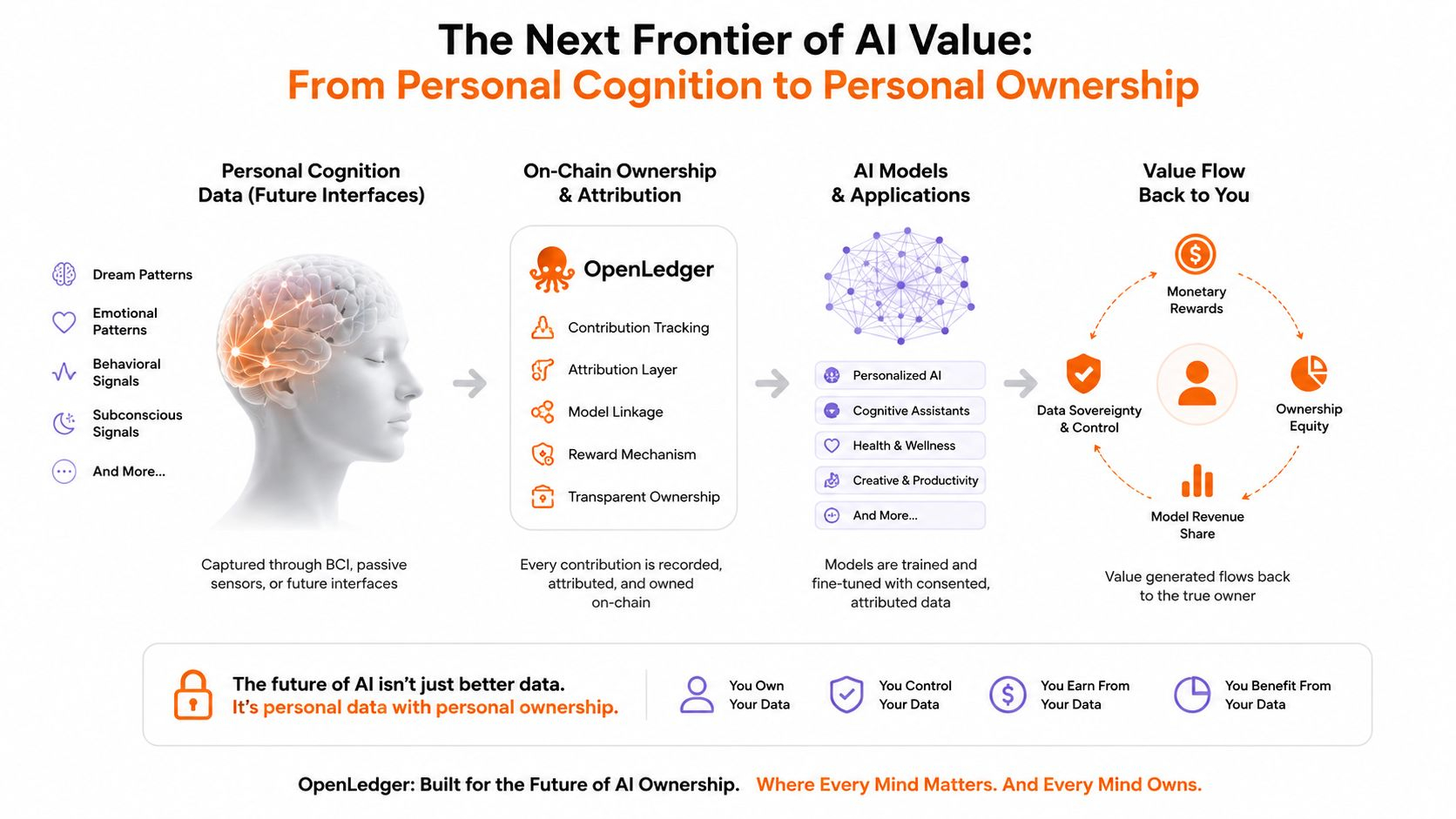
The assumption is changing quietly. Maybe future AI value does not come from public information at all. Maybe it comes from private human context. Memories. Behaviors. Emotional patterns. Even things we never intentionally record.
That thought kept bringing me back to OpenLedger. Not because @OpenLedger talks about dreams or brain interfaces today. It does not. But because its structure feels strangely compatible with where AI ownership might move if personal cognition ever becomes a data class.
OpenLedger already treats data as an economic layer.
Its on-chain AI infrastructure is built around contribution tracking, attribution, model linkage and reward flows. Contributors are not only feeding systems. They are connected to model value through monetization logic.
That changes the conversation. If future interfaces ever capture subconscious signals or personal memory layers, the question stops being can AI use them. The real question becomes who owns them and how value moves back.
OpenLedger feels relevant there because ownership is already part of the architecture. I keep thinking about this future scenario.
Imagine personal dream patterns becoming fine tunable inputs. Not public datasets. Individual cognition streams. Maybe through brain interfaces. Maybe through passive behavioral capture. Maybe something simpler.
In that world the raw asset is no longer text scraped from the internet.The asset becomes human experience itself.
OpenLedger’s blockchain architecture starts looking less like infrastructure and more like accounting for cognitive contribution.
Its incentive design already tracks participation inside the network. Models can connect with contributors. AI agents can be deployed. Ownership becomes liquid instead of fixed.
The jump from data asset to personal cognition asset suddenly feels smaller.
But I also think this creates Difficult pressure. OpenLedger rewards contribution. That works when data is observable and measurable.
What happens when the contribution is subconscious?
Can dream-derived data quality even be valownership chain?
I do not think these are small questions. OpenLedger already relies on economic behavior. Contributors optimize for rewards because incentives drive action faster than ideals. The system understands that.
But if future contributors start monetizing memories or cognitive traces, reward design becomes much harder. People may say they want ownership.
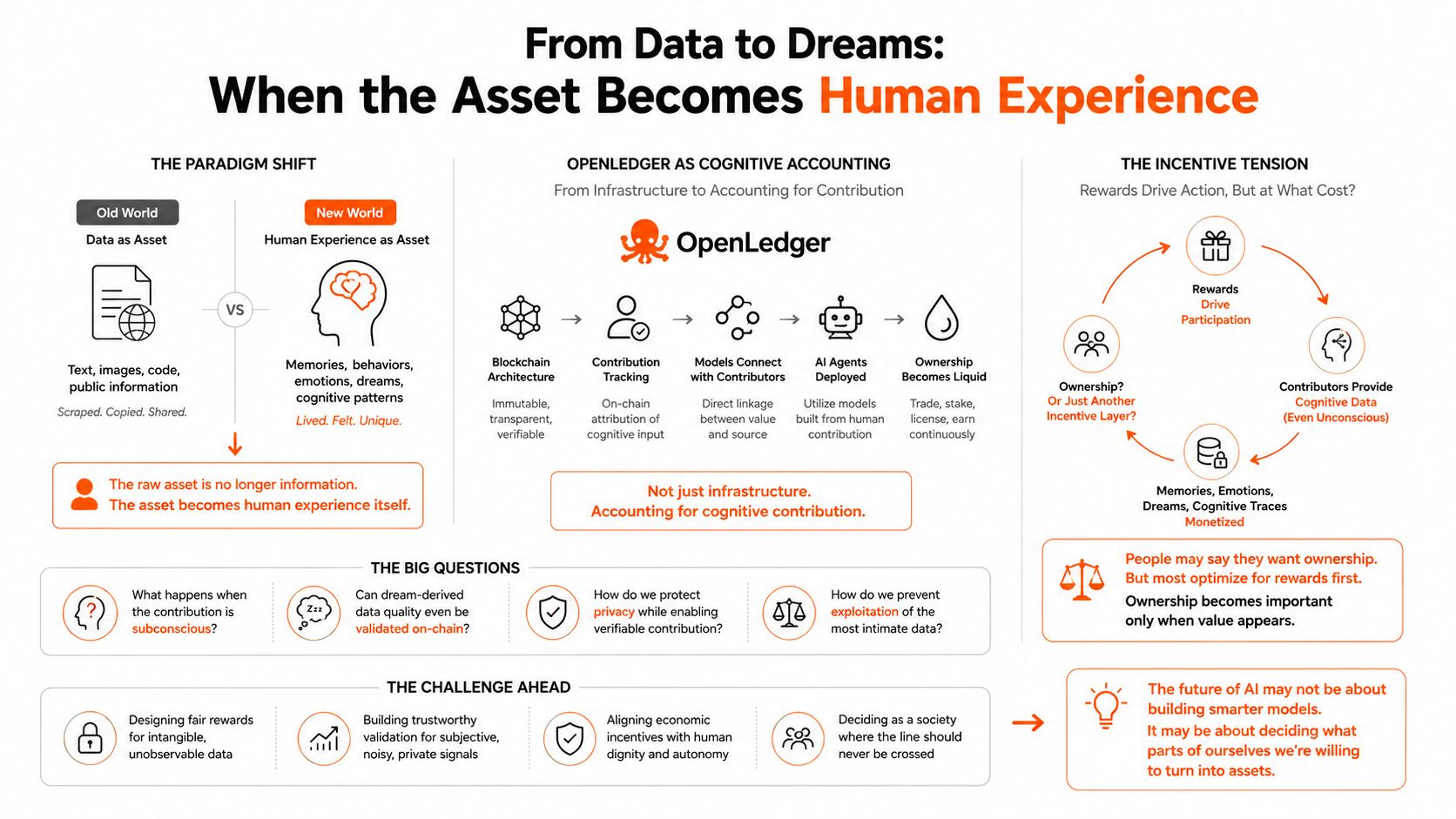
I am not fully convinced. Most users chase rewards first. Ownership becomes important only when value appears. OpenLedger knows this tension because its whole model sits between contribution and monetization.
That is why I keep looking at its AI model ownership layer.
Models inside OpenLedger are not isolated assets. They can become liquid. Connected. Economically active. Wallet integration and smart contract compatibility through the Ethereum ecosystem make participation easier.
The system is preparing for AI assets that behave economically.
The question is whether future human cognition becomes one of those assets too.
I also wonder if speculation gets ahead of reality here.
AI narratives move fast. Brain interfaces move slower. Real human adoption moves even slower.
OpenLedger may build the rails long before people are willing to put personal cognition on-chain.
And maybe that is the strange part. The market still debates data ownership at the level of datasets.
OpenLedger already feels closer to debating ownership at the level of human contribution itself.
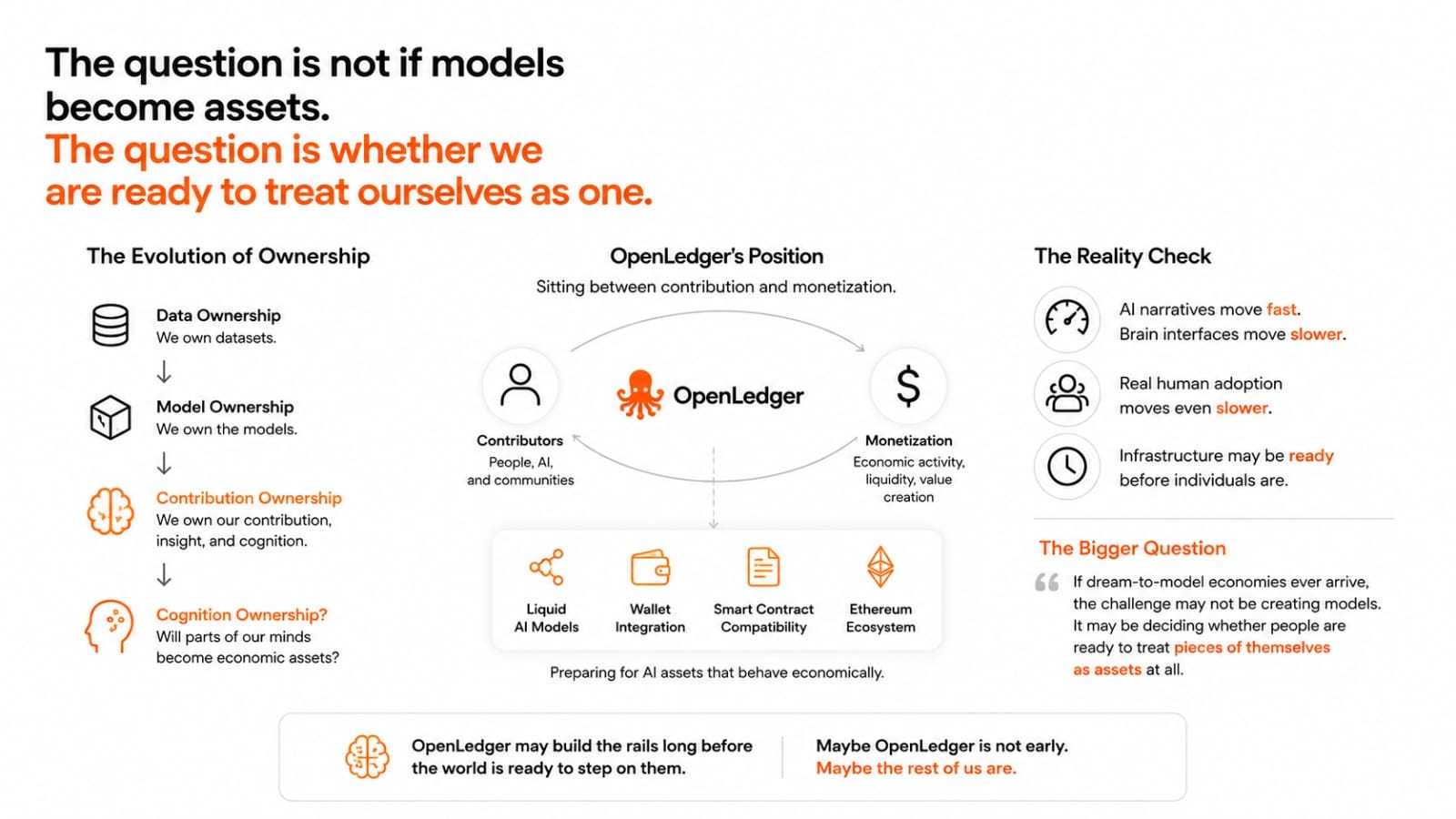
If dream-to-model economies ever arrive, the infrastructure problem may not be creating the models.
It may be deciding whether people are ready to treat pieces of themselves as assets at all. I am still not sure the market is ready for that conversation.
Maybe OpenLedger is not early. Maybe the rest of us are.