
A few years ago, infrastructure was considered the most boring layer of technology. It meant roads, payment rails, cloud servers, or shipping networks — essential systems that stayed invisible unless something broke. Then artificial intelligence changed the conversation almost overnight.
Suddenly, infrastructure became the center of the narrative. GPUs turned into strategic assets. Compute clusters became market headlines. Every major discussion around AI seemed to revolve around one assumption: whoever controls the most computational power controls the future.
For a while, that argument sounded convincing.
But as AI systems started moving beyond entertainment and into economically sensitive environments — finance, insurance, compliance, legal workflows, and autonomous transactions — the real bottleneck began to look very different.
At that point, nobody serious asks how fast a model generates tokens.
They ask a much more uncomfortable question:
Who is responsible when the system fails?
That question sits quietly beneath the entire modern AI economy, and it may ultimately become more important than intelligence itself.
This is where becomes genuinely interesting.
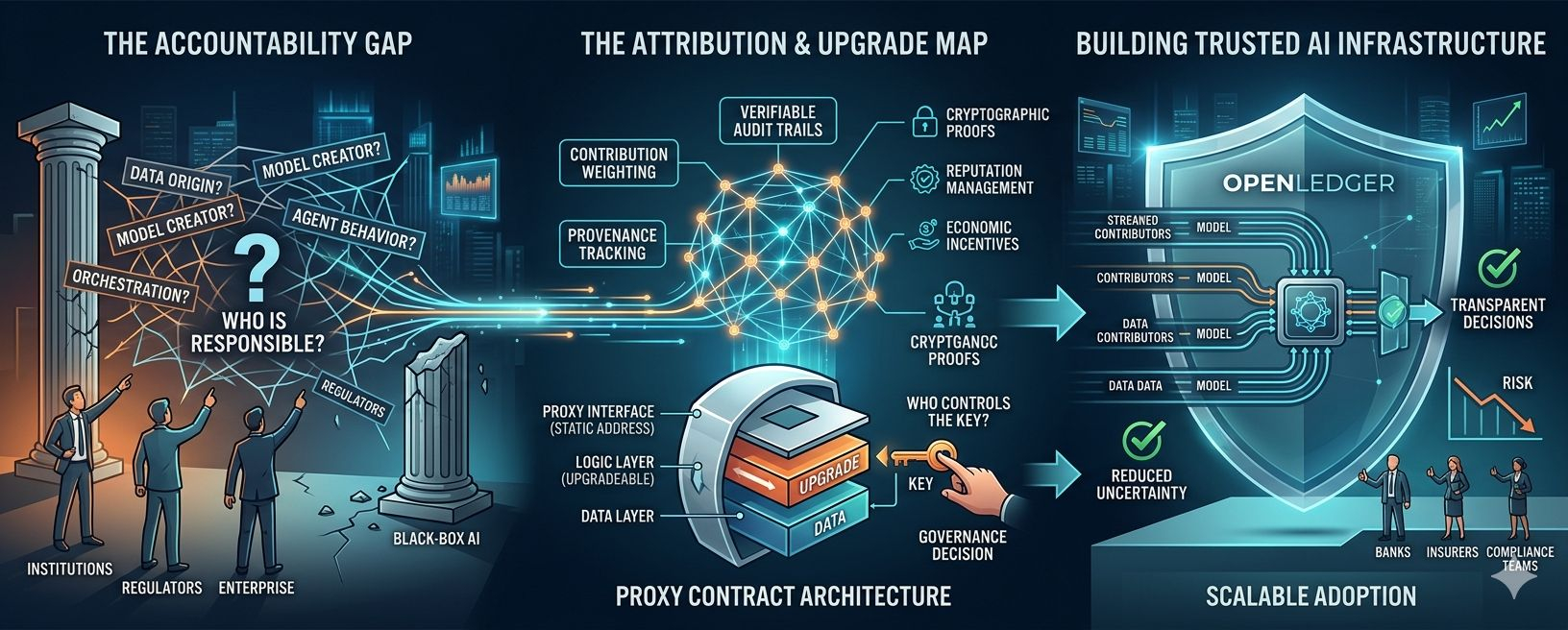
Most people describe OpenLedger as an AI blockchain, but that definition barely scratches the surface. OpenLedger is not simply trying to help AI systems scale faster. It appears to be attempting something much deeper: building attribution, accountability, and governance layers for decentralized intelligence.
And that distinction changes everything.
Today’s AI ecosystem is fragmented in ways most users never notice. One company contributes data. Another trains the model. Another hosts inference infrastructure. Separate orchestration systems manage retrieval layers and agent execution. By the time an AI-generated decision reaches a user, responsibility has already been spread across multiple actors, datasets, and systems.
The result is operational ambiguity.
And ambiguity creates economic friction.
Retail users may tolerate black-box systems if the product feels magical enough. Institutions cannot. Banks, insurers, regulators, and enterprise governance teams do not operate on intuition. They operate on audit trails, risk controls, accountability structures, and verifiable provenance.
Nobody in a compliance meeting says, “the AI seemed trustworthy.”
They ask where the data came from. Who shaped the output. Which systems influenced the decision. And most importantly — who carries responsibility if things go wrong later.
That is why OpenLedger’s focus on attribution may be more important than its token narrative.
Most markets frame attribution as a rewards mechanism — a way to compensate contributors fairly for models, datasets, or participation. But in systems influencing real economic outcomes, attribution starts looking less like a rewards feature and more like a liability map.
And this is where another layer of the conversation becomes impossible to ignore.
People often talk about upgradeable smart contracts and proxy systems as if they are purely technical improvements. On paper, the logic is reasonable. Systems evolve. Bugs happen. Infrastructure needs updates. Nobody wants to migrate millions of users every time something changes.
But proxy architecture introduces a deeper question:
Who controls the upgrade key?
Because whoever controls that key controls the system itself.
The structure is deceptively simple. One layer stores the data. Another layer controls the logic. Users interact with a proxy sitting in front of both. The contract address remains the same, but the logic behind it can quietly change through upgrades.
Same interface.
Different rules.
That means permissions can shift silently. Access conditions can tighten. Transactions can be filtered. Governance mechanisms can evolve behind the scenes without users fully understanding what changed.
Now imagine those dynamics integrated into AI coordination infrastructure like OpenLedger.
Suddenly, upgrades are no longer just technical maintenance.
They become governance decisions.
Who is allowed to participate? Which agents are trusted? Which datasets remain valid? Which behaviors become restricted? These questions are no longer theoretical when AI systems begin operating inside financial or institutional environments.
And this is where OpenLedger becomes more than an AI infrastructure narrative.
If the network succeeds in building verifiable contribution systems while maintaining transparent governance around upgrades and accountability, it could reduce one of the largest hidden barriers to enterprise AI adoption: uncertainty around machine-driven decisions.
Because markets are terrible at pricing uncertainty they cannot map.
History shows this repeatedly. Financial systems evolved beyond speed into auditability and compliance architecture. Global supply chains became dependent on verification systems once production fragmented internationally. Cybersecurity eventually became less about defense alone and more about governance, identity, and trust management.
AI may follow the same trajectory.
Right now, the industry remains obsessed with capability expansion. Bigger models. Faster inference. More autonomous behavior. But eventually, the conversation may shift toward governability.
Not because governance is exciting, but because large-scale adoption depends on it.
Of course, none of this makes OpenLedger risk-free. Attribution inside AI systems is extraordinarily difficult. Contribution weighting is messy. Incentive systems attract manipulation quickly. Crypto ecosystems are especially vulnerable to reputation farming, spam participation, and governance concentration.
Which means OpenLedger’s challenge is not just technical.
It must make decentralized accountability operationally useful rather than theoretically elegant.
Still, the broader direction feels important.
The future AI economy may not belong solely to whoever builds the smartest models. It may belong to whoever builds the most trusted systems for tracing, governing, and managing machine-generated decisions.
That is a quieter thesis than most AI narratives.
Which is exactly why it may matter far more than people expect.
