
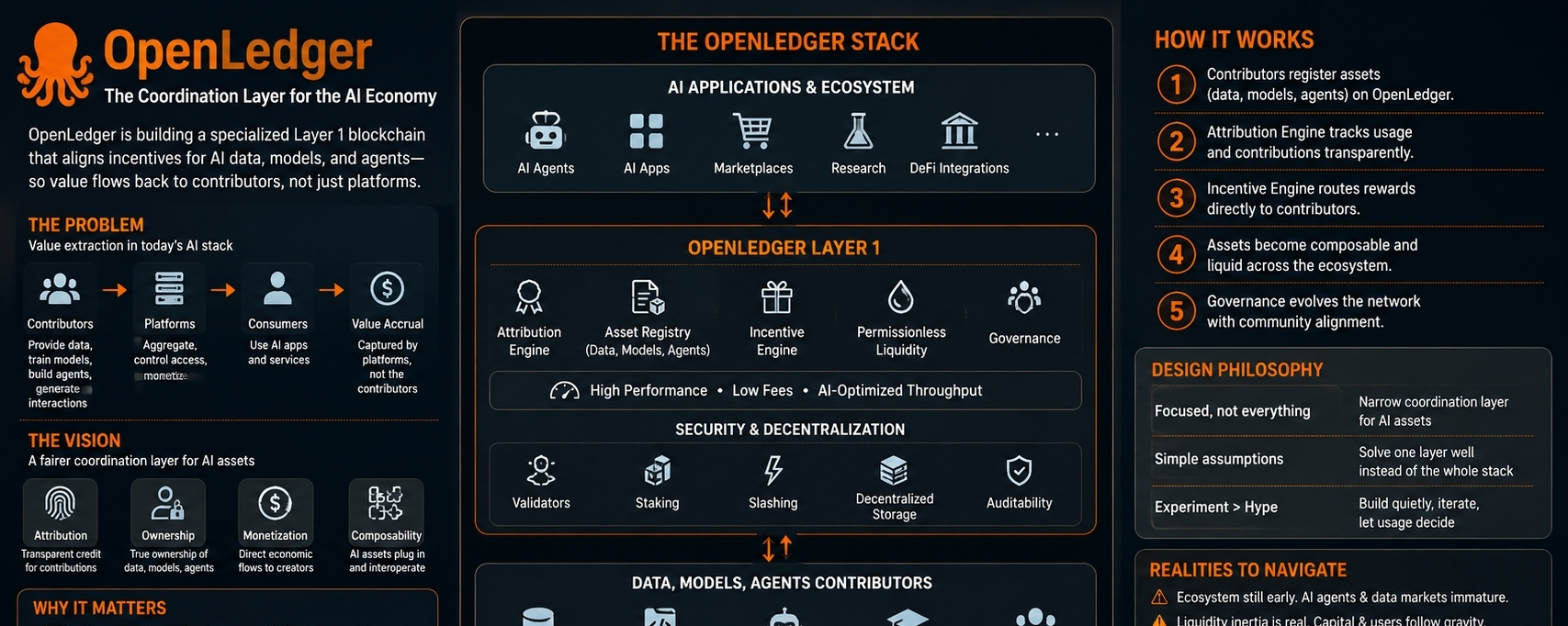
OpenLedger is one of those projects that, at first glance, makes you pause for a second before the usual instinct kicks in. The instinct now is almost automatic. New Layer 1 appears, mentions AI somewhere near the top of the page, talks about infrastructure, scalability, ownership, coordination, data. You scroll for thirty seconds and you already know the shape of the pitch before you finish reading it. Crypto has trained people into pattern recognition more than curiosity lately. Same vocabulary. Same diagrams. Same promise that this chain understands what the others missed.
But OpenLedger felt a little different to me, not because the claims were louder, honestly they were quieter than most, but because it seems to be circling around a real tension that has been sitting unresolved for years. Everybody talks about AI models. Almost nobody talks seriously about where the underlying value actually accumulates once the models become commodities. Data providers get squeezed. Small model builders disappear. Infrastructure becomes concentrated. And suddenly all the “open” systems start looking strangely closed the moment money enters the room.
That part at least feels grounded in reality.
Still, it’s impossible to look at another Layer 1 in 2026 without carrying some exhaustion into it. We’ve done this too many times already. Fast chain. Cheap chain. Modular chain. Parallelized chain. AI-native chain. Consumer chain. Institutional chain. Every cycle produces another batch of networks that claim to solve coordination problems humanity apparently didn’t know it had until a whitepaper explained them.
Then actual users arrive.
That’s always the part people underestimate. Not the benchmark tests. Not validator counts. Not theoretical throughput. Real usage is ugly. Humans spam things. Bots find loopholes. Speculators pile into one corner of the network at the exact same time. Suddenly the architecture that looked elegant in diagrams starts making strange noises.
Solana is probably the fairest example of this because it genuinely does feel impressive when conditions are normal. Transactions settle quickly enough that you stop thinking about them. The UX sometimes feels closer to a regular internet application than a blockchain. That matters. People underestimate how psychologically important smoothness is. But even Solana, after years of optimization and one of the strongest engineering cultures in crypto, has shown moments where heavy demand exposes fragility. Not collapse exactly. More like strain. Congestion changes behavior. Priorities change. The network starts revealing what it values under pressure.
That’s the real test for any Layer 1. Not whether it works in silence. Whether it still behaves coherently once people actually depend on it.
And OpenLedger seems aware of this in an indirect way. The project doesn’t appear obsessed with becoming “the chain for everything,” which already separates it from a lot of the noise. It looks more focused on a narrower coordination layer around AI-related assets, contributions, and liquidity. Data, models, agents. Things that currently live in fragmented environments where attribution is messy and monetization usually benefits the platform sitting in the middle rather than the contributors feeding the system.
There’s at least a recognizable problem there.
Because right now the AI economy has this strange imbalance where everyone contributes but only a few entities own the surfaces where value compounds. People upload data. Fine-tune models. Build niche agents. Generate interactions. Yet ownership becomes blurry almost immediately after scale appears. OpenLedger seems to notice that maybe the missing piece is not another chatbot interface or another model release, but a way to structure incentives around the smaller pieces that feed these systems over time.
Whether blockchain is actually the right tool for that is still an open question.
That’s the part crypto people rarely admit anymore. Sometimes the architecture exists because the funding environment expects a tokenized network, not because decentralization genuinely improves the product. You can feel that tension in almost every AI-crypto crossover project right now. Half the industry is trying to force two narratives together because both attract capital independently. Sometimes it produces something interesting. Sometimes it feels like stapling a GPU to a governance token and hoping nobody asks difficult questions.
OpenLedger at least appears to simplify certain assumptions instead of pretending to solve every layer of the stack simultaneously. It doesn’t seem overly interested in becoming a universal execution environment or competing directly with chains trying to absorb all consumer activity. That restraint is probably intentional. Narrower systems sometimes survive longer because they avoid the impossible burden of being everything at once.
But that creates trade-offs too.
Specialization limits surface area. A chain focused heavily on AI-related coordination may end up depending on an ecosystem that itself hasn’t stabilized yet. AI agents are still mostly experimental. Data markets sound useful until you realize most valuable datasets are either private, legally complicated, or strategically hoarded. Token incentives can encourage participation early on, but incentives are not the same thing as durable behavior. Farmers arrive faster than builders in crypto. Always.
And liquidity has inertia. That’s one of the hardest realities for new Layer 1s now.
People talk about users migrating between ecosystems like migration is frictionless. It isn’t. Capital stays where infrastructure already exists. Developers stay where tooling already works. Traders stay where liquidity already lives. Even when a new chain is objectively better in certain ways, momentum alone can keep attention elsewhere for years. Ethereum survived terrible user experience for an incredibly long time simply because enough gravity accumulated around it. That gravity matters more than most technical advantages.
So when I look at OpenLedger, I don’t really ask whether the idea is interesting. It is. The better question is whether enough people care about this problem deeply enough to move behavior onto a new network instead of layering another protocol on top of existing ecosystems.
Because maybe the future really is fragmented. Multiple chains handling different workloads instead of one dominant settlement layer absorbing everything. That theory has been floating around for years now. In practice though, fragmentation introduces exhaustion too. Bridges, wallets, liquidity routing, identity fragmentation, governance duplication. Users tolerate complexity during bull markets because profit hides inconvenience. In quieter periods, people drift back toward simplicity.
I don’t think the market has fully decided whether it wants many specialized ecosystems or just a few giant ones pretending to be modular.
And maybe that uncertainty is exactly why projects like OpenLedger keep appearing. Not because the previous generation completely failed, but because certain categories of coordination still feel unfinished. Especially around AI, where ownership and contribution tracking remain awkward in ways traditional platforms intentionally avoid solving.
There’s also something slightly refreshing about a project not sounding completely certain about itself. The polished confidence that dominated crypto for years has aged badly. Every chain was inevitable until it wasn’t. Every roadmap looked revolutionary until activity disappeared six months later. OpenLedger feels more experimental than triumphant. I actually think that helps.
Still, execution is everything here. Quiet ideas die all the time in crypto because attention markets reward spectacle first and patience later, if ever. Building infrastructure for an ecosystem that itself is still unstable requires timing almost as much as engineering. Too early and nobody needs it yet. Too late and incumbents absorb the opportunity before you arrive.
I can see the logic behind what they’re trying to do. I can also see about fifteen ways it stalls.
Which honestly makes it feel more believable than most Layer 1 stories now.
It might work. Or nobody shows up.