
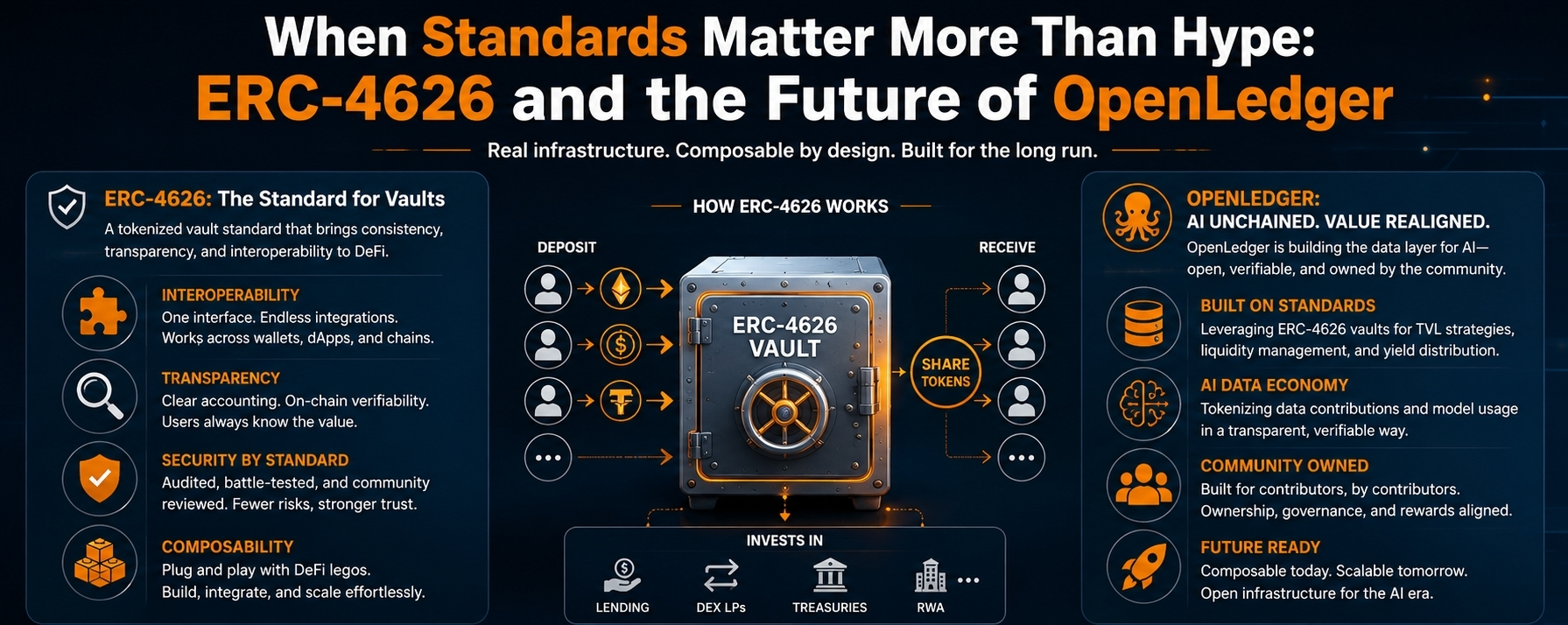

At first glance, ERC-4626 doesn’t feel like something that would change much. It’s just a technical standard for vaults—how deposits go in, how withdrawals come out, and how shares are tracked. The kind of thing most people in crypto scroll past without a second thought.
But in DeFi, these “small” standards often end up shaping everything quietly in the background.
For OpenLedger (OPEN), this matters more than it seems at first. OpenLedger is dealing with something a bit different from typical crypto assets. It’s not just tokens or liquidity pools—it’s AI-driven value: data, models, and agents that actually produce revenue or outputs over time. Turning that into something usable in DeFi isn’t just about putting it on-chain; it’s about making it behave in a way other protocols can actually understand and trust.
That’s where ERC-4626 quietly steps in.
The ERC-4626 Tokenized Vault Standard basically gives everyone the same “way of talking” when it comes to yield vaults. Once a system follows this structure, other protocols don’t need to guess how it works or build custom connections for it. They already know how to interact with it.
For OpenLedger, that removes a lot of friction. Instead of building one integration after another for different DeFi platforms, AI-generated value can be wrapped into vaults that behave consistently everywhere. That means data revenue, model usage fees, or agent-driven earnings can flow into a structure that lending protocols, yield aggregators, and automated strategies can all plug into without special treatment.
The real shift here is simplicity creating scale.
When systems are easier to plug into, capital moves faster. Liquidity doesn’t sit still in isolated pockets—it can flow through strategies, get reused, and reallocated without constant rework. OpenLedger’s AI agents can operate more freely too, because they’re not constantly dealing with integration headaches. Instead of worrying about whether something will “fit,” they can focus on where capital should go next based on performance and signals.
From a developer’s point of view, this also changes the day-to-day experience quite a bit. A lot of DeFi work today is repetitive—writing adapters, fixing edge cases, updating integrations when something breaks. Standards like ERC-4626 quietly remove a big chunk of that burden. You don’t have to rebuild the same logic over and over again. You just connect to a system that already behaves in a known way.
Of course, this doesn’t mean everything becomes risk-free. When more systems start following the same structure, they also start sharing the same weaknesses. If there’s a flaw in how a vault model is used, it can spread more easily. And in AI-driven systems like OpenLedger, mistakes in strategy or modeling can scale just as quickly as good decisions.
But even with those risks, the direction is pretty clear. Standards like ERC-4626 don’t make headlines because they’re not dramatic. They don’t feel revolutionary in the moment. But they slowly change how everything connects under the surface.
For OpenLedger, that means something important: it doesn’t have to stay on the edge of DeFi trying to fit in. It can plug directly into the system as if it was always meant to be there.
And over time, that kind of quiet compatibility tends to matter more than anything loud or obvious.