
I’ve been noticing how difficult it’s become to feel genuinely surprised by crypto anymore. Every cycle arrives with a new slogan, a new “revolution,” a new promise that this time things will finally connect to the real world. A few years ago it was NFTs everywhere. Then metaverse economies. Then endless DeFi forks. Now AI has become the center of attention, and suddenly every other project is positioning itself as the infrastructure layer for artificial intelligence. After watching this industry long enough, you start learning to separate noise from ideas that at least attempt to solve something real.
That’s kind of how OpenLedger ended up on my radar. At first I barely paid attention to it. Honestly, it looked like another protocol trying to merge two popular narratives together — AI and blockchain — because that’s where liquidity and attention currently live. Crypto has always been good at creating excitement around concepts long before the actual systems are ready. Sometimes years before.
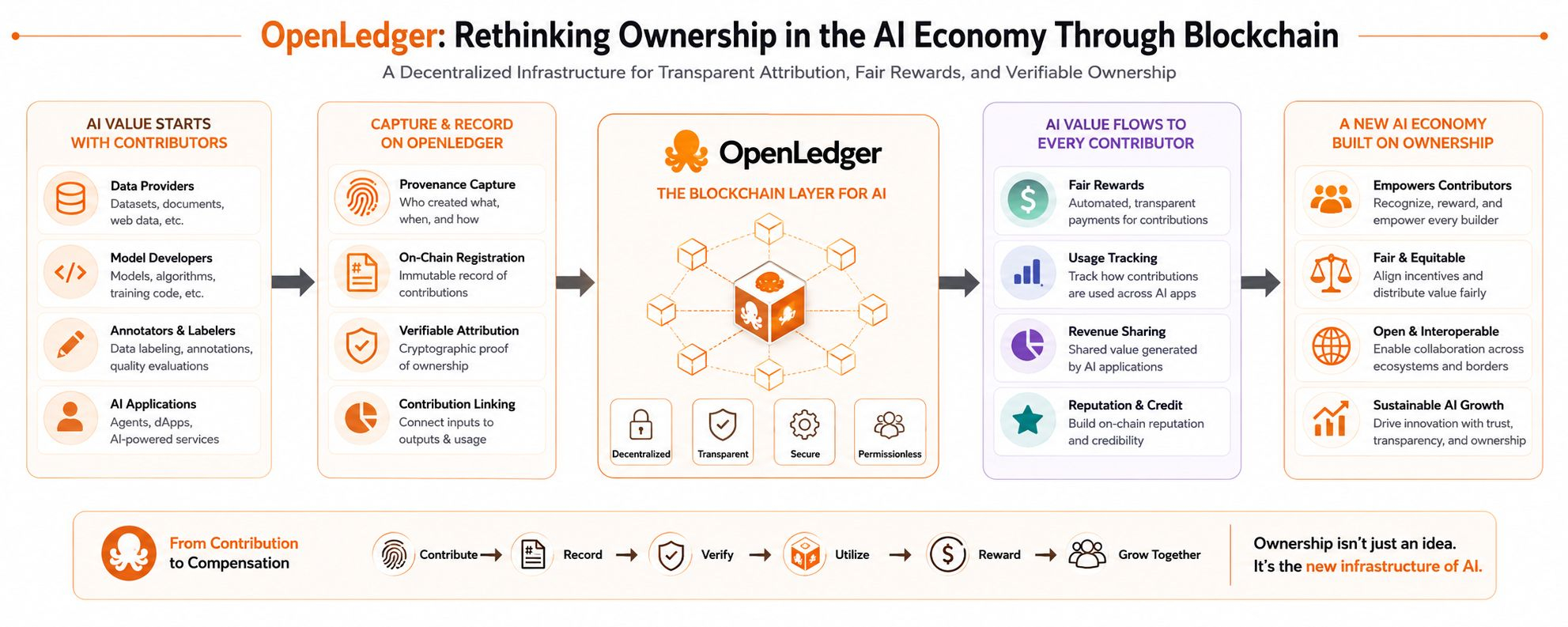
But the more I looked into OpenLedger, the more I understood why people are watching it carefully. The idea itself is actually pretty simple once you strip away all the crypto language. AI systems today rely heavily on data, models, and contributions from thousands of people, yet most of the value usually ends up concentrated in a few giant companies. The average contributor rarely owns anything meaningful in the process. OpenLedger seems to be exploring a different structure where data, AI models, and even autonomous agents can become assets that people contribute to, track, and potentially earn from over time.
And honestly, that part feels more grounded than most narratives floating around this market.
Because if you step outside crypto for a second, the question of who owns data and who profits from AI is becoming increasingly important. People generate information constantly, companies train models on massive datasets, and yet the economic relationship between contributors and platforms remains extremely uneven. OpenLedger appears to be trying to build infrastructure around that imbalance instead of simply creating another speculative token with no larger purpose attached to it.
Still, this is where experience makes me cautious.
Crypto is full of projects with ideas that sound intelligent in theory but become incredibly difficult once they meet reality. Building decentralized systems is hard enough already. Building decentralized AI coordination systems is probably even harder. It’s one thing to say contributors should be rewarded fairly for their data or models. It’s another thing entirely to measure value accurately, prevent manipulation, attract developers, and create incentives that still work once real money starts flowing through the network.
That’s usually where things become messy.
There’s also the broader issue that traditional industries move at a completely different pace than crypto markets. Blockchain communities expect adoption overnight. Real companies don’t operate like that. Enterprises move slowly, regulations move slowly, and AI itself is already dominated by centralized players with enormous resources. Even if OpenLedger has a strong framework, getting meaningful real-world participation will probably take far longer than most investors expect.
And the market rarely likes patience.
One thing I keep seeing in crypto is how speculation arrives before utility. Tokens begin trading, narratives explode across social media, prices move aggressively, and suddenly expectations become disconnected from the actual stage of development. The pressure to constantly maintain attention becomes part of the business model itself. That environment can distort even genuinely interesting projects because teams end up managing market psychology as much as building technology.
OpenLedger will probably face that same challenge. Especially now, when anything connected to AI immediately attracts hype whether the infrastructure exists yet or not.
But even with all the skepticism, I can admit when an idea feels directionally relevant. The intersection between AI ownership, data contribution, and economic incentives is not an invented problem. It’s real. And it’s only going to become more important as AI systems continue spreading into everyday life. Whether blockchain is actually the right tool to solve it remains an open question, but at least the conversation itself matters.
That’s why I find OpenLedger interesting to observe from a distance. Not because I think it’s guaranteed to succeed. Crypto has humbled that kind of certainty out of most people who’ve been around long enough. But because underneath the branding and market speculation, there’s at least an attempt to address something tangible.
Maybe it works. Maybe execution becomes too difficult. Maybe the industry moves on to another trend before the vision fully develops. That happens all the time here. But in a market crowded with recycled promises and short-lived narratives, projects that try to connect crypto to an actual economic problem are still worth paying attention to, even if cautiously.