

Every crypto cycle creates its own obsession.
There was a time when people believed every gaming token would change entertainment forever. Then it was metaverse land. Then layer twos. Then AI exploded into the market like gasoline hitting fire.
Suddenly every project had the same language.
AI powered
Decentralized
Revolutionary
Infrastructure for the future
At some point the words start blending together.
That is usually when I stop listening to marketing and start watching behavior instead.
Because markets reveal the truth long before narratives do.
And that is exactly why OpenLedger caught my attention.
At first I dismissed it the same way many traders probably did.
Another AI infrastructure project.
Another token trying to attach itself to the artificial intelligence boom.
Another attempt to mix blockchain with machine learning.
Nothing unusual.
But the deeper I looked the stranger the project started feeling.
Not in a bad way.
In a way that made me realize most people might still be looking at it from the wrong angle.
Because OpenLedger may not really be about AI attribution alone.
It may actually be about something much bigger.
The economics of memory itself.
And once memory becomes economic everything changes.
What OpenLedger Actually Is
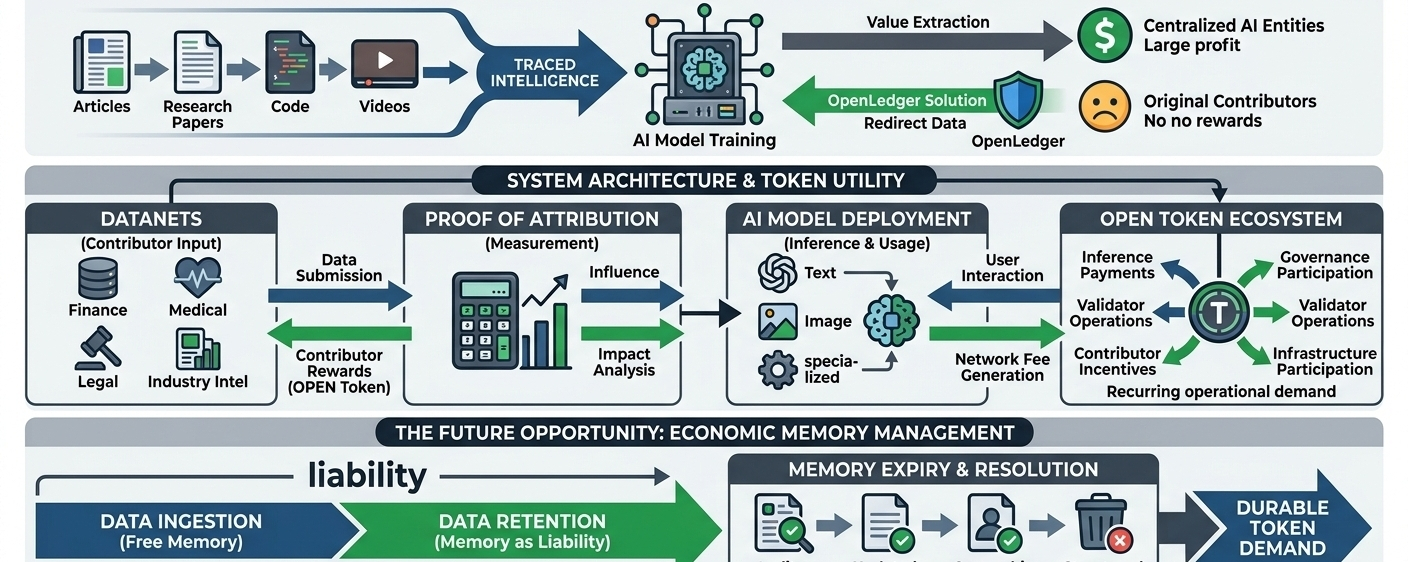
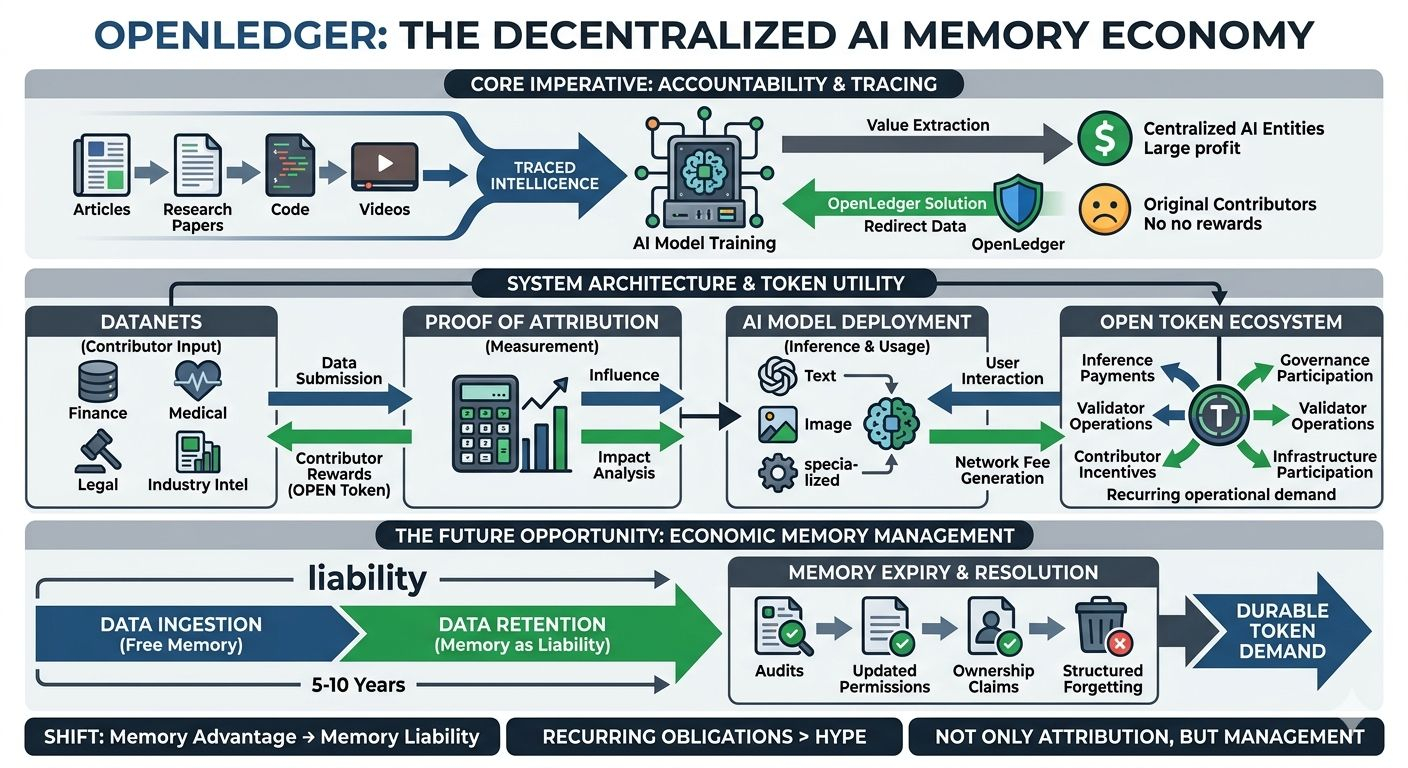
OpenLedger is building a decentralized AI infrastructure network focused on attribution and data ownership.
That sounds technical so let us simplify it.
Right now AI models are trained using enormous amounts of information collected from across the internet.
Articles.
Research papers.
Code repositories.
Forums.
Videos.
Community discussions.
Specialized industry knowledge.
Millions of people unknowingly contribute value into these systems every single day.
The problem is simple.
The AI companies profit massively from the intelligence created by those contributions while the original contributors usually receive nothing.
OpenLedger wants to change that.
The project is trying to create a system where AI knowledge becomes traceable.
If your data helps an AI model generate value the network attempts to track that contribution and reward you for it.
That idea alone is powerful because it touches one of the biggest unresolved questions in AI.
Who actually owns intelligence once machines start learning from everyone
Why This Narrative Feels Different
Most AI crypto projects are selling speed.
Faster inference.
Cheaper compute.
Bigger models.
More efficient infrastructure.
OpenLedger feels different because it is focused on accountability.
And accountability is where the future AI economy may eventually collide with reality.
Right now the AI industry still feels like the Wild West.
Companies are racing to build larger systems as quickly as possible.
But eventually governments regulators enterprises creators and users are going to ask uncomfortable questions.
Where did the training data come from
Who deserves compensation
Can influence be tracked
Can data ownership be verified
Can harmful information be removed
Can contributors reclaim rights later
Those questions are not theoretical anymore.
They are becoming financial questions.
Legal questions.
Political questions.
And eventually they may become unavoidable.
That is where OpenLedger becomes interesting.
The Moment My Perspective Changed
The biggest shift for me happened when I stopped thinking about AI memory as an advantage and started thinking about it as a liability.
Most people assume more memory is always better.
More data means smarter systems.
More context means more accurate outputs.
But memory creates baggage too.
That is the part people rarely talk about.
Every retained piece of knowledge creates responsibility.
Old information becomes outdated.
Permissions change over time.
Data rights become disputed.
Attribution claims pile up.
Regulations evolve.
Enterprises become exposed to legal risk.
The smarter AI becomes the heavier its memory may become.
That changes the entire economic model.
Because suddenly retaining knowledge is no longer free.
It carries cost.
And once memory carries cost there will eventually be markets around managing it.
Possibly even forgetting it.
That was the moment OpenLedger stopped looking like a normal AI token to me.
The Real Opportunity Might Be Memory Management
This is where things get fascinating.
Most people view OpenLedger as an attribution layer.
Contributors upload data.
Models consume it.
Rewards get distributed.
Simple.
But imagine where AI goes five or ten years from now.
AI systems may eventually contain billions of tracked contributor relationships.
Every piece of retained influence could carry obligations.
Some contributors may want compensation forever.
Some enterprises may want historical influence removed.
Some governments may require auditability.
Some data may become commercially dangerous to retain.
Now the system needs more than attribution.
It needs economic memory management.
That is a completely different category.
And if that future arrives OPEN may become tied to recurring operational demand instead of temporary speculation.
That distinction matters more than anything.
Why Most Infrastructure Tokens Eventually Break Down
Crypto markets love potential.
But eventually they demand utility.
That is where many infrastructure projects fail.
The launch looks incredible.
Big exchanges list the token.
Influencers push the narrative.
Communities grow rapidly.
VC firms publish bullish reports.
Everything feels unstoppable.
Then six months later the market quietly asks one brutal question.
Why does this token need continuous demand
That question destroys weak token economies.
Because one time excitement is not enough.
Real infrastructure survives through repeated usage.
Ethereum survives because transactions never stop.
Networks survive because users return constantly.
The strongest crypto economies are not built on hype.
They are built on recurring obligations.
That is the most important thing to understand about OPEN.
The future value may depend less on onboarding contributors and more on whether the system creates unavoidable ongoing activity.
How OpenLedger Works
The project combines several moving parts together into one ecosystem.
Datanets
Users contribute specialized datasets into decentralized data networks.
These datasets can include
Financial information
Medical research
Legal documentation
Industry specific intelligence
Scientific material
Community generated knowledge
The goal is to build structured data economies for AI systems.
Proof of Attribution
This is the heart of the project.
OpenLedger attempts to measure how much influence specific contributors had on AI outputs.
If your data meaningfully helps an AI system generate value the network tries to reward you.
That sounds simple in theory.
In reality it is extremely difficult.
AI models do not think like humans.
Influence inside machine learning systems becomes blurry very quickly.
Thousands of datasets may contribute to a single response.
Patterns overlap.
Knowledge blends together.
That complexity is one of the biggest challenges facing the project.
Still if OpenLedger can solve even part of that problem it could become incredibly important infrastructure.
AI Models and Inference
Developers can deploy AI models directly through the ecosystem.
Users interact with those models while the network tracks activity attribution and payments.
This creates an economy around AI usage itself.
And that is where OPEN enters the picture.
The token powers different activities across the network including
Inference payments
Governance
Infrastructure participation
Contributor incentives
Validator operations
The more the network gets used the more OPEN theoretically becomes integrated into operational activity.
Why The Token Model Matters So Much
This is the part many traders ignore.
Technology alone does not create sustainable token value.
Economic structure does.
The biggest danger for infrastructure projects is becoming economically optional.
If developers can use the system without needing the token long term demand weakens.
If speculative trading becomes larger than real utility the market eventually notices.
That is why token sinks matter.
Who is repeatedly buying OPEN
Why are they buying it
Do they need it operationally or only speculatively
Those questions matter far more than social media hype.
The Memory Expiry Theory
This is still the most compelling part of the entire OpenLedger story to me.
Because it introduces a completely different way of thinking about AI economies.
Right now everyone focuses on storing intelligence forever.
But the future may also require structured forgetting.
Imagine an AI system trained using sensitive enterprise data.
At first that data is valuable.
Later it becomes risky.
Maybe regulations change.
Maybe the information becomes outdated.
Maybe contributors revoke permissions.
Maybe attribution costs become expensive.
Now forgetting becomes economically important.
Not emotionally.
Operationally.
That creates a recurring maintenance economy around AI memory.
And maintenance economies are usually where durable token demand survives.
The Risks Are Very Real
None of this guarantees success.
OpenLedger still faces major challenges.
Attribution itself may be harder than expected.
Bad actors may flood the network with low quality data just to farm rewards.
Fake participation could damage trust.
Enterprise users may prefer centralized systems with cleaner compliance guarantees.
And token unlock schedules could pressure price even if the technology succeeds.
These are not small problems.
They are serious structural risks.
That is why traders should stay grounded.
Good narratives alone do not protect markets forever.
Why This Project Feels Emotionally Powerful
Underneath all the technology there is something deeply human happening here.
For the first time in history intelligence itself is becoming programmable economic infrastructure.
That changes the relationship between people and information forever.
Human knowledge used to disappear into the background of the internet.
Now AI systems are turning knowledge into monetizable output at global scale.
Naturally people are beginning to ask difficult questions.
Who gets rewarded
Who gets erased
Who owns influence
Who controls digital memory
Those questions feel emotional because they are emotional.
This is not only about technology.
It is about value recognition.
About fairness.
About ownership in an age where machines learn from everyone simultaneously.
That emotional layer is partly why projects like OpenLedger attract attention so quickly.
They touch fears and hopes that already exist beneath the surface of the AI revolution.
What Traders Should Really Watch
Most market participants focus on headlines.
That is usually a mistake.
The real signals are quieter.
Are developers continuing to build after hype fades
Are enterprises actually integrating the network
Are contributors staying active without excessive incentives
Is fee generation growing naturally
Is usage becoming operational instead of speculative
Does the token absorb supply effectively
Those metrics reveal whether the ecosystem is becoming real infrastructure or simply another temporary narrative.
Final Thoughts
I think most people are still analyzing OpenLedger too narrowly.
Yes it is an AI attribution network.
But that description feels incomplete.
The bigger opportunity may be the emergence of economic systems around AI memory itself.
And once memory becomes economic retention becomes economic too.
That means the future AI economy may eventually need systems for
Tracking influence
Managing attribution
Pricing retention
Handling contributor rights
Resolving ownership
Possibly even managing structured forgetting
That is a much larger market than most traders currently realize.
Whether OpenLedger ultimately succeeds or fails remains uncertain.
But the direction itself feels important.
Because the next stage of AI may not simply be about building smarter machines.
It may be about building systems capable of handling the economic weight of everything those machines remember.
