
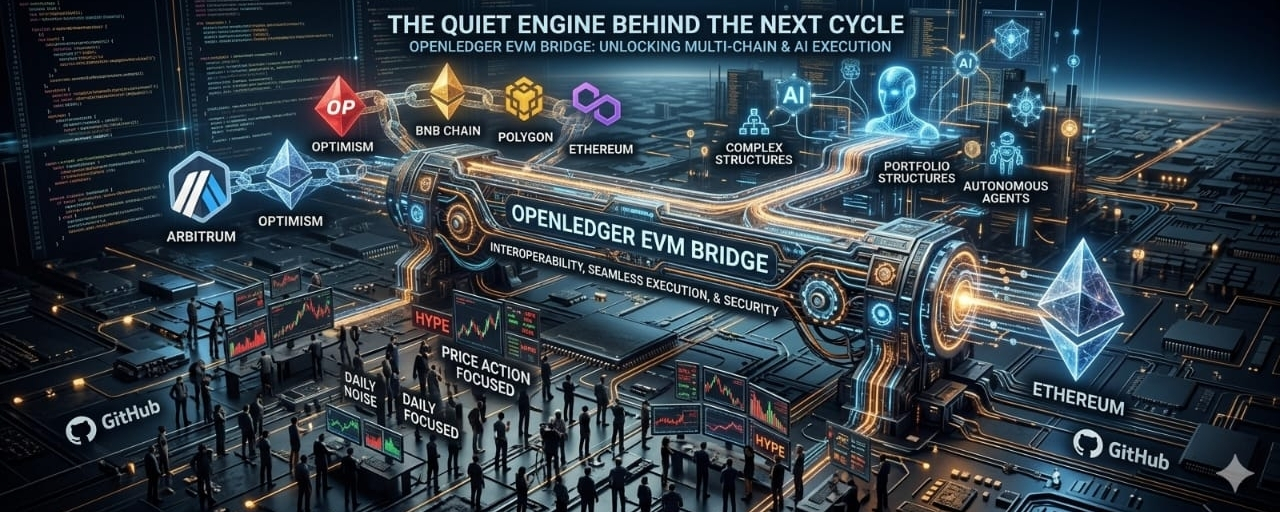
It is strange how the most important shifts in this space rarely arrive with fanfare or a sudden green candle. They happen in the background, buried inside GitHub repositories and developer docs, while most people are busy staring at four-hour timeframes and liquidation heatmaps. I have been guilty of that myself more times than I can count, chasing price action while completely missing the structural changes that would eventually make that price action possible in the first place. The latest thing that made me pause and zoom out was something coming out of the OpenLedger ecosystem, specifically the rollout of their EVM bridge. On the surface it sounds like just another technical upgrade in an industry that churns out technical upgrades every other week, but if you sit with it for a minute and think about what it actually unlocks, the implications start to ripple outward in ways that are genuinely worth paying attention to.
Let me try to break this down without making it sound like a whitepaper, because I think the practical side of this matters way more than the technical jargon. An EVM bridge, at its simplest, is a piece of infrastructure that lets different blockchain networks talk to each other as long as they are compatible with the Ethereum Virtual Machine standard. That means assets, data, and smart contract logic can move between chains like Arbitrum, Optimism, BNB Chain, Polygon, and Ethereum itself without needing to go through some clunky centralized middleman or manually unwrap and rewrap tokens across half a dozen interfaces. For the average user who just wants to use their capital efficiently, that sounds like a small quality-of-life improvement. But for anyone who has spent real time bouncing between ecosystems, chasing yield opportunities, managing collateral across different lending protocols, or trying to deploy a strategy that spans multiple networks, you already know how much friction exists under the hood. Every extra bridge, every additional confirmation, every manual step is a point where things can go wrong or simply take too long. In a market environment where speed of execution can be the difference between catching an opportunity and watching it evaporate, that friction is not just an annoyance, it is a real cost.
I think what makes OpenLedger's move particularly interesting is not just that they built a bridge, because bridges have existed for years now and plenty of projects have launched them with varying degrees of success and security. What stands out here is the context around it. OpenLedger has been positioning itself at the intersection of blockchain infrastructure and artificial intelligence, which is a space that a lot of people are talking about but very few are actually building in a meaningful way. Most of the AI-related crypto projects we have seen so far have focused on the analytical side of things, generating trading signals, parsing on-chain data, predicting price movements, that kind of thing. The execution layer has always been the hard part, because for an AI system to actually act on the insights it generates, it needs to interact with smart contracts, move funds, manage positions, and respond to changing conditions across multiple protocols. That requires a level of interoperability and seamless access that most current infrastructure simply does not provide. If an AI agent has to manually bridge assets every time it wants to shift capital between chains, wait for confirmations, deal with different gas tokens, and navigate inconsistent user experiences across different networks, the whole promise of autonomous on-chain execution starts to break down. It becomes too slow, too fragile, and too prone to failure at exactly the moments when speed and reliability matter most.
This is where the EVM bridge starts to look less like a standalone feature and more like a foundational piece of a much larger puzzle. By creating a unified framework that allows AI-driven systems to operate across multiple EVM-compatible chains without constantly hitting walls, OpenLedger is essentially building the rails that autonomous agents need to function properly in a multi-chain world. That might sound abstract right now, but if you project forward even a year or two, it is not hard to imagine a landscape where a significant portion of on-chain activity is initiated not by humans clicking buttons but by intelligent systems executing strategies, managing risk, and rebalancing portfolios across ecosystems. For that to work at scale, the infrastructure layer has to be solid, secure, and fast. Bridges cannot be the weak point. They have to be reliable enough that you do not even think about them, the same way you do not think about the TCP/IP protocol when you load a webpage. That is the standard the industry needs to reach, and every serious attempt to move in that direction is worth noting.
Looking back at how the multi-chain landscape evolved between 2023 and 2025 helps put this into perspective. Ethereum remained the dominant settlement layer, but the rise of layer-two networks like Arbitrum and Optimism, along with alternative layer-ones that adopted EVM compatibility, created a situation where liquidity and users became increasingly scattered. Each chain offered something different, whether it was cheaper transactions, faster finality, or specific application ecosystems that built loyal communities. But the user experience of moving between them never quite caught up to the ambition of the multi-chain thesis. You would find a great yield opportunity on one network, but your stablecoins were sitting on another. You would want to use a particular DeFi protocol, but your collateral was locked somewhere else. The tools existed to bridge, but they were often slow, sometimes risky, and almost always added enough complexity that casual users would just stay put rather than deal with the hassle. That fragmentation quietly capped the efficiency of capital flowing through the system, and it also limited what developers could build because they had to either commit to a single ecosystem or invest significant resources into making their applications chain-agnostic.
The evolution of bridge technology over the past few years has been instructive to watch. Early bridges were often centralized, relying on a single entity or a small group of validators to custody funds and approve transfers. That model worked until it did not, and we saw several high-profile exploits where hundreds of millions of dollars evaporated because the security assumptions turned out to be weaker than people thought. Those incidents left scars on the industry and made everyone more cautious about cross-chain infrastructure. The next generation of bridges moved toward more decentralized models, using validator networks, optimistic verification, or zero-knowledge proofs to reduce trust assumptions and improve security. By 2026, the standard for what constitutes an acceptable bridge has risen considerably. Users expect not just functionality but also transparency, battle-tested code, and economic security models that can withstand sophisticated attacks. Any project entering this space now has to meet that higher bar, and the fact that OpenLedger is doing so while simultaneously building toward AI integration suggests a long-term view rather than a quick feature drop to generate short-term attention.
From a trader's perspective, the practical benefits are straightforward even if you do not care about the AI angle at all. Capital that can move freely between ecosystems is capital that can chase the best opportunities wherever they appear. If lending rates spike on one chain, you can reallocate. If a new protocol launches with attractive incentives on another network, you can participate without spending an hour navigating bridges and worrying about whether your transaction will go through. If market conditions shift suddenly and you need to move funds to a different environment to manage risk, the infrastructure supports that instead of fighting you every step of the way. These are not hypothetical scenarios. Anyone who has traded actively across multiple chains has experienced moments where the inability to move quickly cost them real money. Sometimes the cost is obvious, like a missed entry or a liquidation that could have been avoided. Sometimes it is subtler, like the slow erosion of returns because your capital sat idle while you waited for a bridge transaction to finalize during a period of high network congestion. Over time, these frictions compound. Removing them does not just make life easier, it changes the math on what strategies are viable and how efficiently the entire system operates.
There is a broader market dynamic at play here too, and it is worth mentioning because it explains why infrastructure developments like this tend to gain traction at certain moments in the cycle. By early 2026, the crypto market has matured to a point where user expectations have shifted significantly from the early days. The era where people were willing to tolerate clunky interfaces, confusing processes, and constant technical hurdles just to participate is fading. As more institutional capital enters the space and as retail users become more sophisticated, the demand for seamless experiences grows. People want things to work the way they expect, without having to understand every layer of the stack. That does not mean decentralization or self-custody goes away, it just means the user experience has to catch up to the underlying technology. Bridges that are slow, confusing, or risky become bottlenecks that hold back broader adoption. Bridges that are fast, secure, and nearly invisible become enablers that let the ecosystem scale.
The multi-chain reality also seems increasingly settled at this point. The idea that one chain will eventually win and absorb all activity looks less plausible with each passing year. What has emerged instead is a web of interconnected networks, each with its own strengths and specialized use cases, all needing to communicate with each other to function as a cohesive whole. In that kind of architecture, interoperability is not a nice-to-have feature, it is the essential connective tissue that holds everything together. Without it, you do not have a unified ecosystem, you have a collection of isolated silos that happen to share some branding and a loosely common tech stack. The difference between those two visions is enormous, and bridges are the infrastructure that makes the unified vision possible. Every time a major project invests seriously in cross-chain capabilities, it reinforces the direction the entire industry is heading.
I think it is also important to acknowledge the risks here, because being excited about the potential should not mean ignoring the challenges. Bridges remain one of the most attacked pieces of infrastructure in crypto, and for good reason. They hold significant value, they sit at the intersection of multiple networks, and any vulnerability can have cascading consequences. The track record of bridge security has improved, but it is not spotless, and every new implementation needs to be scrutinized carefully. Smart contract risk, validator collusion risk, and economic attack vectors all need to be addressed. Users who have been around long enough to remember the major bridge exploits of previous years will approach any new solution with healthy skepticism, and that skepticism is warranted. Trust is earned slowly and lost quickly in this space, and the only way to build it is through time, transparency, and a track record of operating without incident. OpenLedger's bridge will need to go through that same proving process, and how it handles that challenge will determine whether it becomes a core piece of infrastructure or just another option in an increasingly crowded field.
Adoption timelines are another factor that deserves honest consideration. Just because a bridge exists does not mean liquidity immediately flows through it or that developers instantly integrate it into their applications. These things take time. Other protocols need to assess the security model, integrate the technical interfaces, and build the user-facing features that make the bridge accessible to everyday users. Liquidity providers need to feel comfortable committing capital. The broader community needs to see the bridge operating reliably under real market conditions before confidence solidifies. This is a process that unfolds over months and years, not days and weeks. The initial launch is just the starting point, and the real test comes in the sustained usage and resilience that follows.
For investors who think in terms of multi-year timeframes rather than weekly charts, infrastructure plays like this occupy an interesting category. They rarely produce immediate price catalysts, and trying to trade them based on short-term news flow is usually a frustrating exercise. But over longer periods, the projects that solve real infrastructure problems and reduce friction across the ecosystem tend to accrue value in ways that are not always visible in the moment. They become the rails that other applications are built on top of, the plumbing that users interact with without even knowing it, the foundational layers that make the entire user experience better. That kind of value is harder to measure than a simple revenue metric or token price, but it is real, and it compounds as the ecosystem grows around it. The crypto space has a habit of undervaluing infrastructure during quiet periods and then suddenly recognizing its importance when the next wave of applications needs it to function. By that point, the early builders have often already established positions that are difficult to displace.
What I keep coming back to when I think about this development is how much of the market's future depends on things that are not visible on a price chart. The quality of the infrastructure, the smoothness of the user experience, the ability of different systems to work together without constant intervention, these are the factors that determine whether the space can actually support the scale of activity that people imagine. Every time a bridge gets faster, more secure, or more integrated, it expands the design space for what is possible. It lets developers think across chains instead of being confined to one. It lets capital flow to where it is most productive. It lets automated systems operate with the speed and reliability they need to be effective. None of that shows up as a dramatic headline, but it all contributes to the gradual, compounding improvement that moves the industry forward.
In a strange way, the most significant developments in crypto often feel boring at the time they happen. They are not accompanied by massive price moves or viral social media moments. They show up as documentation updates, testnet deployments, and quiet mainnet launches that only a small group of technically minded people pay attention to. But if you trace back the origins of the biggest trends and the most valuable protocols, you often find that they were built on top of infrastructure that someone laid down years earlier, during a period when most people were looking elsewhere. The EVM bridge from OpenLedger feels like one of those moments, a piece of the foundation being put in place that will enable things that are not yet built, applications that have not yet been imagined, use cases that will seem obvious in retrospect but are not yet on anyone's radar.
The market will keep moving, prices will keep fluctuating, and the daily noise will continue to dominate attention. But underneath all of that, the structural improvements keep accumulating. Better bridges, faster networks, more secure protocols, more intelligent systems. Each piece makes the whole thing more capable, more resilient, and more accessible. The projects that contribute to that improvement, especially in areas like interoperability where the need is so clear and the impact is so broad, are doing the kind of work that tends to matter more over time than any short-term narrative ever could. It is not the loudest story in the space right now, but it might just be one of the more important ones.