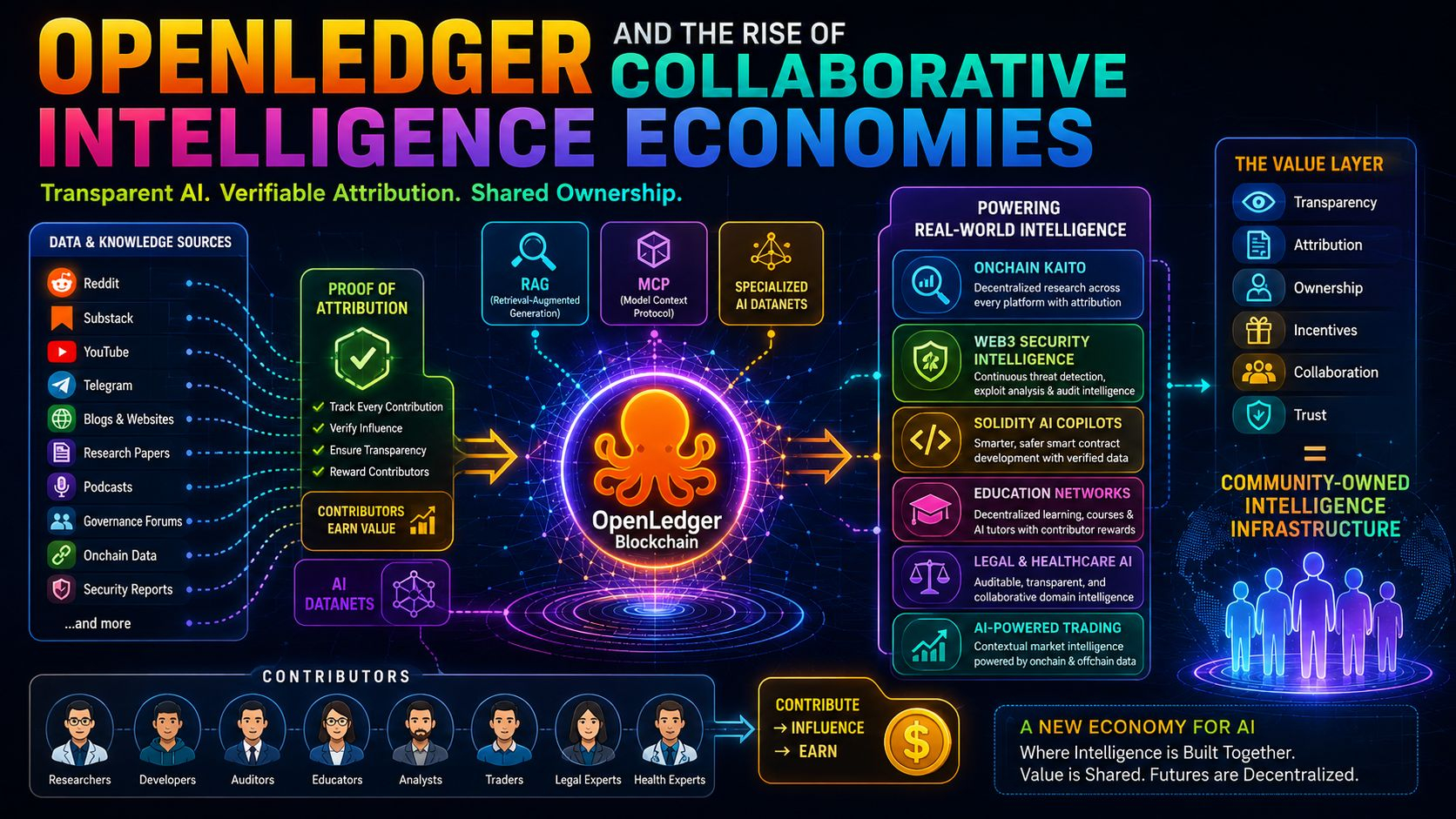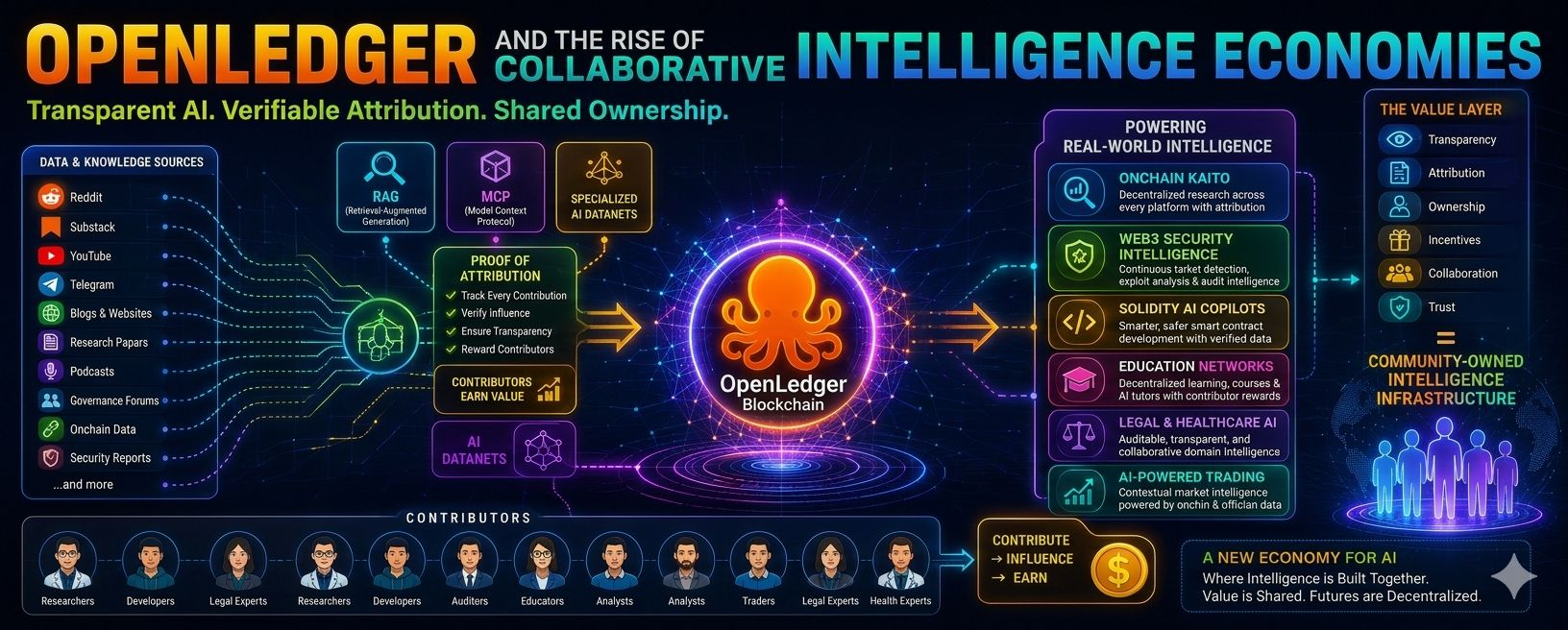
The next generation of AI companies will not be built on closed systems where data contributors remain Invisible while centralized platforms capture most of the value. they will liKely emerge from transparent intelligence networks where ownershIp, attrIbution, and contribution are verifiable across every layer of the AI stack. that is the larger vision @OpenLedger is attempting to introduce.
after reading deeper into the project, what stands out most is that #OpenLedger is not positioning itselF as just another AI blockchain narratIve. The protocol is building infrastructure for collaborative intelligence economies where contrIbutors become part of the value layer itself. through its Proof of Attribution framework, every dataset, contribution, and infLuence on model outputs can be transparently tracked and rewarded. CombIned with specialized AI datanets, Retrieval Augmented Generation (RAG), and Model Context Protocol (MCP), OpenLedger creates a foundation for AI systems that remain auditable, continuously evolving, and community owned.
One of the strongest concepts presented is the idea of an Onchain Kaito. most crypto AI research tools today operate within narrow informatIon environments centered around Twitter, Discord, and governance forums. but a massive amount of valuable intelligence exists outside those platforms across Reddit discussions, Substack articles , telegram communities, blogs, and independent research networks. OpenLedger introduces the possibility of buIlding decentralized AI-powered research systems that aggregate this information while preserving attrIbution for contributors whose content shapes the outputs. instead of relying on black-box summaries, users could trace where narratives originated, how information evolved, and which datasets infLuenced the intelligence being generated.
the same infrastructure becomes highly valuable when applied to Web3 security. tradItional audits provide static reviews, while smart contract ecosystems continue evolving long after deployment through governance upgrades, integrations, and composability. As exploit complexity increases, static auditing alone becomes insufficient. OpenLedger enables decentralized security intelLigence systems where auditors, white hat researchers, developers, and security contributors collaboratively train specIalized models using exploit databases, vulnerability reports, governance attack patterns, and real world incident data. these systems could continuously monitor protocols while contributors are rewarded based on how their datasets improve threat detection and security analysis.
another major application is AI copilots for SolidiTy and smart contract development. Secure smart contract engIneering remains one of the most difficult areas in Web3 because even a minor vulnerability can lead to catastrophic losses. OpenLedger creates the possibilIty for AI development assistants trained on verified codebases, audit reports, exploit archives, optimization techniques, and protocol architecture patterns. unlIke closed AI coding systems, contributors maintain attribution while developers gain transparency into the datasets influencing model outputs.
Education is another area where OpenLedger is archItecture becomes compelling. Current learning platforms remain largely closed ecosystems where instructors lose ownership over educational content while AI tutors operate behind opaque systems. OpenLedger could support decentralized education networks where educators, researchers, and industry experts collaboratively contribute courses, certifications, and training datasets. AI systems could dynamically generate personalized learning pathways while preserving attribution across every contributor involved.
he framework also extends naturally into legal, healthcare, and enterprise intelligence systems. Legal AI today struggles with jurisdiction complexity, trust, and auditability. Healthcare AI faces similar concerns around transparency and verifiable reasoning. OpenLedger introduces a collaborative infrastructure where legal professionals, clinicians, researchers, and institutions contribute validated datasets while AI-generated outputs remain traceable back to their sources. Meetings, governance discussions, and enterprise decision making systems could also evolve into fully auditable intelligence layers powered by attributed AI models.
One of the most powerful applications may ultimately be AI-powered trading intelligence. Crypto markets move rapidly through narratives emerging across social media, governance systems, whale activity, research communities, and onchain ecosystems. Most current trading dashboards aggregate surface level metrics while failing to integrate the deeper contextual information driving market behavior. OpenLedger creates the possibility for decentralized trading assistants powered by collaborative datasets involving governance proposals, market research, sentiment analysis, and blockchain activity. Traders would not simply receive AI-generated signals but would gain visibility into which datasets, narratives, and contributors influenced every output.
What ultimately makes OpenLedger stand out is that it reframes AI as a collaborative economic infrastructure rather than a closed technological product. Most modern AI systems extract value from contributors without ownership, transparency, or participation. OpenLedger proposes an alternative model where intelligence itself becomes community owned infrastructure powered by attribution and contribution economies.
If this model succeeds, the next generation of billion-dollar AI companies may not emerge from centralized black-box systems. They may instead emerge from transparent, attributable, and decentralized intelligence networks where the people contributing knowledge finally become stakeholders in the AI economy they help create.