
I’ve been thinking about something lately.
Every major technology shift eventually changes one thing: who gets rewarded.
The internet rewarded websites.
Social media rewarded creators.
Mobile rewarded app developers.
Now AI is creating value at a scale we’ve never seen before, yet the reward structure still feels unfinished.
Most people interact with AI every day without thinking about where the value goes. A model is trained, data is consumed, responses are generated, and businesses profit. The process works, but it’s surprisingly difficult to track who contributed what and who deserves a share of the value being created.
That’s one reason @OpenLedger has been on my watchlist.
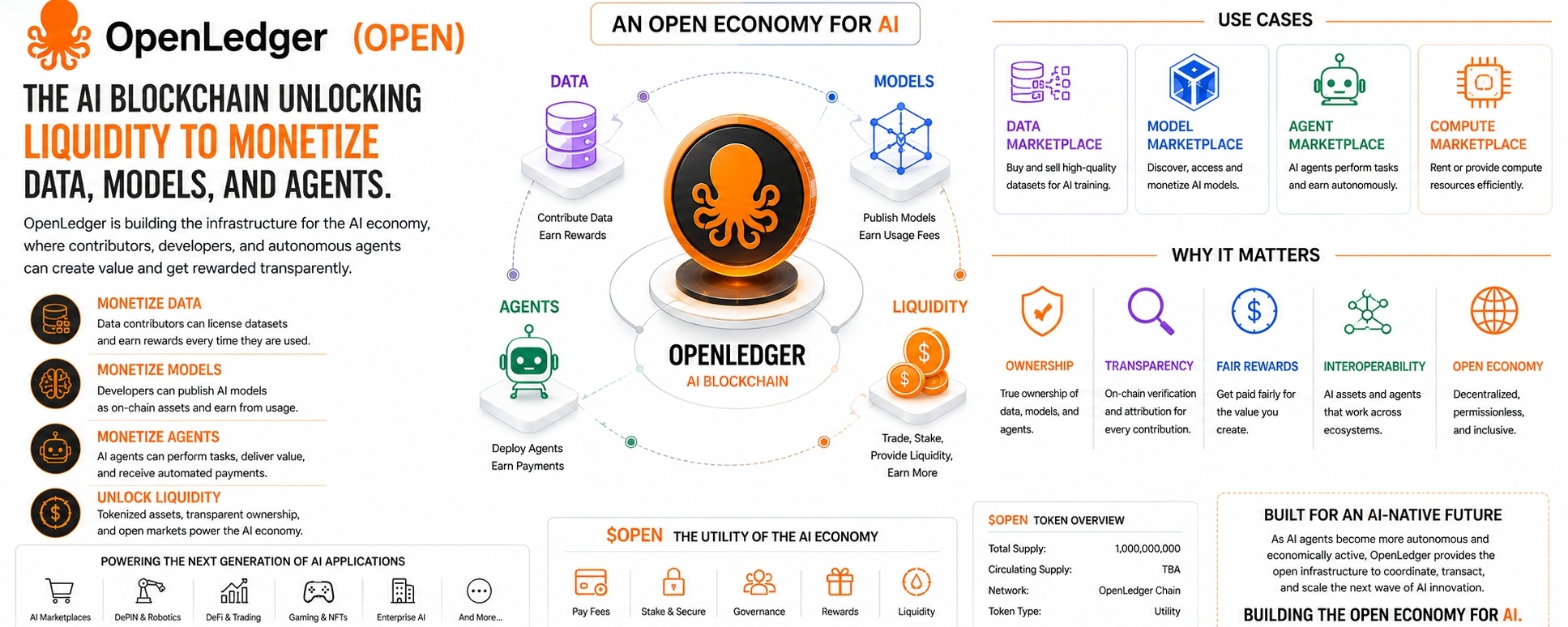
The project isn’t trying to become another chatbot or another AI application competing for attention. Instead, it’s focused on building an AI blockchain where data, models, and agents can become productive economic assets.
At first, I thought this sounded like another complicated Web3 narrative.
Then I looked deeper.
The idea is actually centered around a fairly practical question:
If AI relies on contributors, why shouldn't contributors participate in the value AI creates?
That question becomes more important as AI systems become increasingly sophisticated.
Today, people contribute data.
Tomorrow, autonomous agents may contribute services.
Eventually, AI models could interact with each other, complete tasks, access resources, and generate economic activity with minimal human involvement.
When that happens, transparent ownership and attribution become critical.
And that's where OpenLedger's thesis becomes interesting.
Instead of treating data as a hidden resource, the network attempts to make contributions visible and economically measurable. Instead of viewing models as isolated software products, it creates a framework where models can become monetizable assets. And instead of treating agents as simple automation tools, it positions them as participants in an emerging AI economy.
What stands out to me is that #OpenLedger isn't focusing on the most obvious part of the AI boom.
Most projects focus on intelligence.
OpenLedger focuses on coordination.
Historically, coordination layers often become extremely valuable because they connect participants who otherwise wouldn't be able to interact efficiently.
Think about payment networks.
Think about cloud infrastructure.
Think about internet protocols.
The companies that enabled ecosystems often became just as important as the products built on top of them.
AI may follow a similar pattern.
Another aspect I find interesting is how the conversation around AI ownership is starting to change.
A year ago, people mainly debated model performance.
Today, discussions increasingly involve data rights, attribution, transparency, incentives, and monetization.
That shift feels important.
Because eventually the market may care less about who built a model and more about how value flows through the ecosystem surrounding it.
OpenLedger appears designed for that transition.
Of course, none of this guarantees success.
The AI sector is crowded. Competition is intense. Building infrastructure is often harder than building applications because adoption takes time and network effects matter.
Execution will ultimately determine everything.
But the narrative itself feels increasingly relevant.
I've noticed that the strongest long-term projects often solve problems people don't fully appreciate until those problems become unavoidable.
Right now, AI ownership still feels like a future discussion.
A few years from now, it may become one of the industry's biggest debates.
Who owns the data?
Who owns the models?
Who receives the economic benefit when AI creates value?
OpenLedger seems to be positioning itself around those questions before they become mainstream.
Maybe I'm wrong, but that's what makes the project interesting to me.
Not because it's promising a smarter AI.
But because it's trying to build the economic infrastructure that smarter AI may eventually need.
And if AI truly becomes a network of autonomous contributors rather than just software tools, the platforms coordinating that economy could end up being far more important than most people expect today.
The real opportunity may not be creating the next AI model.
It may be creating the system where AI, data, and contributors can finally share value in a transparent way.
@OpenLedger #OpenLedger #openledger $OPEN