The more I study decentralized AI infrastructure, the more I realize the market keeps misunderstanding where the real bottleneck actually sits.
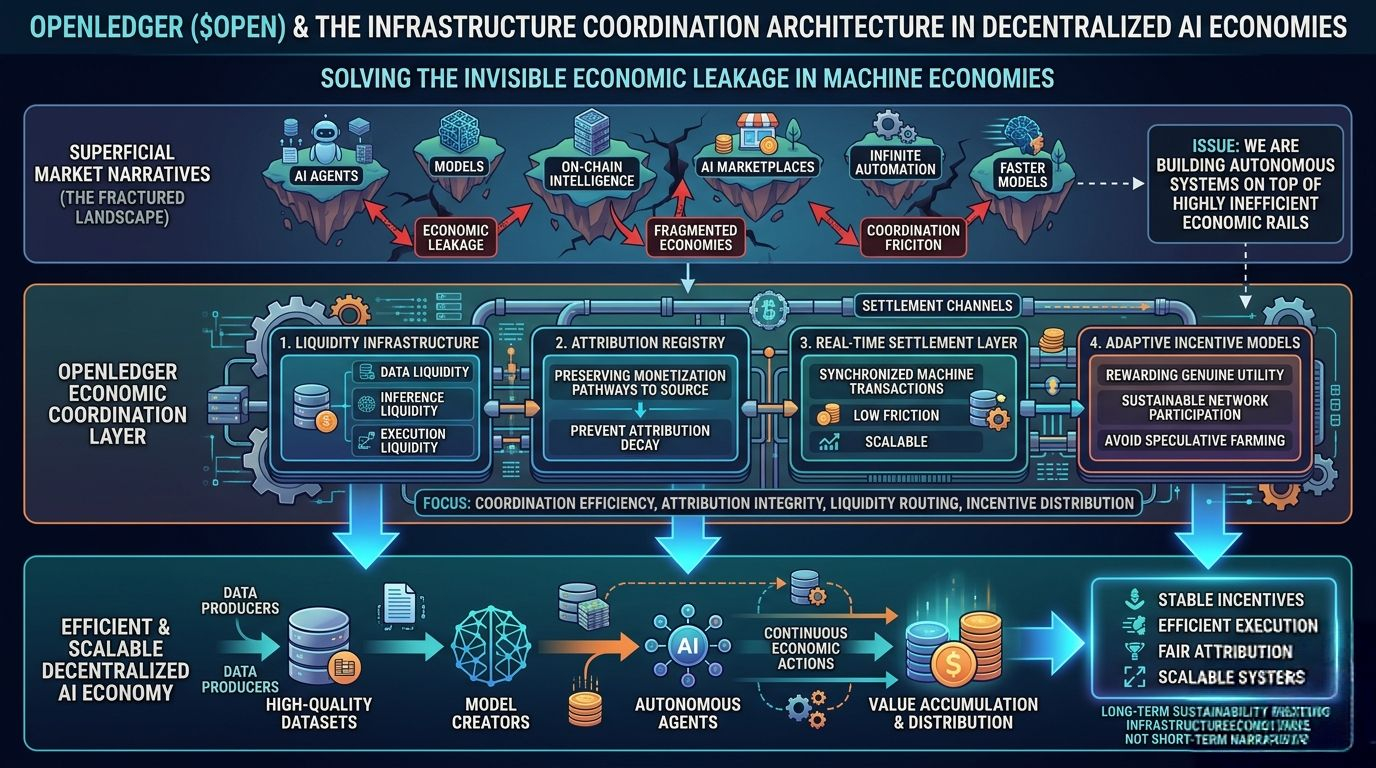
Most people still evaluate AI-blockchain projects through the surface layer. They look at narratives first. Autonomous agents. AI marketplaces. On-chain intelligence. Infinite automation. Faster models. Bigger ecosystems.
But underneath all of that marketing language sits a far less glamorous problem that almost nobody wants to discuss because it is structurally complicated:
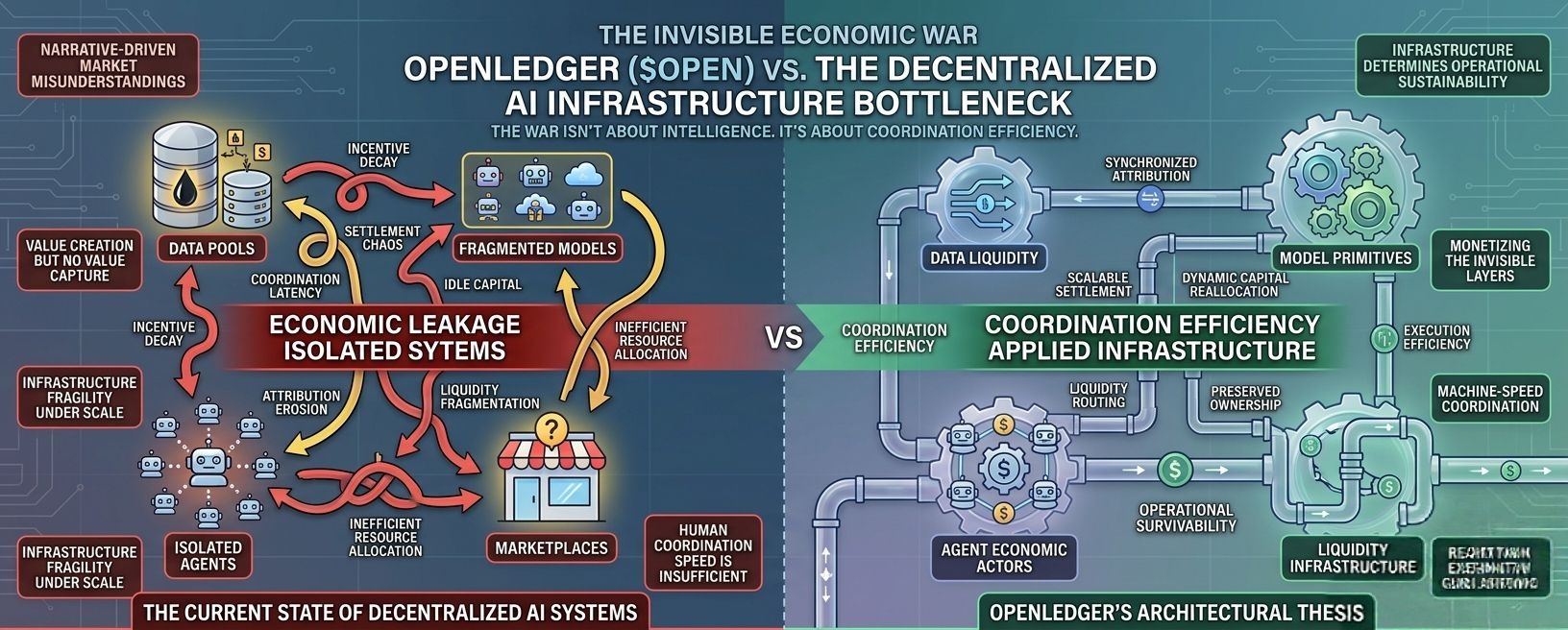
AI economies are becoming increasingly efficient at generating value while remaining deeply inefficient at distributing, coordinating, and monetizing that value across fragmented systems.
That distinction changes everything.
And honestly, this is where OpenLedger starts becoming far more interesting than the average “AI + crypto” protocol currently flooding the market.
Not because it promises some futuristic machine civilization.
Not because it claims to replace existing AI systems.
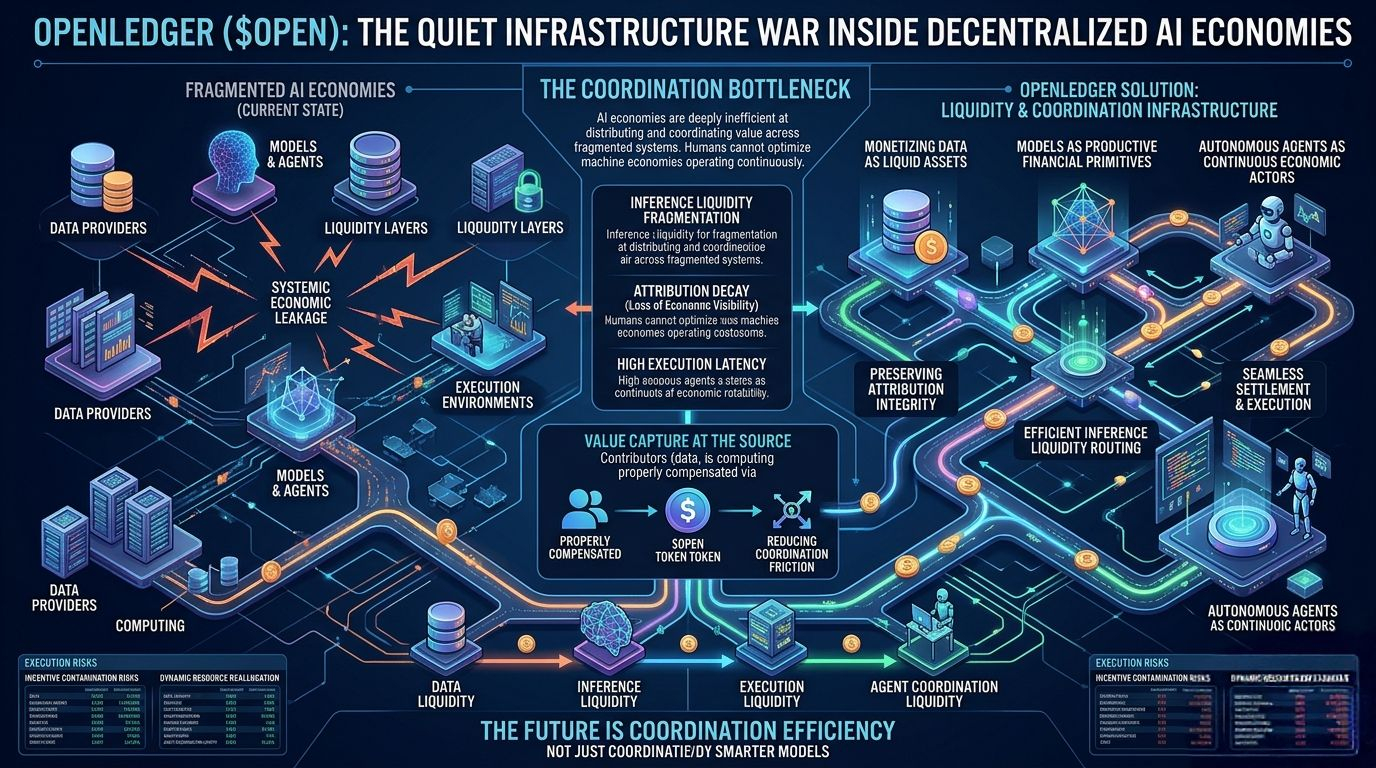
But because it appears to focus on the invisible economic leakage happening between data providers, models, agents, liquidity layers, and execution environments.
That is a much deeper infrastructure problem.
Whenever I stop and think about decentralized AI systems objectively, I keep arriving at the same conclusion:
The future bottleneck is probably not intelligence itself.
It is coordination efficiency between intelligent systems.
That sounds subtle at first, but the implications are enormous.
Most decentralized AI projects today are still treating AI like an isolated product layer. Build a model. Deploy an agent. Create automation tools. Launch incentives. Attract users.
But machine economies do not function cleanly just because intelligence exists.
They require synchronized infrastructure capable of handling attribution, settlement, liquidity routing, execution timing, incentive distribution, and cross-environment portability simultaneously.
And right now, most ecosystems are structurally weak in those areas.
Value gets created continuously.
Yet value capture remains fragmented.
That fragmentation becomes expensive over time.
The easiest way to describe the current state of decentralized AI infrastructure is this:
We are building autonomous systems on top of highly inefficient economic rails.
That contradiction eventually becomes impossible to ignore.
OpenLedger appears to recognize this early.
The project’s positioning around monetizing data, models, and agents is not merely about “AI accessibility.” Underneath the branding sits a more important economic thesis:
Data itself is becoming a liquid asset class.
Models are becoming productive financial primitives.
And autonomous agents are slowly evolving into continuous economic actors rather than static software tools.
Once that transition happens, traditional coordination systems start breaking down very quickly.
Because human coordination speed becomes insufficient.
Humans cannot optimize machine economies operating continuously across global environments twenty-four hours a day.
We hesitate.
We rebalance slowly.
We react emotionally.
We transfer liquidity manually.
We depend on fragmented platforms that were never designed for autonomous economic synchronization.
That creates massive inefficiency.
I think this is the part most investors still underestimate.
The largest economic leak in decentralized AI may not come from poor intelligence quality.
It may come from poor infrastructure coordination surrounding intelligence.
That is a completely different problem category.
And it is also much harder to solve.
OpenLedger’s architectural direction seems to focus less on building “another AI product” and more on creating liquidity infrastructure capable of reducing coordination friction between data producers, model creators, and autonomous systems.
That is strategically important because decentralized AI ecosystems are already suffering from what I would describe as attribution decay.
Attribution decay happens when datasets move across multiple training environments, fine-tuning systems, inference layers, and agent networks until the original economic contributors become almost invisible.
Eventually value accumulates disproportionately at aggregation layers while the source layer loses monetization power.
That creates long-term incentive instability.
Why would high-quality contributors continue supplying valuable data if ownership visibility disappears over time?
This becomes especially dangerous in decentralized ecosystems where participation quality directly impacts network sustainability.
Most projects focus aggressively on user acquisition.
Far fewer focus on preserving attribution integrity across machine economies.
But attribution integrity is not a cosmetic feature.
It is an economic survival mechanism.
If OpenLedger successfully creates infrastructure that preserves monetization pathways closer to the source layer, then the protocol may be addressing one of the least appreciated weaknesses inside decentralized AI markets today.
And honestly, this is where the conversation becomes much more serious than typical token speculation.
Because infrastructure economics behave differently from narrative economics.
Narratives can create temporary valuation spikes.
Infrastructure determines whether systems remain operational under scale pressure.
Those are not the same thing.
Another structural issue emerging across AI ecosystems is inference liquidity fragmentation.
Inference demand is highly uneven by nature.
Some models experience intense computational demand while others remain underutilized for long periods.
Without efficient coordination systems, computational capacity becomes fragmented and economically inefficient.
Idle infrastructure slowly becomes dead capital.
This matters because decentralized AI systems cannot realistically compete with centralized infrastructure providers if their resource allocation mechanisms remain inefficient.
Markets usually underestimate how destructive small inefficiencies become once scaled across millions of automated interactions.
Even tiny coordination delays eventually compound into massive economic leakage.
A few seconds of execution latency.
Minor verification friction.
Fragmented liquidity routing.
Inefficient settlement timing.
Individually these issues seem manageable.
Collectively they create systemic drag across entire ecosystems.
And machine economies amplify those inefficiencies faster than human economies ever did.
That amplification effect is extremely important.
Traditional financial systems still rely heavily on periodic human interaction.
AI economies increasingly operate continuously.
That means infrastructure weakness becomes visible much faster.
The future competition may not simply be about who builds the smartest models.
It may become about who builds the most economically efficient coordination architecture around those models.
This is why OpenLedger’s positioning around liquidity infrastructure deserves closer analysis than many investors are currently giving it.
Because liquidity itself is evolving.
Historically we treated liquidity mostly as financial capital.
But decentralized AI introduces entirely new liquidity categories:
Data liquidity.
Inference liquidity.
Execution liquidity.
Model accessibility liquidity.
Agent coordination liquidity.
These are fundamentally different infrastructure requirements.
And the protocols capable of coordinating them efficiently could become extremely important over the next decade.
Still, this is also where realism becomes necessary.
Infrastructure theories always sound elegant in early-stage market environments.
Execution pressure changes everything.
The challenge is not conceptual clarity.
The challenge is operational survivability under real-world conditions.
For example, agent-to-agent economies sound efficient theoretically.
But once autonomous agents begin exchanging services, predictions, data, and execution tasks continuously, settlement architecture becomes extraordinarily complex.
You suddenly need reliable attribution systems, scalable transaction coordination, low-friction settlement layers, and economically sustainable incentive models operating simultaneously.
Otherwise the ecosystem collapses into synchronization chaos.
Most AI projects still avoid discussing this because the infrastructure challenge is far more difficult than the marketing challenge.
Building excitement is easy.
Building sustainable coordination systems is not.
Another problem OpenLedger will eventually face is incentive contamination.
This is one of the most dangerous structural weaknesses inside Web3 systems generally.
Short-term incentives often attract economically meaningless participation.
People optimize for rewards instead of utility.
Networks become saturated with low-quality contributions.
Artificial activity replaces productive activity.
Eventually the economic layer becomes distorted.
This is where many decentralized ecosystems quietly fail without immediately realizing it.
The metrics still appear healthy temporarily.
Activity numbers rise.
Participation increases.
But underneath the surface, the quality of economic coordination deteriorates.
For OpenLedger to remain structurally viable long term, the protocol will need to ensure incentives reward genuinely useful machine outputs rather than speculative behavioral farming.
That is significantly harder than launching infrastructure.
And honestly, it may become one of the defining survival filters for AI-blockchain ecosystems moving forward.
The market currently rewards narrative velocity.
Eventually it will reward coordination efficiency.
Those are very different evaluation frameworks.
Another aspect worth discussing is autonomous capital reallocation.
I think this area remains severely underestimated.
Machine economies require continuous resource migration toward higher-efficiency environments.
Liquidity cannot remain static.
Computation cannot remain idle.
Data cannot remain trapped inside isolated ecosystems forever.
Capital efficiency increasingly depends on dynamic coordination layers capable of reallocating resources intelligently in real time.
Humans are not naturally equipped for that level of continuous optimization.
We are too slow.
Too emotional.
Too fragmented operationally.
Eventually infrastructure itself must become adaptive.
That transition represents a major philosophical shift inside decentralized systems.
We are moving from static participation models toward continuously self-adjusting economic architectures.
If OpenLedger succeeds in positioning itself inside that transition layer, the project could occupy a strategically important infrastructure role over time.
But again, success here is far from guaranteed.
The difficulty of execution remains enormous.
Because decentralized coordination problems are rarely solved permanently.
They evolve.
Every increase in autonomy introduces new layers of complexity.
Every increase in scalability introduces new verification burdens.
Every increase in liquidity movement introduces new settlement risks.
And markets consistently underestimate how quickly coordination systems become fragile under stress conditions.
That is why I remain cautious whenever the market becomes overly confident about AI-blockchain convergence narratives.
Most ecosystems today still operate closer to experimental coordination laboratories than mature financial infrastructure.
OpenLedger may absolutely possess a compelling long-term thesis.
The project appears directionally aligned with real infrastructure problems instead of purely speculative storytelling.
That alone already separates it from many superficial AI-token ecosystems currently dominating short-term attention cycles.
But structural alignment is only the beginning.
Execution quality determines whether infrastructure theories survive contact with reality.
If attribution systems fail, value capture centralizes again.
If liquidity routing becomes inefficient, machine economies slow down.
If settlement layers introduce excessive complexity, users retreat toward centralized convenience.
If incentive systems deteriorate, ecosystem quality collapses from within.
These risks are not hypothetical.
They are recurring historical patterns across decentralized markets.
And honestly, this is probably the healthiest way to evaluate OpenLedger right now:
Not as a guaranteed winner.
Not as a speculative miracle.
But as an attempt to solve one of the most economically important — and least emotionally marketable — infrastructure problems emerging inside decentralized AI systems.
The protocols that matter long term may not be the loudest.
They may simply be the ones quietly reducing invisible economic leakage while everyone else chases narratives.
That is a much less glamorous story.
But infrastructure markets are rarely built on glamour.
They are built on coordination efficiency.
And the next phase of decentralized AI will probably depend on that reality far more than most people currently realize.