

In oil price news today, WTI crude futures are nearing $100 per barrel as skepticism about a US-Iran diplomatic breakthrough has reversed a previously optimistic “peace dividend” in the oil markets, reinstating a geopolitical risk premium of $3 to $5 per barrel.
Although Friday’s session saw some gains, both WTI and Brent ended the week lower, highlighting conflicting signals between day-session risk repricing and softness due to anticipated OPEC+ supply increases in July.
$WTI trades below $100 Is it time to gas up? pic.twitter.com/hvSfbRt6qI
— TheCanadianInvestor I (@thegamblerXBT) May 22, 2026
The diplomatic impasse affects the potential return of 1M to 1.5M barrels per day of Iranian crude that had been factored into market expectations. As these expectations fade, energy stocks like ExxonMobil (NYSE: XOM) and Chevron (NYSE: CVX) are benefiting from higher crude prices.
The following sections will analyze the geopolitical factors affecting risk premiums, producer margins, capital returns for major companies, and recent stock performance across key tickers.
Negotiation Deadlock and Hormuz: How Iran Deal Skepticism Is Re-Pricing the Oil Price Risk Premium
The core issue between Washington and Tehran lies in Iran’s refusal to reduce its uranium stockpile and disagreements over control in the Strait of Hormuz, a key route for global oil supply.
Past geopolitical tensions have shown that such risks can drive up crude prices; for instance, in March 2026, Brent briefly hit $111 per barrel.
Analysts suggest the market is currently reflecting a risk premium, meaning WTI prices may react more to diplomatic developments than to consumption data. A successful deal could lower WTI by $6 to $10 per barrel, while a breakdown or escalation could raise it by $4 to $7 above $97 per barrel.
Traders have been locking in prices amid Iran-related risks, and the $97 level is significant resistance. OPEC+’s expected output increases are partially offsetting this trend, contributing to a current market loss despite some support during Friday’s session.
Producer Math: How $97 WTI Reprices Energy Sector Free Cash Flow
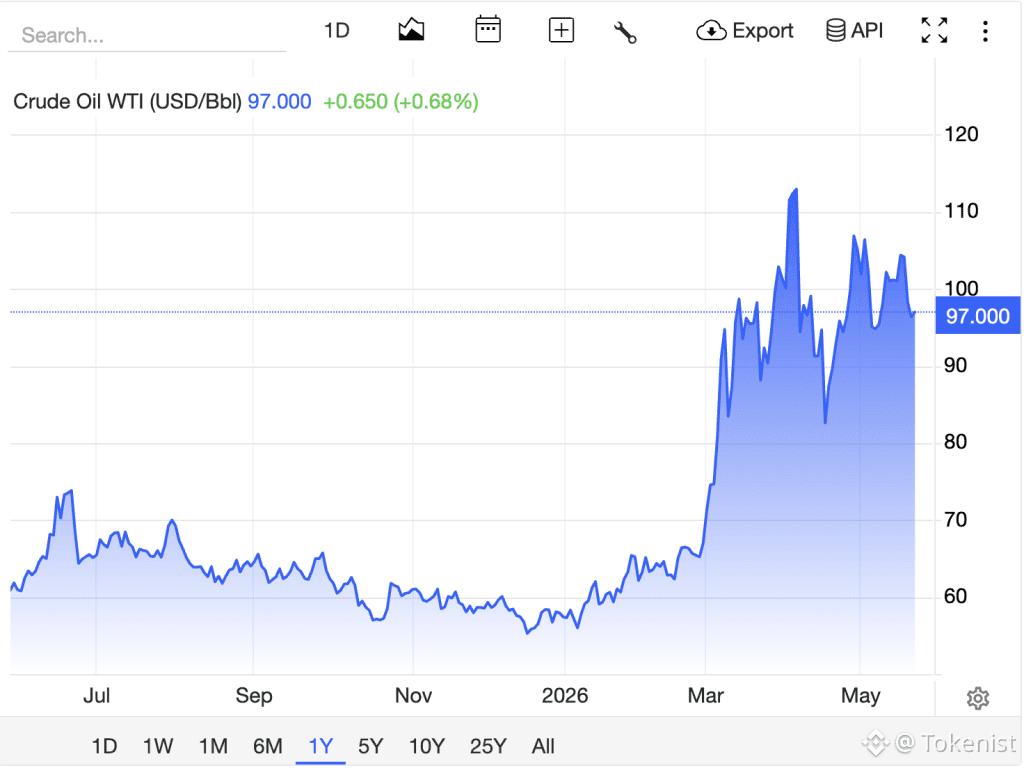 SOURCE: TradingEconomics
At $97 WTI, Permian Basin operators carry break-even costs of $35 to $45 per barrel, generating per-barrel margins of $35 to $45.
Bakken producers, with break-evens in the $42 to $52 range, capture margins of $28 to $38 per barrel at the same strip. Eagle Ford operations, slightly higher-cost at $44 to $54 per barrel, still yield margins of $26 to $36 per barrel.
For ExxonMobil (NYSE: XOM), the move from a $90 baseline to $97 WTI translates to roughly $2Bn in additional annual free cash flow, consistent with the company’s own disclosed sensitivity of approximately $2Bn per $10 change in the oil price.
Chevron (NYSE: CVX) has disclosed comparable sensitivity, with each $10 increase in crude generating approximately $1.8Bn in incremental operating cash flow.
XLE, as the sector proxy, has been outperforming the S&P 500 on geopolitical risk sessions in 2026, a pattern consistent with the fund’s heavy weighting toward integrated majors that benefit disproportionately from front-end crude price strength.
The transmission from geopolitical deadlock to equity market opportunity is direct: higher near-term WTI prices lift realized revenue on current production volumes before any capital deployment decision is required, compressing effective payback periods on existing wells and freeing cash for return programs in the current quarter.
Dividend Yields and Capital Return Outlook: Whether $97 Oil Price Sustains the 2022 Playbook
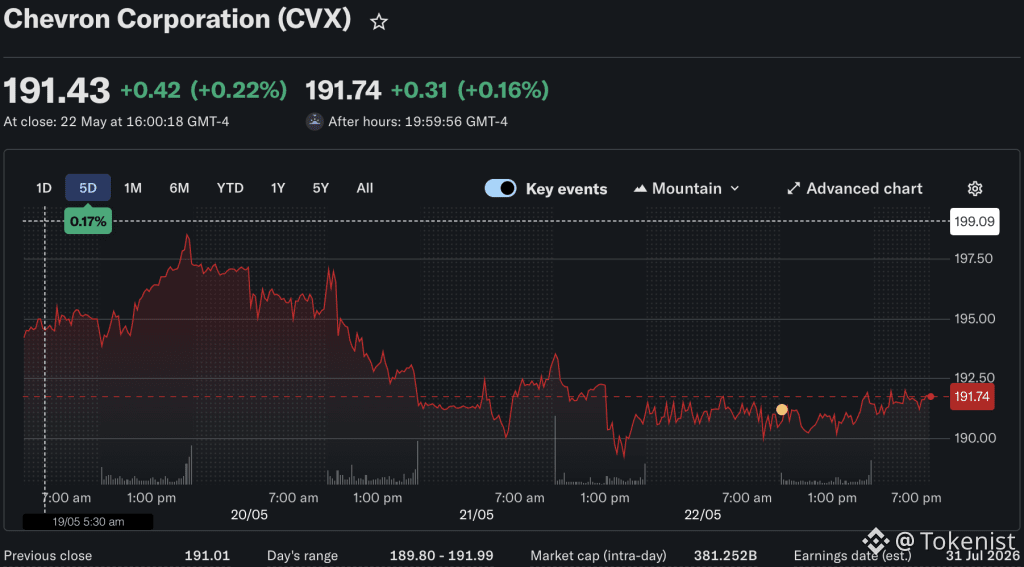 SOURCE: Yahoo Finance
In other oil price news, the 2022 analog is relevant. When WTI oil stayed above $90 per barrel in mid-2022, ExxonMobil and Chevron ramped up buybacks and maintained dividend growth, with XOM returning over $30Bn to investors.
Currently, with WTI at around $97, both companies have a funding threshold of $65-$70 per barrel for capital budgets, dividends, and buybacks without causing balance-sheet stress. A potential collapse of Iran deal talks could push oil to $100, fueling speculation about energy sector buybacks.
ExxonMobil (NYSE: XOM) offers a 3.5% yield with a $20Bn annual buyback plan, while Chevron (NYSE: CVX) yields 4.2% and has raised its dividend for 37 years, needing a WTI price of about $65 to sustain its payouts.
The main risk to this capital return scenario is a diplomatic resolution that could lower oil prices and cash flow, affecting buyback capabilities. The impact of Iran sanctions on the oil price and energy stocks was evident in 2026, highlighting the volatility in this market.
The author does not hold or have a position in any securities discussed in the article. All stock prices were quoted at the time of writing.
The post Oil Price: WTI Climbs Toward $100 as Iran Deal Doubts Re-Emerge appeared first on Tokenist.