
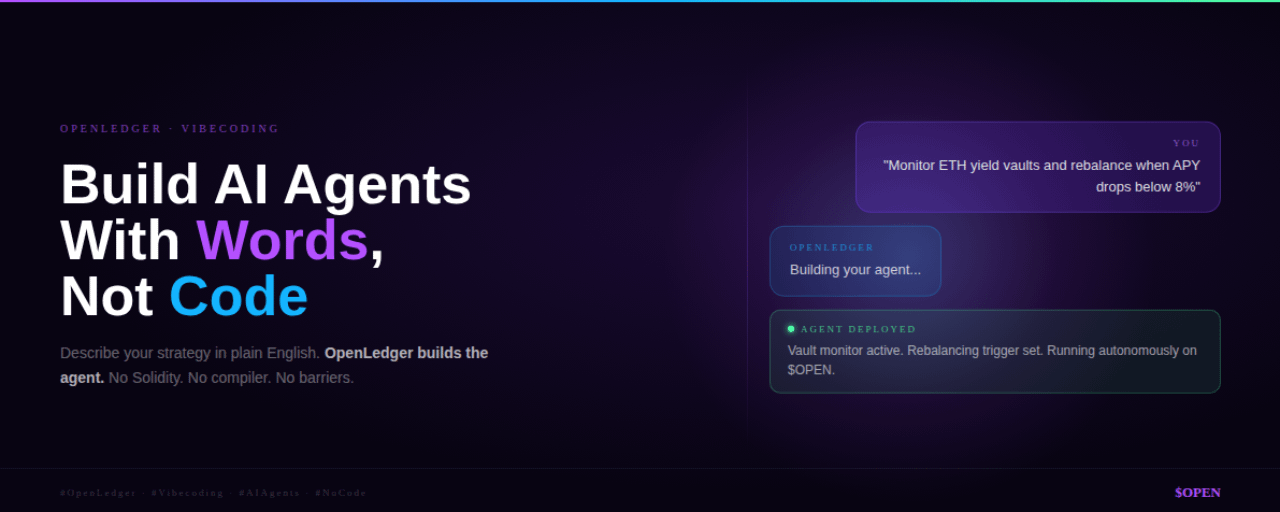
Coding used to be the wall that kept most people out of Web3.
You had an idea. Maybe even a good one. But without Solidity experience or a developer on speed dial, that idea went nowhere.
@OpenLedger just knocked that wall down with something called Vibecoding.
So what is Vibecoding?
You describe what you want your AI agent to do in plain English. OpenLedger builds it. The agent runs on-chain in real time, executing trades, automating workflows, pulling data, interacting with DeFi protocols.
Why this is bigger than it sounds
The real barrier to AI agent adoption was never the technology. It was who got to use it.
To build a working autonomous agent on-chain, you needed smart contract skills, gas optimization knowledge, and a solid understanding of every protocol you wanted to touch. That locked out a lot of smart people who just happened to not write code for a living.
Vibecoding changes that equation completely. What you know becomes the input. The technical side handles itself.
OpenLedger is making a pretty clear statement here: your ability to deploy an AI agent should not depend on your GitHub commit history.
What you can actually build
A trader who knows a DeFi strategy inside out can deploy an agent that executes it around the clock.
A researcher can spin up an agent that monitors on-chain data and flags insights without any manual work.
A founder can prototype an AI-powered product before they ever hire a developer.
That is a genuinely different world from what existed six months ago.
Where $OPEN comes in
Every agent built through Vibecoding runs on OpenLedger's infrastructure. $OPEN handles gas, execution, and operations across the network.
OctoClaw. The EVM Bridge. ERC-4626 vaults. Vibecoding. Each launch adds more builders, more agents, and more activity flowing through the same token.
What would you build if you could just describe it out loud? Drop it below.