
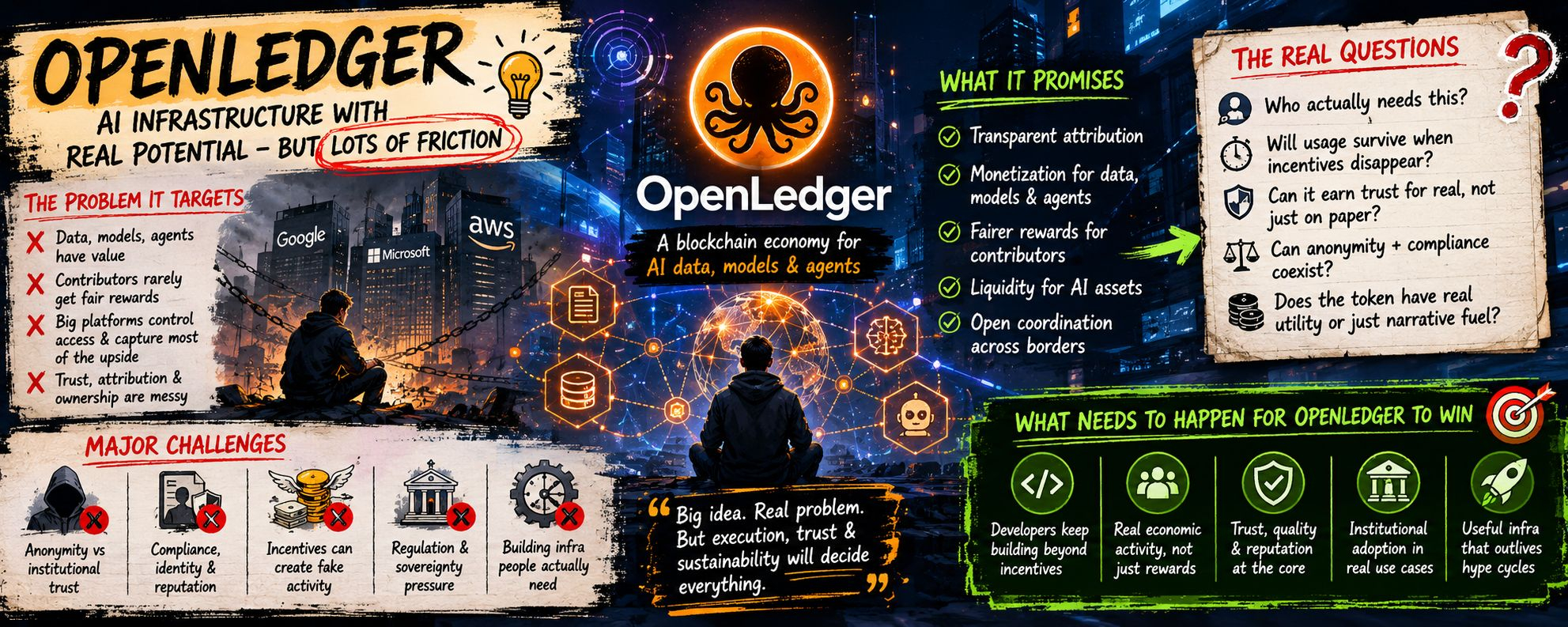
OpenLedger keeps showing up in conversations because people hear “AI” and “blockchain” in the same sentence and immediately start hallucinating inevitability. I’ve seen this movie too many times. A new coordination layer arrives claiming it will reorganize ownership, incentives, attribution, liquidity. Same vocabulary. Different cycle.
The interesting part—buried underneath the marketing varnish—is the actual problem it is trying to attack. AI has a supply chain issue. Data contributors rarely capture value. Smaller model builders get crushed by distribution monopolies. Useful outputs disappear inside centralized platforms where ownership becomes contractual fog. Fair enough. There is friction there. Real friction.
OpenLedger seems to be betting that blockchain can become the accounting system for AI itself. Data in. Models trained. Agents deployed. Compensation routed back to contributors through some transparent economic graph. Clean idea. Suspiciously clean.
Because once the architecture leaves the whitepaper and enters the real economy, things become ugly very quickly.
Nobody building serious AI infrastructure wakes up asking for tokenized coordination. They ask for compute access, inference cost reduction, reliable pipelines, distribution, legal clarity, liability insulation. Mundane problems. Expensive problems. If OpenLedger wants relevance, it has to become operationally unavoidable, not philosophically elegant.
That distinction matters.
Crypto loves inventing marketplaces before proving there is market pressure. Tokenize the model. Financialize the dataset. Incentivize participation. Fine. But incentives are debt disguised as growth. Remove emissions and the truth arrives immediately. Dead wallets. Silent dashboards. Telegram ghosts pretending not to notice liquidity left three weeks ago.
The harder question is whether anyone actually needs a decentralized marketplace for AI assets badly enough to tolerate blockchain’s natural inefficiencies. Public settlement. Transaction complexity. Fragmented liquidity. Governance theater. Most enterprises already dislike exposing operational metadata internally, never mind broadcasting traces into systems architected around public verifiability.
Compliance departments do not care about decentralization rhetoric. They care about auditability without unnecessary exposure. Selective disclosure. Counterparty accountability. Legal recourse. Public-by-default systems collide violently with enterprise reality because institutions are allergic to unnecessary transparency. Nobody managing proprietary models or sensitive datasets wants operational visibility leaking into an open network unless the economic upside becomes overwhelming.
That creates a structural contradiction sitting directly under OpenLedger’s thesis.
Speculative anonymity attracts crypto participants. Reputation-based accountability attracts institutions. Those incentives point in opposite directions. A pseudonymous actor farming rewards inside an open network is not remotely compatible with the trust assumptions required for serious enterprise participation. Reputation in AI matters because bad data poisons systems. Weak models destroy confidence. Fraud scales beautifully online.
The token itself raises familiar questions. I stop listening whenever utility starts sounding ceremonial. Governance. Alignment. Ecosystem incentives. Vocabulary inflation. If the asset is essential for actual network coordination, pricing access, securing valuable flows, maybe there is substance there. If it mainly exists to lubricate speculation while everyone politely pretends future adoption will justify present valuation, then we are back inside the usual recursive theater where the token becomes the product.
Developer activity matters more than announcements. Always. Engineers are brutally honest with their time. If builders continue integrating despite lower incentives, something useful might exist underneath the noise. If momentum depends on rewards, grants, conference panels, and vaguely worded ecosystem partnerships, the signal is already obvious.
AI infrastructure is becoming geopolitical now. That changes the game. Governments increasingly view models, compute, and datasets as strategic assets. Sovereignty questions appear. Regulation hardens. Capital concentrates. Which makes the fantasy of perfectly open AI liquidity networks feel strangely detached from institutional gravity. States like control. Enterprises like permissioning. Lawyers like identifiable counterparties. Nobody serious allocates capital into architectural ambiguity for fun.
OpenLedger might still find a lane. Invisible plumbing sometimes wins. Attribution rails. Licensing coordination. Settlement infrastructure sitting quietly underneath systems nobody notices until they fail. That version makes sense to me. Quiet infrastructure survives.
The louder versions rarely do.
Because eventually somebody in procurement asks the boring question that kills half the industry: what operational problem disappears if we remove this token entirely? And the room gets very quiet.