
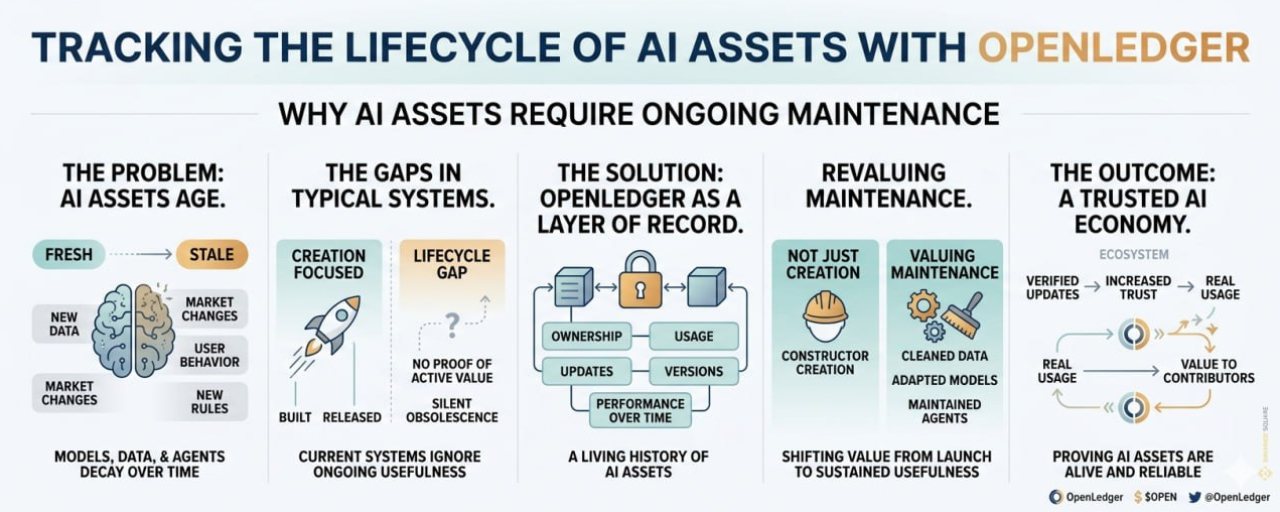
One thing people do not talk about enough is that AI does not stay fresh forever.
A model may feel impressive when it first appears. A dataset may look useful when it is collected. An agent may work well for one task, in one moment, with one set of conditions around it. But time moves. Information changes. Markets change. rules change. user behavior changes. Even language changes in small ways.
And after a while, the same AI asset may not be as useful as it once was.
That is a quiet problem.
Most conversations around AI focus on creation. Someone builds a model. Someone launches an agent. Someone collects data. The moment of release gets the attention. It feels like the important part. But the real test often comes later, when the asset has to keep working in a world that has moved on.
This is a different way to look at OpenLedger.
Not only as a place where data, models, and agents can be monetized. Not only as an AI blockchain or a system for ownership. But as a possible layer for tracking the life of AI assets over time.
Because AI assets have lives.
They are created.
They are used.
They are updated.
They become better.
Sometimes they become weaker.
Sometimes they stop being useful at all.
That may sound obvious, but most digital systems are not very good at showing that full story. A dataset can be listed as valuable, but how do we know whether it is still accurate? A model can have strong early results, but how do we know whether it still performs well after months of changes in the real world? An agent can complete a task today, but what happens when the tools it depends on are updated?
You can usually tell when an AI system has aged badly.
The answers feel a little behind. The agent follows old patterns. The model misses new terms. The data does not reflect the current situation anymore. Nothing is completely broken, but the output starts to feel less grounded. It is not wrong in a dramatic way. It is just slightly out of date.
That kind of decay is hard to notice at first.
And that is where a ledger can become useful.
OpenLedger seems to treat AI assets as things with history, not just as finished products. That history can include ownership and usage, but it can also include updates, versions, changes, and performance over time. In a world where AI tools keep shifting, that record may matter more than people expect.
A model without history is just a claim.
A dataset without history is just a file.
An agent without history is just a promise that it works.
But when these things carry a record, people can begin to ask better questions. When was this updated? Who improved it? Where has it been used? Did usage increase after a change? Did another model perform better with this dataset? Did an agent become more reliable after connecting to a certain resource?
These are not flashy questions. They are practical ones.
AI may need that kind of practical memory.
The strange thing about AI is that it can look polished on the surface while being messy underneath. A user sees a clean answer. A business sees a working tool. But behind that, there may be old data, reused models, hidden dependencies, and small updates that no one is tracking clearly.
That is fine when the use case is casual.
It becomes more serious when AI starts helping with work that needs accuracy, timing, or accountability. A stale dataset in a recommendation system is one thing. A stale dataset in finance, healthcare, logistics, or compliance is something else.
Freshness becomes part of value.
That is the angle that makes OpenLedger interesting here. It is not only asking whether an AI asset can earn. It is also asking whether an AI asset can prove that it is still alive in some useful way.
That proof does not have to be dramatic. It can come through usage, updates, contributions, and records of how the asset performs inside the network. Over time, the value of an asset may depend less on how impressive it sounded at launch and more on whether it keeps being maintained.
That feels closer to how real work happens.
Most useful systems are not built once and left alone. They are cleaned up. Adjusted. Tested. Repaired. Improved slowly. Someone notices an issue. Someone adds better data. Someone changes a rule. Someone removes something outdated. The work is often small and invisible, but it keeps the system useful.
AI will need that same kind of maintenance.
And maybe maintenance should have value too.
This is a quieter part of OpenLedger’s idea. The people who update, refine, verify, and improve AI assets may be just as important as the people who create them first. A dataset that is cleaned every month may be more valuable than a bigger one that is ignored. A model that keeps adapting to real usage may be more useful than one with a strong launch story. An agent that is carefully maintained may matter more than one that simply looks impressive in a demo.
The AI world often rewards the new.
But useful systems usually reward the maintained.
OPEN fits into this picture as part of the value flow, but it is not the whole point by itself. The deeper idea is that AI assets may need an economy around their ongoing usefulness, not just their first appearance. If contributors can be connected to the improvements they make, and if those improvements lead to real use, then value has a more natural path back to them.
Of course, this depends on whether the records are meaningful.
A system can track activity without understanding quality. It can show that something was updated without proving the update was good. It can record usage without explaining whether the result was helpful. So OpenLedger would still need strong signals, careful design, and real users who care about the difference between active assets and abandoned ones.
That is not easy.
But the problem itself feels real.
AI is moving fast, and fast-moving systems leave old parts behind. Some of those parts will still be useful. Some will need repair. Some will become quietly dangerous if people keep trusting them after they are outdated.
OpenLedger’s role may be to make that aging process more visible.
Not in a loud way. More like a record that follows the asset as it changes. A reminder that AI is not just built. It is kept alive, piece by piece, by people and systems that continue to care for it.