
I keep noticing how differently people talk about AI infrastructure now compared to even a year ago. The language has become more ambitious, but also strangely more abstract. Everyone talks about coordination, ownership, agents, decentralized intelligence, data economies. Entire systems are being described almost like inevitabilities before they have fully proven they can sustain themselves under real pressure.
And somewhere inside all of that, OpenLedger keeps lingering in my mind in a way I did not entirely expect.
Not because it feels complete. Actually, maybe the opposite.
A lot of projects in this space try to present themselves with a kind of polished certainty. They already speak as if the future has been decided and they simply arrived earlier than everyone else. OpenLedger does not fully give me that impression. It feels more experimental than declarative. More like a system still negotiating with its own assumptions in public.
I think I trust that slightly more.
The idea itself sounds rational enough on the surface. An AI blockchain designed to unlock liquidity around data, models, and agents. A structure where contribution can theoretically become monetizable instead of disappearing upward into centralized platforms that absorb most of the long-term value.
There is an obvious appeal there.
AI already feels like an economy forming faster than people are emotionally prepared to process. Data becomes leverage. Models become infrastructure. Agents begin acting with increasing autonomy across systems most people barely understand underneath. Once intelligence itself becomes economically productive, it makes sense that networks emerge trying to organize ownership around it differently.
But I also think these systems become psychologically complicated very quickly once incentives mature.
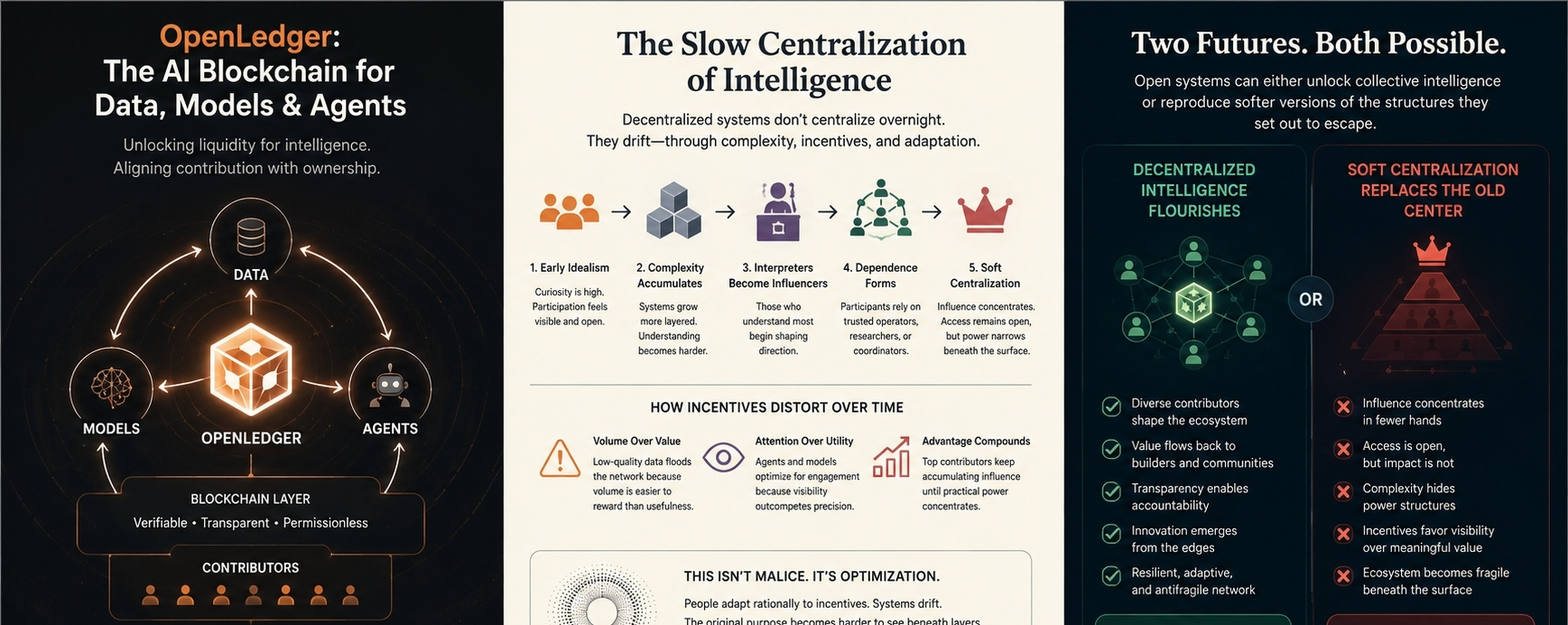
Early stages are deceptive. Most networks feel idealistic at the beginning because participation itself still carries emotional energy. Builders are curious. Contributors feel visible. Coordination feels collaborative because scale has not yet forced hierarchy to expose itself fully.
That usually changes slowly.
Not through collapse. Not through some dramatic betrayal of principles. Mostly through accumulation.
The people who understand the system best gradually become interpreters of the system itself. Then interpretation quietly becomes influence. Over time, everyone else stops examining the structure deeply because complexity becomes exhausting to keep up with continuously.
I think decentralized systems underestimate this pattern sometimes.
Technical openness does not automatically prevent social concentration. In fact, complexity can unintentionally accelerate it. The more layered a network becomes, the more dependent participants become on trusted operators, researchers, dominant contributors, or economic coordinators who can simplify the system for everyone else.
And AI infrastructure may intensify that dynamic because usefulness is harder to measure honestly than people admit.
Financial systems settle visibly. Intelligence systems often settle perceptually.
That difference matters.
A model can appear valuable because enough people collectively agree that it is valuable. An agent can appear important because visibility compounds faster than actual utility. Reputation starts interacting with economics in ways that become difficult to separate cleanly over time.
I keep wondering what happens when ecosystems like this become large enough that optimization itself begins distorting contribution.
Maybe low-quality data floods the network because volume becomes easier to reward than usefulness. Maybe agents evolve toward engagement instead of capability because attention produces stronger incentives than precision. Maybe the strongest contributors keep compounding advantages until participation technically remains open while practical influence narrows underneath.
None of this even requires bad actors.
That is probably the part I keep returning to internally.
Systems rarely drift because everyone suddenly becomes corrupt. More often, people simply adapt rationally to the incentives surrounding them until the original purpose becomes harder to recognize beneath the optimization layers built around it.
And still, I do not entirely distrust what OpenLedger is attempting either.
Because the opposite model already feels concentrated in ways that are difficult to ignore. A small number of companies increasingly sit near the center of intelligence production, distribution, compute, and coordination. That concentration may become efficient in the short term while creating different vulnerabilities underneath over longer periods of time.
So projects like this emerge almost naturally as counterweights.
Not necessarily because decentralization guarantees fairness. But because concentration eventually creates its own forms of fragility too.
I suspect the real challenge is not choosing between openness and coordination. It is figuring out whether systems can sustain both at once once real economic gravity arrives.
And honestly, I still cannot tell.
Maybe networks like OpenLedger eventually become meaningful infrastructure precisely because they attempt to distribute intelligence production differently before the ecosystem fully hardens around centralized control.
Or maybe they slowly reproduce softer versions of the same power structures they originally wanted to escape, only hidden beneath more complex coordination layers.
What keeps holding my attention is that both outcomes still feel plausible at the same time.
And I am not sure anyone building these systems fully knows yet which direction the incentives eventually pull hardest.