
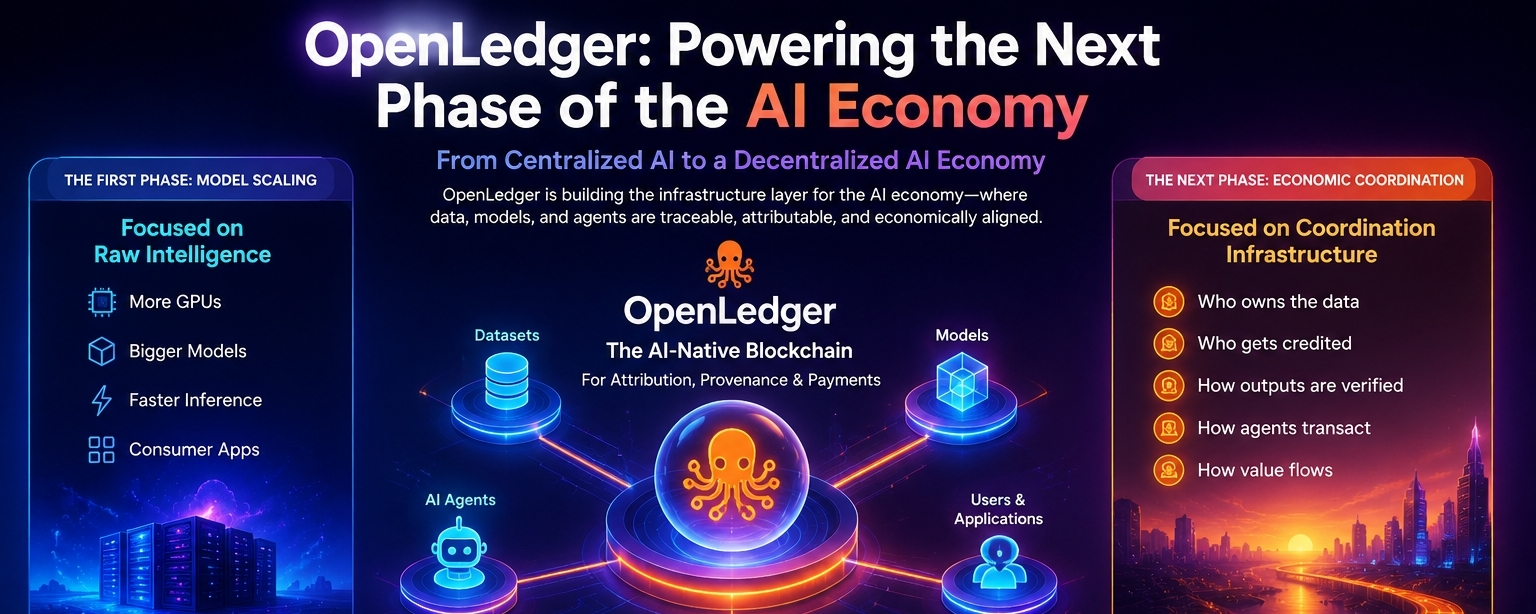
The more I study the AI sector, the more I believe the market is focused on the wrong narrative.
Everyone talks about larger models, faster inference, and endless AI demos. But I don’t think the next phase of AI will be defined by any of that.
The real battle will be about ownership, attribution, and coordination.
That’s one reason I’ve been watching OpenLedger closely.
Most AI projects today are built around attention: tokens, chatbots, influencer marketing, partnership announcements.
Meanwhile, the deeper infrastructure problems remain unresolved:
• Who owns the data? • Who captures the value AI creates? • How are contributors rewarded fairly? • How do autonomous AI agents coordinate outside centralized Web2 systems?
These are difficult problems — and they may become some of the most important ones in the entire AI economy.
Crypto has already shown us this pattern before.
People ignored DeFi infrastructure until liquidity became critical. They ignored Layer 2s until scaling broke user experience. They overlooked modular ecosystems until interoperability became necessary.
AI feels like it’s entering the same stage now.
Everyone wants “AI exposure,” but very few are thinking about how AI economies will actually function at scale.
Because real AI economies are messy: fragmented datasets, unclear permissions, opaque monetization, weak attribution systems, and poor transparency.
As AI agents begin interacting autonomously — exchanging data, models, compute, and services — coordination becomes essential.
You cannot build efficient economic systems on unclear accounting.
Builders need predictable costs. Contributors need attribution. Enterprises need auditability. Regulators need traceability.
This is where infrastructure matters.
And this is why OpenLedger interests me.
Not because it’s the loudest AI project. But because it’s trying to solve a foundational infrastructure problem: how to coordinate and attribute value creation in AI economies.
That’s incredibly difficult.
Execution will matter more than vision.
But if scalable attribution and coordination layers become necessary for autonomous AI ecosystems, projects solving these invisible infrastructure problems could become extremely important over time.
Historically, the biggest long-term opportunities often emerge from the infrastructure nobody pays attention to early enough.