
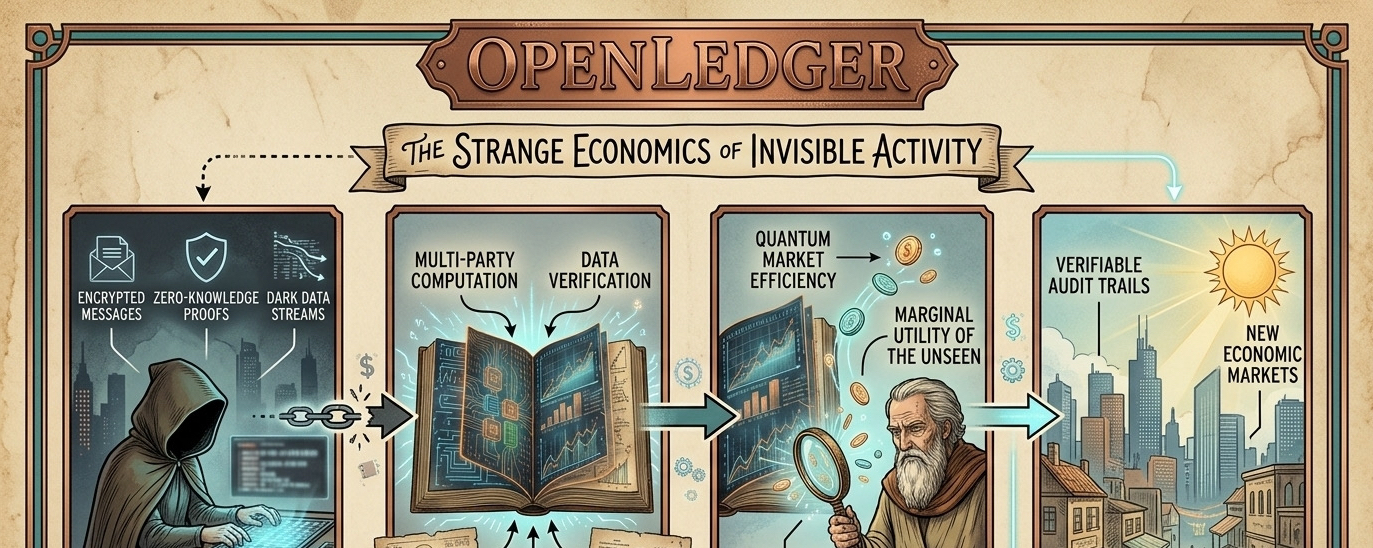
I keep watching @OpenLedger not because it demands attention, but because it doesn’t.
It arrives in a way that feels almost quiet compared to the usual noise of crypto narratives — no explosive certainty, no aggressive promises, just a steady language built around data, models, agents, and liquidity, as if value itself is slowly being broken into smaller invisible pieces and reassembled somewhere we can’t fully see.
And I’ve seen this pattern before.
Different cycles. Same emotional structure.
Infrastructure. Interoperability. Gaming economies. Social tokens. Modular chains. Each era believed it was describing something new, but what really changed was the vocabulary, not the behavior underneath it.
People still search for permanence inside systems designed for motion.
Attention becomes capital. Capital becomes weather. Everything shifts, but the belief in stability never disappears.
OpenLedger feels like it exists inside that same gravity field, but slightly misaligned — not louder, not more aggressive, just more clinical in how it frames the future: data as an asset, models as participants, agents as economic actors.
It doesn’t feel like a product pitch.
It feels like an acknowledgment of something already happening quietly across the internet.
Because long before blockchain, we already fragmented ourselves online — every click, every search, every conversation leaving behind residue that someone, somewhere, learned to value.
AI didn’t create that system.
It only made it visible.
And OpenLedger seems to be building directly on top of that realization.
But recognition has never been the same as stability.
I keep thinking about how every system that promises “ownership” eventually begins to rely on participation. Slowly, almost invisibly, users shift from being participants to becoming contributors, then workers, then infrastructure — without ever noticing the transition happening in real time.
That’s the pattern I can’t unsee in this space.
Even in AI + blockchain narratives, the language of autonomy sounds powerful… but also slightly detached.
Agents interacting with agents. Systems negotiating with systems. Humans reduced to supervision layers at the edge of optimization loops.
Efficient. Scalable. But emotionally distant.
And maybe that’s the real question behind all of this — not whether it works technically, but what kind of internet it produces socially.
Because every system eventually becomes a culture before it becomes a product.
And cultures leave traces.
What makes @OpenLedger interesting is not certainty, but timing. The market is tired of empty abstraction now. People want systems tied to real usage, real computation, real data flow — not just narratives floating above activity.
But even then, skepticism has matured.
No one believes whitepapers the way they used to. No one trusts funding rounds as proof of life anymore. Even partnerships feel temporary, almost performative.
The only real test left is time.
Whether anyone still uses it when incentives fade.
And that’s where most systems disappear — not technically, but emotionally.
Abandonment happens quietly in crypto. Communities leave before infrastructure dies. Attention exits before systems fail. What remains is often just an empty shell still running, still functional, but no longer lived in.
OpenLedger hasn’t reached that phase yet.
Right now it still lives inside interpretation — where imagination fills the gaps faster than evidence can catch up. Some see machine economies forming. Others see another narrative cycle preparing for the next wave of speculation.
Both readings might be partially true.
Or neither.
So I stay in the same position I usually end up in with these kinds of systems:
Not convinced. Not dismissive. Just observant.
Watching the language more than the price.
Watching behavior more than announcements.
Watching whether participation deepens — or just becomes louder for a while before fading again.
Because eventually every system stops explaining itself.
And when that happens, only usage remains.