When I look at the conversation around OpenLedger and traditional blockchains, I honestly feel like a lot of people are still viewing AI through an outdated lens. Most discussions treat AI like it’s just another application that can simply sit on top of existing blockchain systems without changing the foundation underneath. But the more I’ve watched AI evolve, the more obvious it becomes that this isn’t just another app. AI is starting to behave like an entirely new digital layer of the internet, and that changes the kind of infrastructure it needs.
That’s why I genuinely believe AI will eventually need its own chain.
Not because it sounds trendy. Not because every industry suddenly wants to attach itself to blockchain. And definitely not because people enjoy creating new narratives every few months. I think AI needs its own infrastructure because the problems AI creates are fundamentally different from the problems traditional blockchains were originally designed to solve.
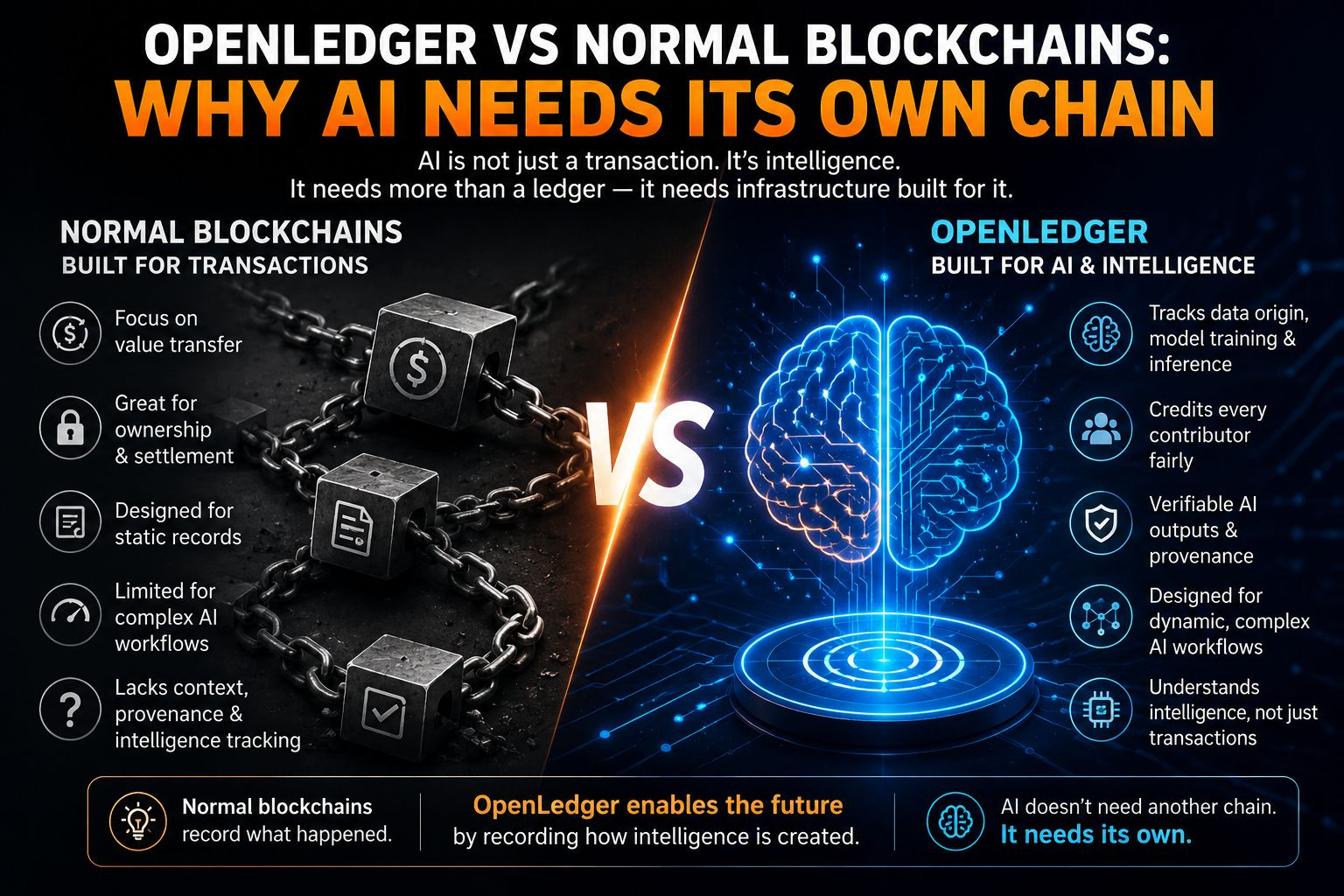
Most blockchains today were built around trust in transactions. Their job is to answer questions like: Who owns this asset? Did this transfer happen? Can this record be changed? That system works incredibly well for digital ownership, payments, and decentralized finance. But AI introduces a completely different kind of challenge.
AI isn’t just moving value around.
It’s generating outputs.
It’s learning from data.
It’s making decisions.
It’s interacting with tools.
And increasingly, it’s starting to act on behalf of humans.
The moment AI starts doing that, the entire trust model changes.
Now the important questions become much deeper. Where did this model learn from? Who contributed to it? Which version created this result? Can the output be verified later? Was the model manipulated? Was the data reliable? Can someone trace how a certain decision was made?
Traditional blockchains were never really built for those kinds of questions. They can store records, sure, but storing records and understanding intelligence are two very different things.
And honestly, I think that’s where the gap starts to appear.
The more powerful AI becomes, the less people are willing to accept “just trust the model” as an answer. People want transparency. They want accountability. They want to know where outputs came from and whether those outputs can actually be trusted. That’s not paranoia anymore. It’s becoming a basic expectation.
From what I’ve seen, this is exactly why projects like OpenLedger feel different. They aren’t just trying to build another blockchain. They seem to recognize that AI itself creates a new category of infrastructure problems.
AI systems are messy under the hood. A single output can involve training datasets, fine-tuning layers, prompts, external tools, human feedback, inference systems, and updates that happened over months or even years. Every layer affects the final result. And if those layers can’t be traced properly, trust starts breaking apart very quickly.
That’s why provenance matters so much.
Honestly, I think provenance might become one of the most important concepts in the entire AI industry. In the future, knowing where intelligence came from could become just as valuable as the intelligence itself.
Think about it this way. Imagine thousands of contributors helping improve AI systems over time. Some people contribute specialized datasets. Others improve evaluation systems. Some fine-tune models for healthcare. Others build agent workflows or verify outputs. All of those contributions create value. But current systems are terrible at recognizing that value fairly.
Traditional blockchains were designed around ownership. AI ecosystems are built around contribution. That’s a massive difference.
And I think this is where many people underestimate the problem. AI isn’t going to be powered by one company forever. The future probably looks far more distributed than people realize. Open-source models are growing rapidly. Independent developers are building niche AI tools. Smaller communities are creating valuable datasets and domain expertise that large companies don’t always have.
That means AI is slowly becoming an ecosystem rather than a product.
And ecosystems need infrastructure that understands collaboration, attribution, and accountability at a much deeper level.
That’s why the idea of an AI-native chain makes sense to me.
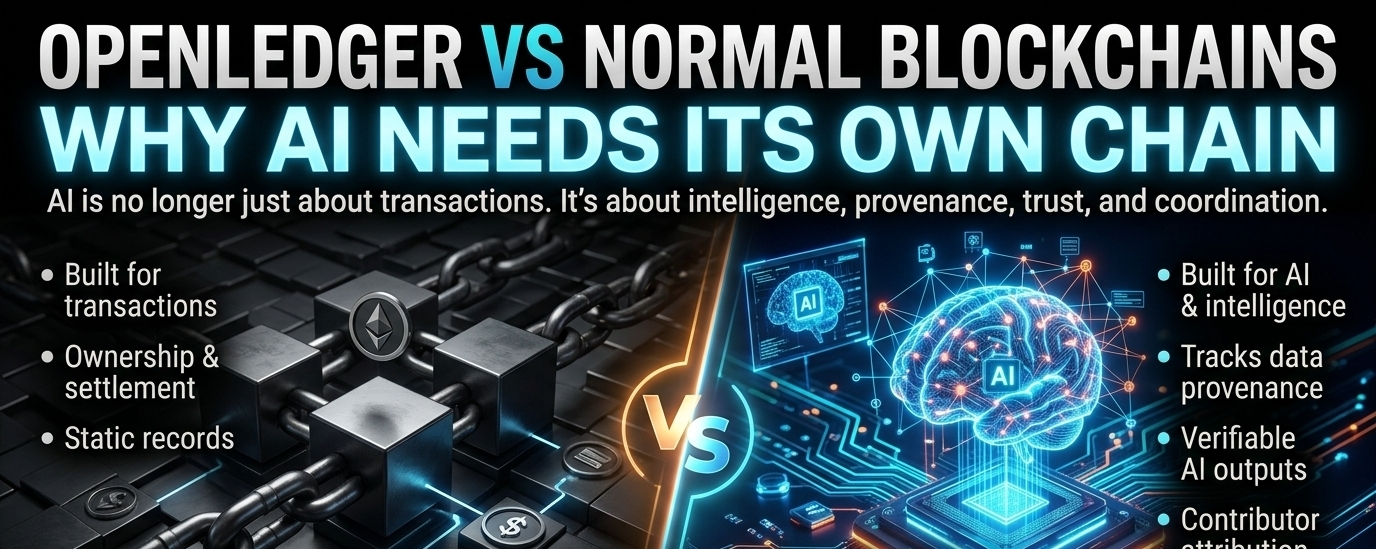
Not because normal blockchains are bad, but because they were optimized for different priorities. Most traditional chains care about transactions, settlement, and consensus. AI systems care about provenance, verification, inference tracking, coordination, and contribution layers. Those are very different workloads.
Honestly, it reminds me of how technology always evolves through specialization. We don’t expect one tool to handle every task perfectly. Databases are optimized differently from search engines. GPUs are designed differently from CPUs. Streaming systems are built differently from storage systems.
So why do we suddenly expect one blockchain architecture to perfectly handle finance, gaming, supply chains, identity, and AI all at the same time?
That expectation honestly feels unrealistic to me.
AI workloads are heavy, dynamic, and constantly changing. They involve huge amounts of metadata, coordination between systems, and real-time interactions between models and agents. Trying to force all of that into infrastructure originally designed for token transfers eventually starts feeling awkward.
And I think people can already sense that.
A lot of current blockchain-based AI systems feel more like workarounds than natural designs. Important activity happens off-chain. Verification becomes fragmented. Attribution gets messy. And eventually the chain starts acting more like a receipt system instead of a true intelligence layer.
That’s why I think specialized AI infrastructure will become increasingly necessary.
Another thing I keep coming back to is auditability. Right now AI still feels exciting and experimental, but eventually these systems are going to handle far more serious responsibilities. They’ll operate business workflows, generate code, assist medical systems, automate research, manage customer operations, and coordinate software agents.
Once AI reaches that level, people won’t just ask what the system produced. They’ll ask how it produced it.
Which model version generated this output?
What data influenced the result?
Were the sources verified?
Can the process be reproduced later?
Was the AI operating within proper constraints?
Those questions matter because AI outputs are no longer just entertainment. They’re becoming part of real-world decision-making. And once decisions are involved, accountability becomes unavoidable.
That’s where traditional blockchain systems start feeling incomplete. They can prove that data exists, but they don’t naturally explain the behavior behind intelligence systems. AI needs infrastructure that can preserve context, traceability, and lineage in a much richer way.
And honestly, I think that’s the real opportunity behind OpenLedger-style systems.
They’re trying to create a trust layer not just for transactions, but for intelligence itself.
That’s a completely different challenge.
I also think incentives are a bigger issue than most people realize. AI ecosystems depend on many contributors, but current systems reward contribution very unevenly. Data providers often don’t get proper recognition. Human feedback is undervalued. Smaller developers struggle to capture value compared to giant platforms.
An AI-native chain could potentially improve that by building contribution directly into the infrastructure itself.
Not perfectly, obviously. No system solves human incentives overnight. But at least the architecture could acknowledge that intelligence is collaborative by nature.
And honestly, I think that’s an important shift.
Because underneath all the technical language, this debate is really about what kind of future AI grows into.
Do we want AI systems controlled entirely by a handful of centralized entities?
Or do we want intelligence ecosystems that are more transparent, traceable, and open to participation?
That’s not just a technical question anymore. It’s an infrastructure question.
From my perspective, OpenLedger feels important because it recognizes that AI creates a new category of digital trust problems. Traditional blockchains gave us programmable trust for assets and transactions. AI-native chains may eventually give us programmable trust for intelligence itself.
And personally, I think that distinction matters a lot more than people currently realize.
The internet is changing. We’re moving from a world built around information to a world increasingly built around machine-generated intelligence. That shift affects everything underneath it — economics, accountability, incentives, ownership, collaboration, and trust.
And when the foundation changes that much, infrastructure eventually has to evolve too.
That’s why I don’t see AI needing its own chain as some exaggerated futuristic idea anymore. To me, it feels like the natural next step. AI systems are becoming too important, too autonomous, and too deeply integrated into digital life to rely entirely on infrastructure designed before machine intelligence became central to the internet.
OpenLedger may or may not become the final answer. The technology will probably evolve many times from here. But the core idea behind it feels increasingly difficult to ignore: intelligence itself needs a native trust layer.
And honestly, the more I watch AI develop, the harder it becomes to believe that ordinary blockchains alone will be enough for what’s coming next.