Look, I’ll be honest.
Everywhere I look, people keep having the same AI conversation.
Bigger models.
More compute.
Faster responses.
Larger datasets.
Then somebody throws benchmark numbers into a thread and everyone starts acting like we just witnessed the future arrive early.
I've seen this before.
Tech cycles do this constantly.
People get obsessed with whatever they can actually see. The flashy part. The part with screenshots and headlines and dramatic announcements.
Right now, that's AI models.
Not the ugly stuff underneath.
Definitely not infrastructure.
And here's the thing people don't talk about enough: reality usually looks way messier than whatever story markets decide to tell themselves.
Because if you actually sit down with developers for ten minutes not influencers, not people posting "AI changes everything" threads every six hours you'll hear a completely different conversation.
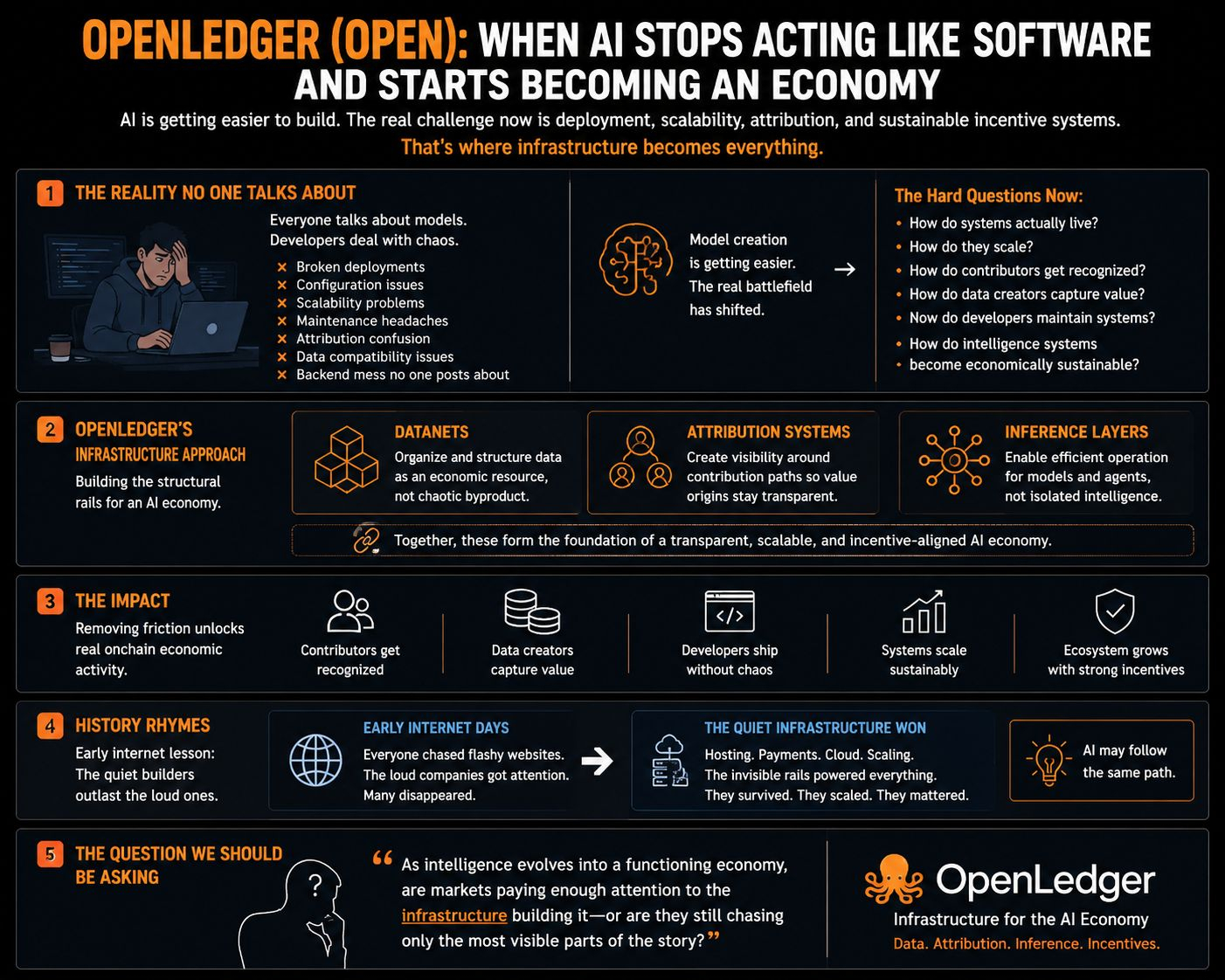
Broken deployments.
Configurations deciding to die for no reason.
Compatibility issues.
Scaling problems.
Maintenance headaches.
Data problems.
Attribution confusion.
Random backend chaos that somehow appears at the worst possible time.
None of that sounds exciting.
Nobody wakes up and says, "Wow, I can't wait to deal with infrastructure today."
Nobody.
But that's where things get interesting.
Because I think people are staring at the wrong bottleneck.
For a while, building models felt like the hard part.
Not anymore.
Training methods keep improving.
Open-source communities keep growing.
Access keeps getting easier.
People can build models now.
People can fine-tune them.
People can create AI agents.
That part keeps getting easier.
The harder question today feels completely different.
How do these things actually survive?
Seriously.
How do they scale without turning into operational disasters?
How do contributors get recognized?
How do people providing datasets capture value?
How do developers keep systems alive without spending half their life putting out fires?
And maybe the biggest question of all...
How do intelligence systems become sustainable businesses and ecosystems instead of just impressive demos?
Because let's be real.
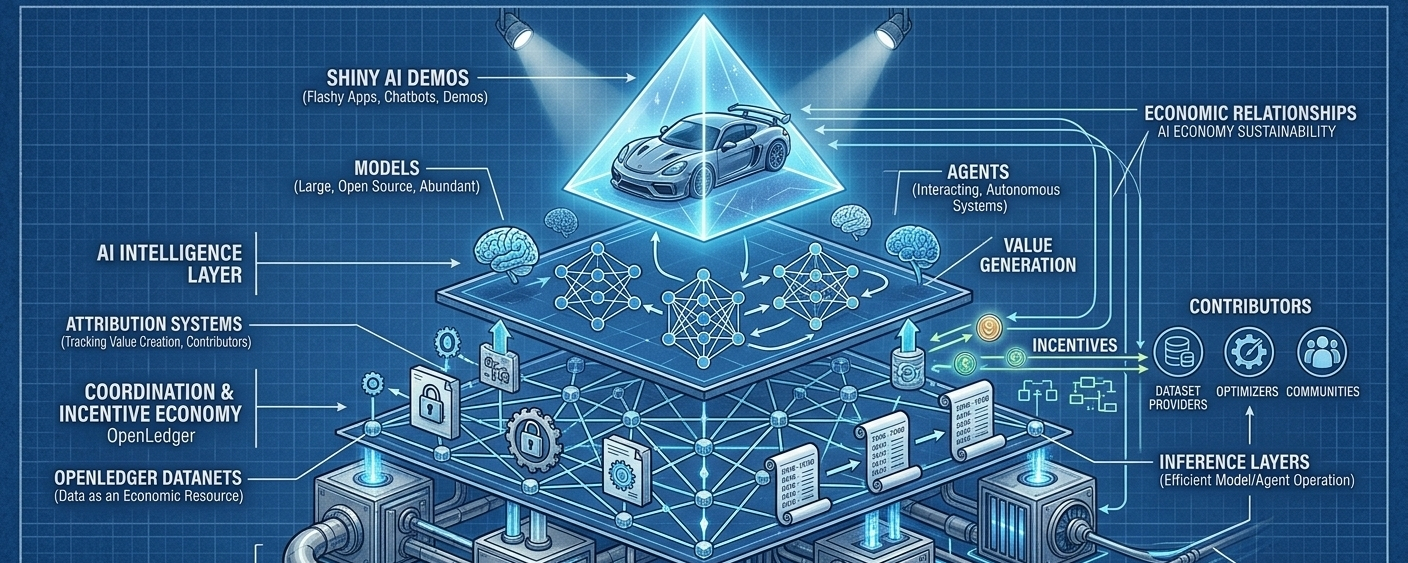
A lot of AI right now still feels like showing off a sports car engine sitting on a table.
Cool engine.
Now where's the rest of the car?
That's where infrastructure starts mattering.
And that's where OpenLedger caught my attention.
Not because of giant promises.
Not because somebody yelled that it's changing the world tomorrow morning.
Actually the opposite.
The interesting stuff feels quieter.
Most people scroll right past infrastructure updates because they look boring.
Cloud updates?
People scroll.
Attribution systems?
People scroll.
Inference architecture changes?
Scroll.
Scroll.
Scroll.
Meanwhile, those same people will stop for ten minutes if somebody posts "AI + crypto + next big thing."
I've watched this happen over and over.
But under all the noise, there's a problem sitting there that nobody has really solved cleanly.
Value creation feels messy.
People contribute datasets.
Developers optimize models.
Communities improve systems through feedback.
AI agents interact with users and generate information.
Everybody adds something.
Everybody pushes the machine forward.
Then suddenly you run into a very annoying question:
Who actually created value here?
Because the answer starts getting blurry fast.
And blurry incentives create messy systems.
Messy systems usually don't survive.
People stop participating.
Motivation drops.
Growth slows down.
I've watched enough technology cycles to know that incentives eventually matter more than excitement.
They always do.
OpenLedger seems to approach this from the infrastructure side instead of treating it like a marketing exercise.
Its Datanets framework tries to organize data as an economic resource instead of letting information float around as scattered noise.
Its attribution systems aim to create visibility around contribution paths so people can actually understand where value comes from.
Its inference layers focus on creating environments where models and agents can operate efficiently instead of existing like isolated islands.
Individually, those sound technical.
Maybe even a little boring.
But put them together and something bigger starts showing up.
AI stops looking like software.
It starts looking like an economy.
And those aren't the same thing at all.
Software does things.
Economies coordinate people.
Software processes requests.
Economies distribute incentives.
Software answers questions.
Economies create relationships.
Big difference.
People miss that difference all the time.
And honestly, history keeps trying to warn us.
Think back to the early internet days.
Everyone chased the visible companies.
Everyone chased the exciting websites.
Everyone chased attention.
Everybody wanted the flashy names.
Then something funny happened.
A lot of the loud companies disappeared.
The quieter infrastructure players stuck around.
Hosting mattered.
Payment systems mattered.
Cloud services mattered.
Scaling mattered.
Turns out all the exciting stuff needed invisible systems underneath it just to function.
Nobody celebrates plumbing while buildings go up.
People suddenly care when the plumbing stops working.
Funny how that works.
AI could end up following the same path.
Because intelligence itself might eventually become abundant.
Models might become abundant.
Agents might become abundant.
And when something becomes abundant?
Value usually moves somewhere else.
I've seen that movie before too.
Sometimes value moves toward coordination.
Sometimes it moves toward infrastructure.
Sometimes it moves toward whoever removes friction for everybody else.
Which creates a really interesting question.
Maybe future winners won't just be the loudest AI applications.
Maybe they won't be the projects posting the biggest promises every week.
Maybe some of the important pieces sit underneath everything, quietly building rails before anyone notices the traffic coming.
Because traffic eventually shows up.
It always does.
And when it does, everyone suddenly starts asking where the roads came from.
So maybe the real question isn't whether AI gets bigger.
That feels obvious at this point.
The more interesting question is this:
Are people paying enough attention to the infrastructure underneath AI economies... or are they still staring at the shiny stuff on top?