
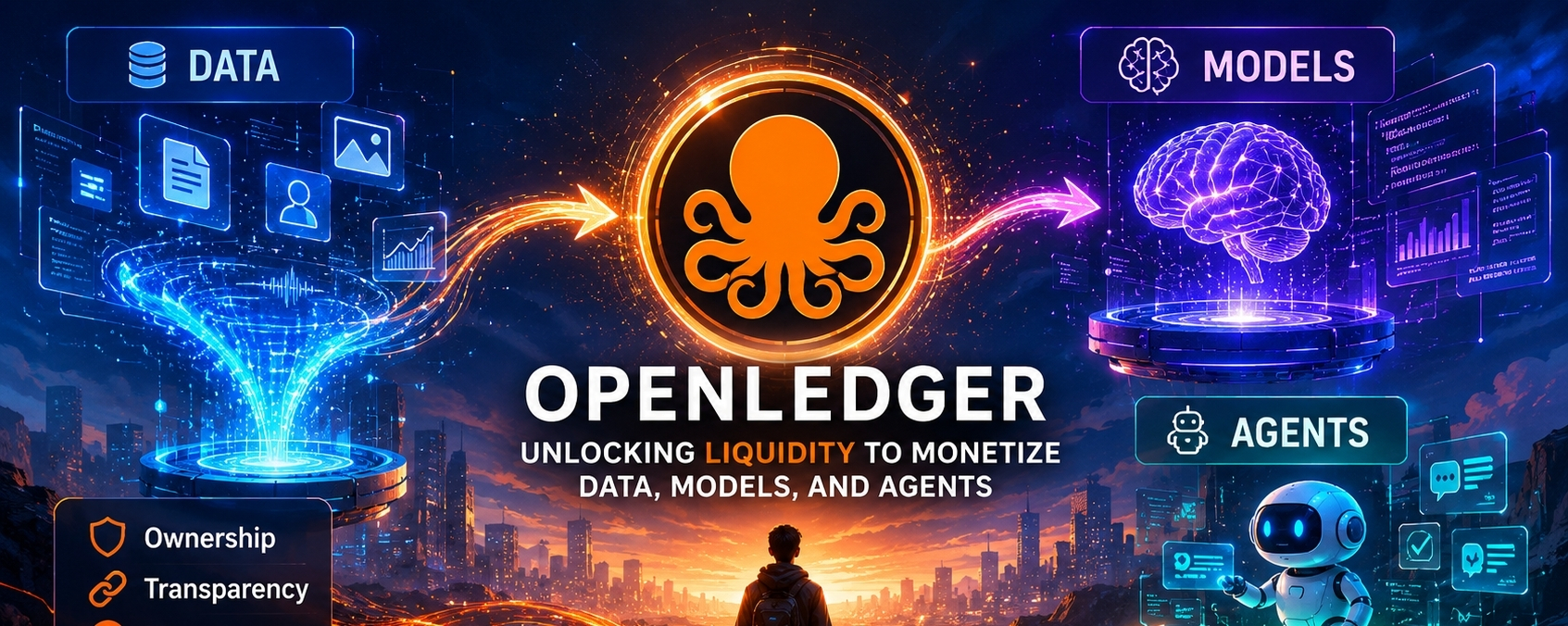
.Most big ideas in AI and crypto start to sound the same after a while. New chain, new protocol, new marketplacedifferent names, similar promises. So it takes a bit of patience to notice when something is actually trying to answer a real problem instead of just adding more noise.
OpenLedger (OPEN) is one of those ideas that sits quietly in the middle of a messy question: what happens when the things that create intelligencedata, models, and AI agents—start to matter economically, but nobody really knows how to fairly account for them?
Right now, most AI systems feel clean on the surface, but they are built on something very unclean underneath. A model might look like a single product, but it’s actually the result of thousands of invisible inputs. Articles, images, code, conversations, user behaviorlayer after layer of human activity gets absorbed into training. Once the model is built, all of that disappears into the background.
And that’s usually where the story ends.
What OpenLedger is trying to do is reopen that background a little. Not to make it complicated for the sake of it, but to make it less forgotten. The idea is simple in principle: if data helps build intelligence, and that intelligence creates value later, then there should be a way to see the connection and, in some form, let value flow back through it.
The word they use for this is liquidity, but it doesn’t feel like the usual financial meaning. It’s more about movement than trading. Can data be reused across systems without losing its origin? Can models be deployed in different places while still carrying a sense of where they came from? Can AI agents work across environments without becoming completely disconnected from the inputs that shaped them?
These are not flashy questions, but they are important ones.
There’s also something changing in how we think about AI agents themselves. They’re no longer just tools that respond to prompts. In many systems, they’re starting to behave more like ongoing processesthings that can take actions over time, connect steps together, and do work without being watched at every moment.
Once you reach that point, it becomes harder to say where value is actually created. Is it the developer who built the agent? The dataset that trained it? The model it runs on? Or the agent’s own execution over time?
OpenLedger doesn’t try to answer that with a single rule. Instead, it tries to record the relationships so the system itself remembers what contributed to what. Not perfectly, and not without tradeoffs, but at least in a way that doesn’t erase everything into one final output.
Of course, this isn’t simple in practice. Any system that tries to track too much tends to slow down. And in real-world AI usage, speed and simplicity usually win. People want tools that work immediately, not systems that require too much explanation before they’re useful.
That’s the tension sitting underneath all of this. On one side, there’s a growing need for better attributionbecause AI is clearly built on shared human input. On the other side, there’s the reality that most systems only survive if they stay lightweight enough to actually use.
OpenLedger is essentially trying to live in that gap.
Whether it succeeds or not is still uncertain. A lot of ideas in this space look reasonable in theory but become harder when they meet real usage, real users, and real constraints. But the direction it points to is still worth paying attention to, because it reflects something that’s already happening.
AI is no longer built from one place, by one team, with one dataset. It’s a mix of contributions that stretch across time, platforms, and people who may never see the final system they helped shape.
And once you notice that, it becomes hard to go back to thinking of AI as something singular.