
Everybody keeps screaming about AI like we already made it. Like the future is here. Meanwhile half these products barely work properly, most “AI projects” are just wrappers around someone else’s API, and every crypto guy suddenly acts like they’re building Skynet because they added the word “agent” to their website.
It’s exhausting.
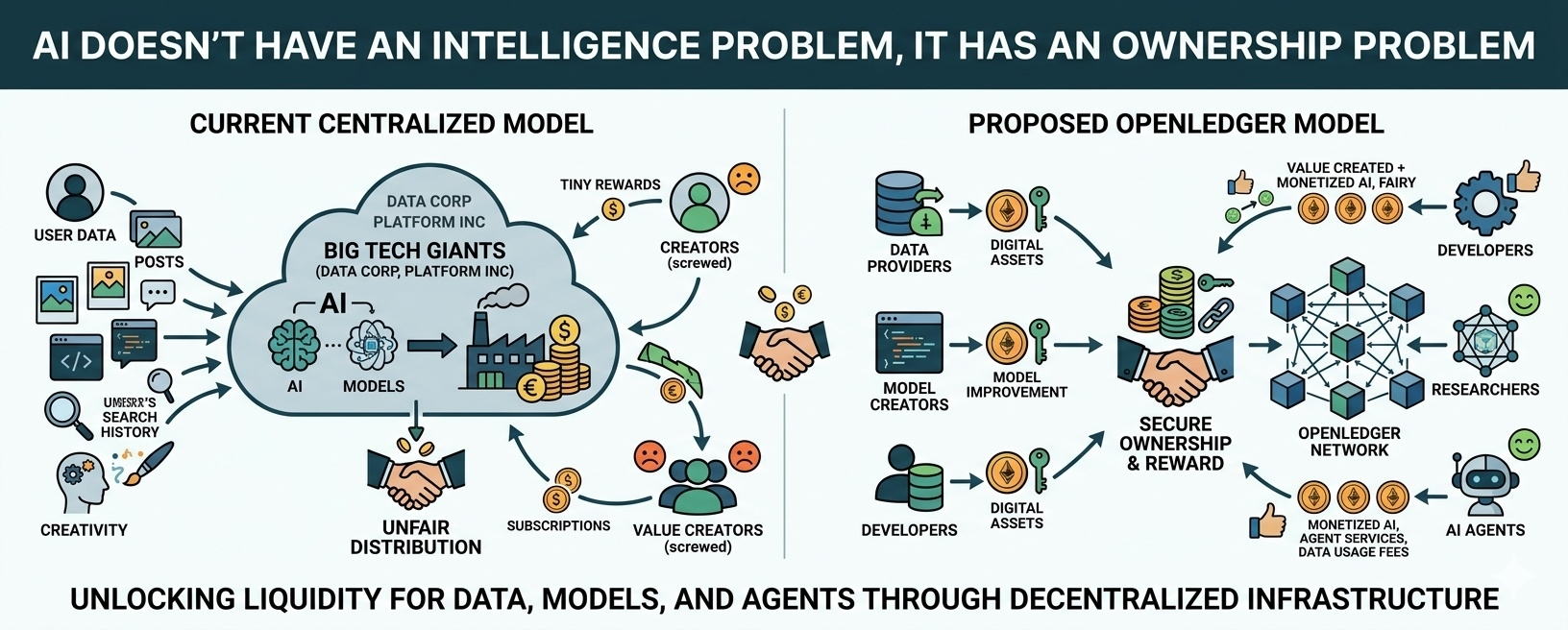
And the worst part is the whole system already feels rigged. Big companies scrape data from everyone. Posts. Comments. Photos. Search history. User behavior. Literally everything. Then they train models on it, make billions, and the people creating the actual value get nothing back. Not even a thank you. We’re basically feeding machines for free while corporations print money off the output.
That’s why I started paying attention to OpenLedger in the first place. Not because I think every AI coin is going to the moon. Most of them are garbage. Let’s be real. But at least OpenLedger is trying to solve an actual problem instead of launching another useless token with anime graphics and fake roadmap promises.
The problem is simple.
AI runs on data. Data has value. The people providing the data usually get screwed.
That’s it.
Everybody talks about the models. Nobody talks enough about where the fuel comes from. AI doesn’t magically appear out of nowhere. Somebody trains it. Somebody feeds it information. Somebody creates the content. Somebody writes the code. Somebody builds the datasets. But once the machine starts making money, suddenly all the value gets sucked upward into giant centralized platforms.
Same old internet story again.
Only difference now is the machines are smarter.
And honestly, this whole “AI revolution” starts looking less exciting when you realize how centralized it already is. A few companies own the compute. A few companies own the distribution. A few companies own the models. Smaller developers are stuck renting access from the same giants they’re supposedly competing against. It’s like trying to open a small food stall inside somebody else’s shopping mall while they control the electricity, the customers, the rent, and the exits.
Good luck with that.
That’s where OpenLedger actually makes sense to me. The idea is basically trying to turn data, AI models, and agents into things people can actually own and monetize instead of just handing everything over to centralized systems forever.
And yeah, I know. Crypto people say stuff like this every cycle. “Decentralized future.” “Ownership economy.” “Next generation infrastructure.” Most of the time it’s just marketing garbage wrapped around speculation.
But this AI situation is different because the ownership problem is real.
Right now people are unknowingly training systems that may eventually replace parts of their own jobs. Think about how insane that actually is. Artists train image models. Writers train text models. Programmers train coding models. Everybody contributes without even realizing it, then companies turn around and charge subscriptions for tools built on top of public human behavior.
That model feels broken.
And before somebody says “well users agreed to terms and conditions,” yeah sure, technically. Nobody reads that stuff. Companies know it. Everybody knows it. The internet became one giant trade where people gave away data for convenience because there wasn’t really another option.
Now AI is scaling that system into overdrive.
The thing I keep coming back to is this: if data is valuable, why are the people creating it treated like free raw material?
That’s the question projects like OpenLedger are trying to answer. Or at least trying to move toward. The idea is creating a system where data contributors, developers, and model creators can actually capture value instead of everything getting swallowed by centralized platforms.
And honestly, if AI keeps growing the way people think it will, this becomes a huge issue later.
Because we’re heading toward a world full of AI agents doing work automatically. People joke about it now, but it’s already starting. Agents can research things, write things, automate tasks, trade, analyze data, interact with APIs. Give it a few more years and these systems are going to be everywhere.
Now imagine all those agents needing data. Needing models. Needing compute. Needing payment systems.
That creates an entirely new economy around machine activity.
And the question becomes: who owns that economy?
Because if the answer is “five giant tech companies own everything,” then congratulations, we just rebuilt the internet again except this time the machines are doing more of the labor while regular people become even more dependent on centralized systems.
That’s why blockchain keeps getting dragged back into the AI conversation no matter how much people clown on crypto. Not because every blockchain project is good. Most aren’t. But blockchains are actually useful for one thing: tracking ownership and moving value around without needing one central gatekeeper controlling every interaction.
That matters here.
Especially when multiple people contribute to the same ecosystem. Data providers. Developers. Researchers. Users. Agents. Everybody adding pieces to the machine.
Traditional systems usually solve that by centralizing everything under one corporation. Easier for them. Worse for everyone else long term.
OpenLedger seems to be betting that AI infrastructure needs a different model before the whole thing becomes permanently locked down by centralized players. And honestly? I think they might be right about that part.
Because we’ve already seen how this movie plays out.
First the internet was supposed to be open. Then a few platforms swallowed everything.
Social media was supposed to connect people. Now it farms engagement and rage for ad money.
The creator economy was supposed to help independent creators. Most creators are still broke while platforms take massive cuts.
Now AI shows up and suddenly people trust corporations again to manage the next technological shift fairly? Really?
I don’t buy it.
And look, I’m not saying OpenLedger magically fixes everything. Maybe it fails. Maybe the tech doesn’t scale properly. Maybe users don’t care enough about decentralization. Most people choose convenience every time anyway. That’s just reality.
But at least the project is looking at the actual problem instead of pretending the future is just infinite AI hype and cartoon profile pictures posting “AGI soon” every five minutes.
The current system already feels unhealthy.
Everything is becoming subscription-based. Everything is becoming centralized. Everything is becoming dependent on APIs controlled by a handful of companies.
Even open-source developers are struggling because giant corporations can absorb community work, monetize it at scale, then outcompete the same communities that helped build the ecosystem in the first place.
People are starting to notice that.
And honestly, that’s why this whole “unlocking liquidity for data, models, and agents” thing matters. Not because it sounds cool on a pitch deck. Because AI is becoming an economy. A real one. Data is money now. Intelligence is money now. Automation is money now.
The people feeding those systems should probably matter too.
Otherwise we’re heading toward a future where regular users create all the value while giant platforms own all the infrastructure. Again. Same cycle. Different technology.
And maybe that’s the most frustrating part of this entire AI boom.
The technology itself is actually incredible.
But the ownership structure around it already looks broken.
