
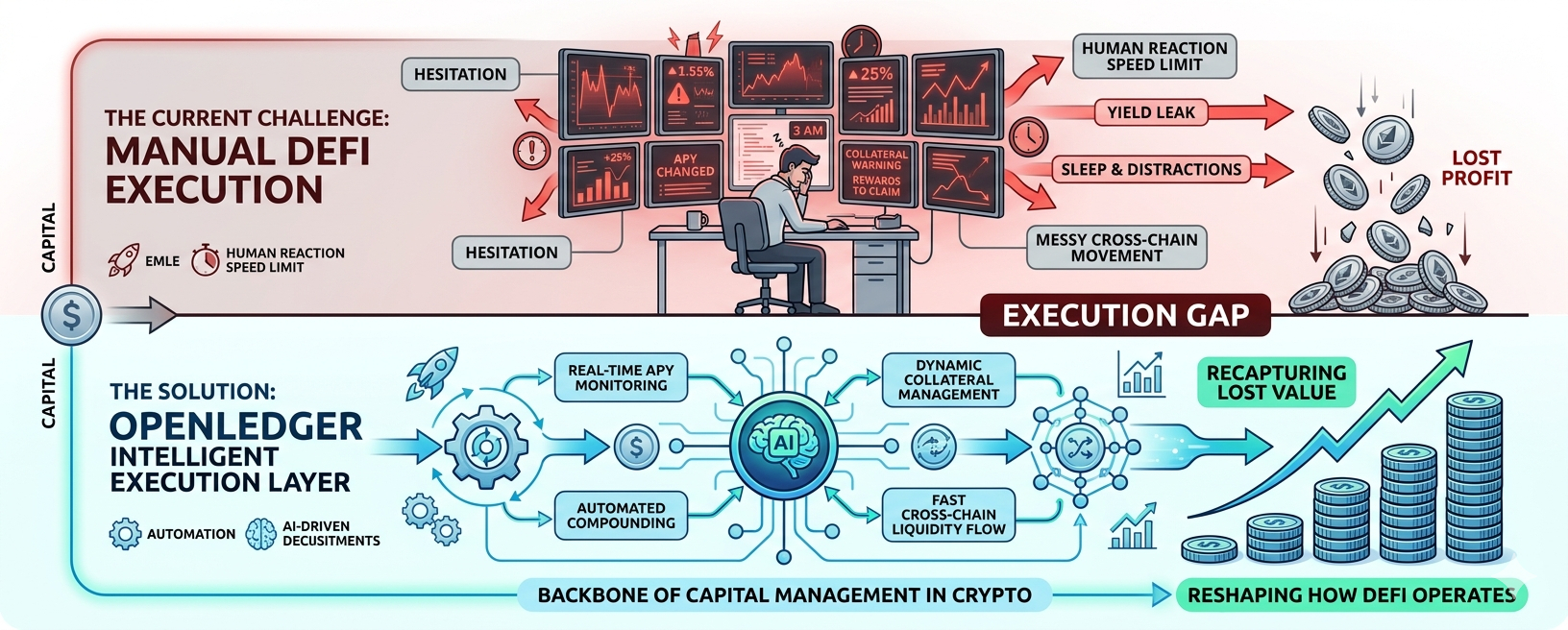
Whenever I explore OpenLedger, one thing becomes very clear in my mind — the real problem in DeFi is no longer lack of information. Today almost everyone knows where the best yields are, which protocols are trending, and where opportunities exist. But despite all this knowledge, people still miss profits. Why? Because DeFi moves faster than humans can react. Markets change every second while humans sleep, hesitate, or simply get busy. That silent gap between knowing and executing is where the real “yield leak” begins.
The interesting part is that OpenLedger is not trying to create a completely new problem. Instead, it is focusing on recovering the value people are already losing every day because of slow execution. APY changes constantly, collateral ratios need monitoring, rewards require instant compounding, and cross-chain liquidity movement is still messy and inefficient. Humans cannot manage all these things perfectly in real time, especially in a market that never stops running.
This is where the idea of an intelligent execution layer becomes important. The narrative seems simple but powerful — in the future, success in DeFi may depend less on who has knowledge and more on who has the fastest and smartest execution system. Automation, AI-driven decisions, and real-time adjustments could eventually become the backbone of capital management in crypto. If that happens successfully, it could completely reshape how DeFi operates.
At the same time, this is also the point where hype and reality separate. Conceptually, the logic is strong and the problem is very real. But if the execution layer is not truly seamless, then the entire idea remains just another attractive theory. That’s why I’m still observing carefully not fully convinced, but definitely not ignoring it either. Because sometimes the biggest opportunities in crypto come from solving the most boring infrastructure problems
