
Most people interacting with artificial intelligence today are not only users. In a less visible way, they are also workers. Every prompt, correction, preference, dataset contribution, behavioral pattern, and feedback loop becomes part of a larger machine-learning economy that continuously improves AI systems. Yet unlike traditional labor markets, this contribution is rarely acknowledged as economic participation. The AI industry often describes intelligence as a product of algorithms and infrastructure, but the reality is more complicated. Modern AI systems increasingly depend on vast layers of distributed human activity that remain largely uncompensated and structurally invisible.$OPEN
This imbalance has existed for years, but the scale of AI adoption has intensified the issue. Large AI $companies accumulate value from data aggregation, model refinement, and network effects, while the people indirectly shaping these systems remain disconnected from ownership. The internet already normalized the extraction of user-generated value through advertising models. AI may simply be extending that logic into a new phase where human behavior itself becomes part of the production layer.
Blockchain projects have attempted to challenge similar structures before. Some focused on decentralized data markets, others on distributed compute networks or tokenized machine-learning ecosystems. Most struggled to gain meaningful adoption beyond speculative crypto communities. The problem was rarely just technological weakness. More often, these systems failed because decentralized coordination is inherently difficult when participants cannot clearly measure contribution, value, or trust. Data is not a simple commodity like oil or electricity. Its usefulness changes depending on context, timing, and model architecture. That complexity made earlier attempts at decentralized AI infrastructure fragmented and economically unstable.open
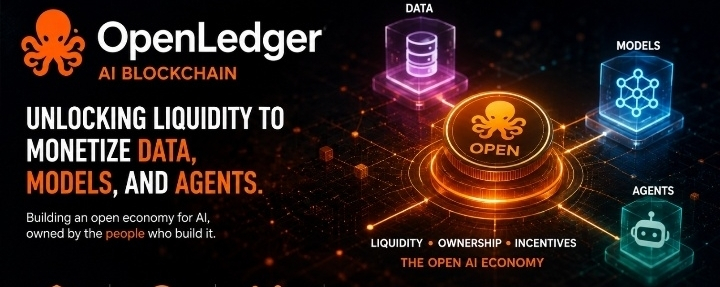
It is within this unresolved environment that OpenLedger positions itself. Rather than presenting AI as a purely technical challenge, OpenLedger frames AI infrastructure as an economic coordination problem. The project describes itself as an AI blockchain designed to unlock liquidity for data, models, and agents. Beneath the terminology, the broader idea appears relatively straightforward: contributors to AI ecosystems should be able to capture value from the systems they help create.
The project’s emphasis on liquidity is revealing because it reflects a financial interpretation of AI infrastructure. OpenLedger is not simply proposing decentralized storage or computation. Instead, it suggests that datasets, AI models, and autonomous agents can become economically active assets inside blockchain systems. In theory, contributors who provide useful information or improve AI systems could receive ongoing rewards linked to usage and network activity rather than one-time transactions.
This approach attempts to solve one of the deeper structural problems inside AI development. Today, most contributors lose visibility once their input enters centralized training pipelines. OpenLedger claims blockchain architecture can create traceability around contributions, attribution, and economic participation. If successful, this would mean AI systems become less dependent on opaque corporate ownership structures and more connected to programmable incentive mechanisms.
The appeal of this argument is understandable because it responds to a genuine shift occurring across the technology industry. AI is becoming increasingly dependent on large-scale data coordination, while concerns around data rights, attribution, and ownership continue expanding. Governments are beginning to question how AI companies obtain training material. Creators increasingly challenge whether their work is being absorbed into machine-learning systems without permission or compensation. OpenLedger is therefore entering a conversation that already exists beyond crypto circles.
Still, many of the project’s assumptions become more difficult when examined closely. One major challenge involves determining how contribution value is actually measured. Blockchain systems can record transactions permanently, but they cannot independently evaluate whether a specific dataset improved a model in a meaningful way. Attribution in AI training remains technically uncertain even within highly controlled centralized environments. If OpenLedger promises fair compensation mechanisms, the reliability of those mechanisms becomes central to the entire model.
There is also an unresolved tension between decentralization and operational efficiency. AI systems require enormous computational coordination, while blockchain systems are historically slower and more transparent by design. Combining the two creates architectural compromises. OpenLedger may rely on hybrid structures where critical AI operations occur off-chain while settlement and attribution occur on-chain. That design is practical, but it also introduces familiar questions about how much decentralization truly exists once core infrastructure depends on external systems.
Another issue involves economic concentration. Many blockchain ecosystems begin with decentralized narratives but gradually consolidate influence among early investors, governance participants, or infrastructure providers. OpenLedger’s language around ownership and monetization sounds more democratic than traditional AI platforms, yet ownership inside tokenized systems can still become highly unequal. If governance power correlates mainly with token accumulation, then the system risks reproducing similar power hierarchies under different branding.
The project’s focus on AI agents also deserves careful attention. Across the broader industry, autonomous agents are increasingly described as future economic participants capable of interacting independently with digital systems. OpenLedger appears to envision agents not only as tools but as monetizable actors within blockchain environments. However, the current reality of AI agents remains far less mature than much industry rhetoric suggests. Most so-called autonomous systems today still operate within constrained frameworks and require substantial human supervision. The infrastructure needed for reliable, independent machine agents remains experimental in many respects.
At the same time, OpenLedger’s broader perspective reflects an important evolution inside crypto thinking. Earlier blockchain projects often attempted to decentralize finance first and attach utility later. OpenLedger instead starts from the assumption that AI itself may become one of the dominant economic infrastructures of the coming decades. If that assumption proves correct, then questions around who owns AI systems, who supplies their intelligence, and who captures their value may become more politically and economically significant than many current blockchain debates.
The users most likely to benefit from OpenLedger’s approach are probably independent developers, smaller AI researchers, data contributors, and participants excluded from centralized AI ownership structures. For these groups, blockchain-based attribution systems could create alternative economic pathways that do not rely entirely on large technology companies. Yet large enterprises may remain cautious because decentralized systems often introduce governance uncertainty, regulatory ambiguity, and operational complexity that institutions traditionally avoid.
What ultimately makes OpenLedger notable is not that it has solved the ownership problem inside AI, but that it treats AI value extraction as a structural issue rather than merely a technical one. The project is effectively asking whether intelligence itself can become part of an open economic network instead of remaining concentrated inside corporate platforms. That question extends beyond blockchain and beyond AI hype cycles.
If future AI systems increasingly depend on collective human participation to evolve, the more difficult question may not be whether contributors deserve compensation, but whether any decentralized system can realistically distribute value fairly once intelligence itself becomes one of the world’s most competitive industries.