
I’m waiting to see what OpenLedger looks like on a genuinely bad market day. I’m watching for the moments when activity suddenly explodes, when everyone rushes for the same exits, and when systems stop operating under ideal conditions. I’m looking beyond performance claims because those are easy to make when demand is predictable. I’ve seen plenty of projects look impressive during calm periods and then struggle when markets become chaotic. I focus on consistency because, in the end, consistency is what people trust.
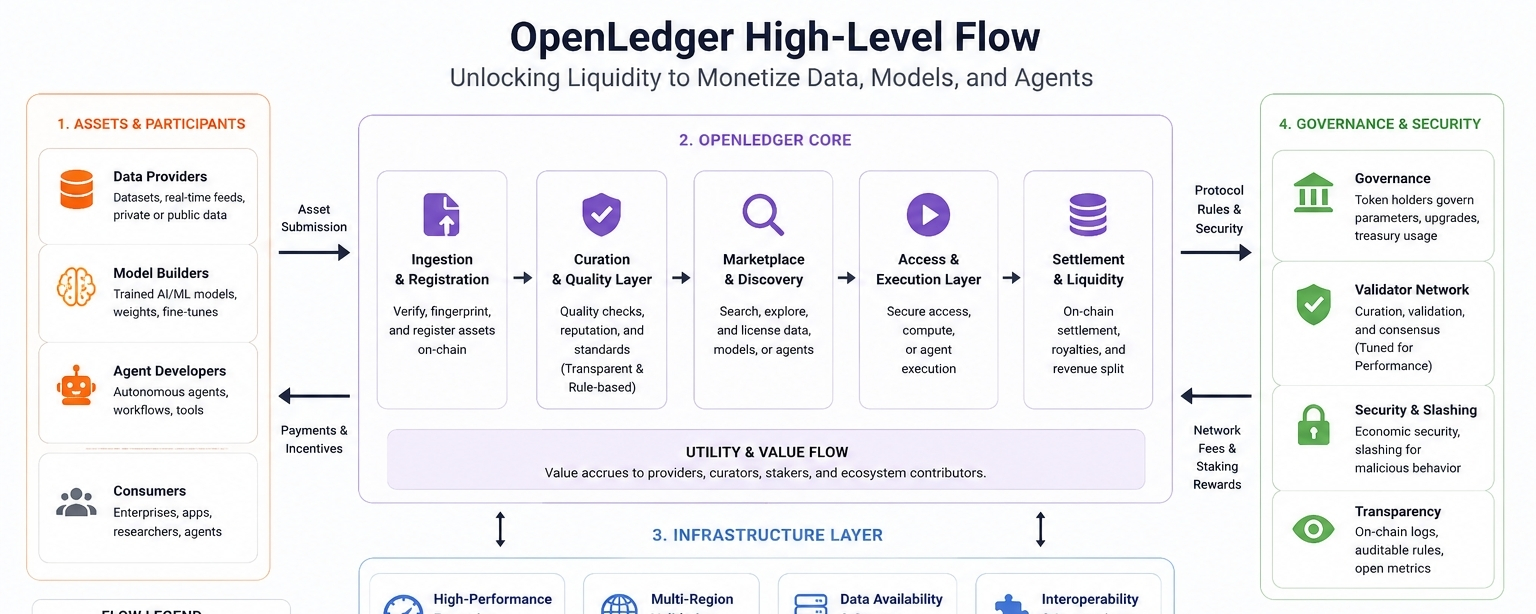
OpenLedger is often discussed through the lens of AI, data, models, and agents. That story is interesting, but from where I sit, the more important question is much simpler. Can it become a place where participants feel comfortable operating when conditions are no longer comfortable?
That may sound obvious, but it is the difference between infrastructure that lasts and infrastructure that becomes another short-lived narrative.
Markets have a habit of exposing weaknesses that never show up in presentations. Everything looks efficient when volumes are normal, liquidity is healthy, and nobody is in a hurry. The real test starts when prices move aggressively, when traders are reacting emotionally, and when the system suddenly has to process far more activity than it did an hour earlier.
Those are the moments that define credibility.
People often get distracted by speed because speed is easy to understand. Faster sounds better. Higher numbers look impressive. But after spending enough time around financial markets, one thing becomes clear: predictability matters more than peak performance.
Nobody remembers that a platform was exceptionally fast on a random Tuesday afternoon.
They remember the day volatility hit hard and the platform still worked exactly as expected.
That is where OpenLedger's future reputation will be built. Not through average performance, but through its ability to stay predictable when everything around it becomes unpredictable.
The biggest risk for any venue is not necessarily being slow. The bigger risk is becoming inconsistent.
Once participants start wondering whether execution will be different during periods of stress, behavior changes. Liquidity providers become more cautious. Traders widen their assumptions about risk. Participants begin protecting themselves from uncertainty rather than engaging confidently with the market.
That shift is subtle at first, but it compounds quickly.
Small delays become larger concerns. Minor inconsistencies become topics of discussion. Confidence gradually becomes harder to maintain because people stop focusing on opportunity and start focusing on what might go wrong.
That is why reducing variance matters so much.
A system does not need to be perfect. Markets never are. What participants want is a reasonable expectation of how the venue will behave when pressure arrives. They want routine. They want reliability. They want outcomes that feel familiar even when conditions are difficult.
OpenLedger will eventually face the same balancing act that every serious platform faces.
Performance has a cost.
Openness has a cost.
Decentralization has a cost.
Coordination has a cost.
The challenge is deciding which costs are worth paying.
If validator quality becomes important to maintaining performance, there is a strong argument for holding operators to higher standards. The reality is simple: a venue is often limited by its weakest participants. If slow or unreliable operators consistently drag down the overall experience, everyone pays the price.
From a purely operational perspective, that argument makes sense.
The problem is that technical logic and social perception are not always the same thing.
The moment people begin feeling that participation decisions are subjective, trust can become more difficult to maintain. What one group sees as sensible quality control, another group may see as selective gatekeeping.
Neither side is necessarily acting in bad faith.
That is simply the reality of systems that combine technology with human governance.
This is why transparency matters just as much as performance. Participants can tolerate strict standards when the rules are clear. What they struggle with is uncertainty. Once decisions start feeling inconsistent, every future decision gets examined through a political lens whether that was the intention or not.
That risk exists in almost every ambitious infrastructure project.
It starts small.
Then it becomes the conversation.
The same dynamic applies to regional coordination, distributed operations, and other mechanisms designed to improve responsiveness. Geography can absolutely be a useful tool. Placing infrastructure intelligently can improve performance and reduce latency. But geography itself is not the solution.
Execution is.
The reality behind these systems is usually less exciting than the marketing around them.
Someone has to coordinate.
Someone has to maintain standards.
Someone has to handle failures.
Someone has to make operational decisions.
The projects that succeed are usually the ones that make all of that look boring.
Not because nothing is happening, but because everything is happening exactly as expected.
That kind of boring is valuable.
In fact, it is often the strongest signal of quality.
When nobody is talking about infrastructure, it usually means the infrastructure is doing its job.
When infrastructure constantly becomes the story, something is usually wrong.
The same principle applies to performance-focused technology. Faster clients, optimized execution environments, and better engineering are all valuable. They should be pursued. But none of them matter in isolation.
A powerful engine does not automatically create a reliable vehicle.
Everything around that engine still needs to work.
If the broader system is not designed around stability, then faster components simply allow problems to arrive more quickly.
There is also the question of concentration risk.
The industry often celebrates efficiency while paying less attention to dependency. Yet dependencies have a habit of becoming visible at exactly the wrong moment. A system that relies too heavily on a narrow set of implementations can look incredibly strong right up until the day something breaks.
That does not mean specialization is bad.
It means resilience should matter as much as performance.
The same tradeoff appears in user experience.
Features that simplify onboarding and reduce friction are undeniably useful. They make platforms easier to use. They lower barriers to participation. They create smoother experiences.
But convenience creates dependencies too.
Every layer that helps users can also become a pressure point.
If support changes, policies shift, sponsorship disappears, or a critical service experiences downtime, participants quickly discover how much they relied on that layer.
Convenience is valuable.
Dependence is risky.
The difference between the two often becomes visible only during periods of stress.
That is why I keep returning to the same idea whenever I evaluate projects like OpenLedger.
The goal should not be looking impressive when conditions are perfect.
The goal should be remaining trustworthy when conditions are imperfect.
Because trust is ultimately what determines whether liquidity stays.
Liquidity follows confidence.
Confidence follows predictability.
Predictability follows discipline.
And discipline is hardest to maintain when markets become emotional.
If OpenLedger succeeds, the outcome will probably look less dramatic than many people expect. Activity will continue flowing. Infrastructure will remain stable. Participants will stop thinking about whether the system can handle stress because experience will have already answered that question for them.
The platform will become something markets value deeply but rarely celebrate: dependable.
If OpenLedger fails, the warning signs will likely appear long before any technical collapse. Governance will begin attracting more attention than execution. Curation will start feeling exclusive. Decisions will feel increasingly political. Performance improvements will struggle to offset growing uncertainty about who is making decisions and why.
At that point, speed stops being enough.
Because markets can forgive imperfections.
What they rarely forgive is uncertainty.
In the end, OpenLedger's future will not be decided by how impressive it looks during favorable conditions. It will be decided by whether people still trust it when conditions become difficult.
That is the difference between a platform that grows and a platform that lasts.