
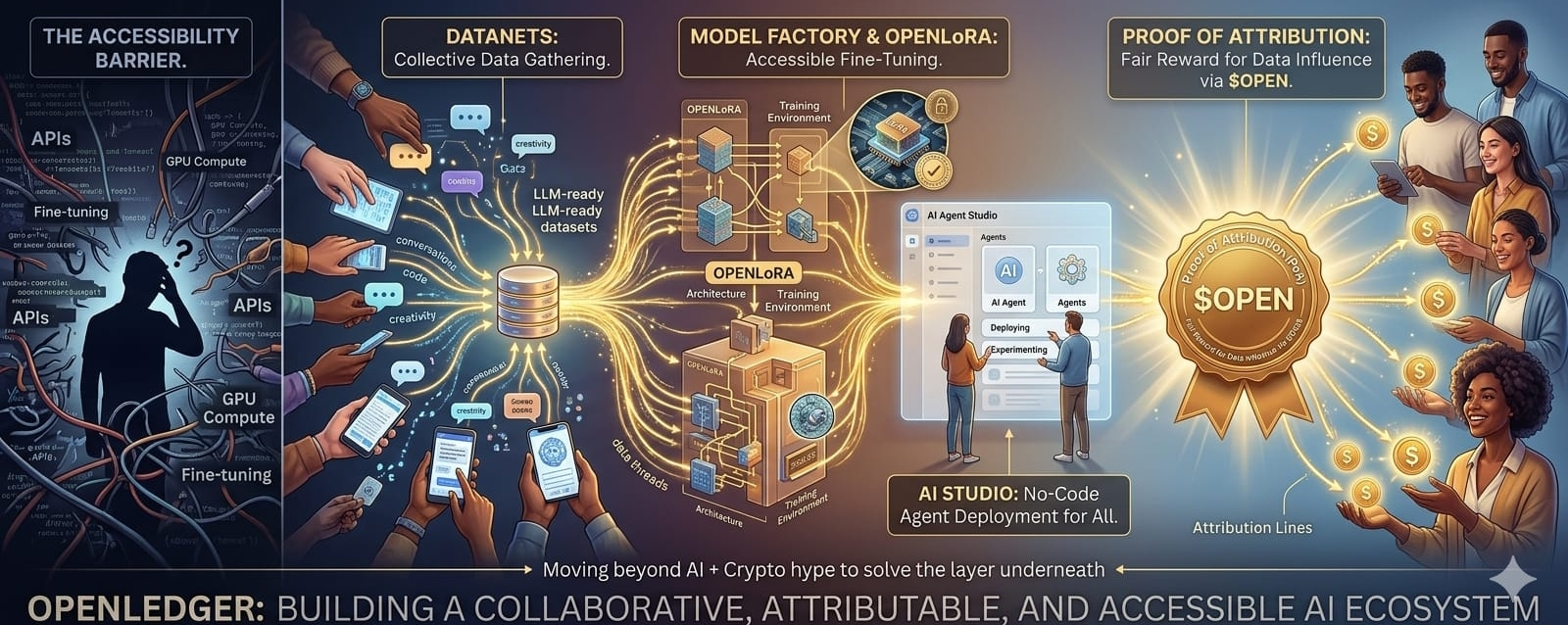
A few weeks ago I decided to seriously explore AI tools because everywhere I looked, people kept saying the same thing — AI agents are the future. On Twitter especially, it felt impossible to avoid. Every other thread was talking about automation, autonomous agents, AI economies, and how early we still are. So naturally I thought getting involved would be simple. I imagined opening a platform, connecting my wallet, clicking a few buttons, and watching some AI system start working. But the deeper I went, the more confusing everything became. One platform expected coding knowledge like it was basic common sense. Another immediately started talking about deployment layers, APIs, model hosting, GPU compute, fine-tuning, and infrastructure setups that honestly made me lose interest within minutes. It felt less like entering the future and more like trying to understand a language I had never learned before. That experience made me realize something important: even though AI is moving incredibly fast, it still feels inaccessible to most normal people.
That’s one reason OpenLedger started standing out to me differently. It didn’t feel like another project simply attaching “AI” to crypto because it’s trending. The more I looked into it, the more it felt like they were focused on solving the layer underneath everything — the part most people never see but that actually matters long term. Their infrastructure around Model Factory and OpenLoRA caught my attention because it gives builders an environment for training, fine-tuning, and hosting models without making the process feel completely impossible. But what genuinely made me stop and think was the idea of on-chain verification for LoRA adapters. In AI today, almost everything feels hidden behind black boxes. Models produce outputs, people use them, value gets created, but nobody really knows where influence came from or who contributed to the intelligence behind it. Transparency is becoming more important than people realize, especially as AI starts becoming integrated into more parts of daily life.
Then I came across their concept of Proof of Attribution, and honestly that was the point where everything clicked for me. Right now AI learns from humanity constantly. Conversations, writing, creativity, research, opinions, datasets, feedback — people contribute value to these systems every single day without even thinking about it. But once the model becomes useful or profitable, the original contributors basically disappear from the picture. Their influence becomes invisible. OpenLedger’s PoA system feels different because it introduces the idea that contributions should actually be traceable. Instead of human input vanishing into the background forever, the system tracks data influence on outputs and creates a way for contributors to be rewarded through $OPEN. And the more I thought about it, the more it felt like one of the missing layers in the entire AI conversation. Everyone talks about smarter models, but very few people talk about fair attribution.
The same feeling came when I looked deeper into Datanets. Most discussions around AI focus entirely on models themselves, but the reality is that data is the foundation behind every intelligent system. Without quality data, even the most advanced models eventually hit limitations. Datanets makes sense because it allows communities to collectively gather, organize, and transform raw information into LLM-ready datasets together. That idea could become much more important in the future than people currently expect. Because eventually, access to strong data may become even more valuable than access to models themselves. And if communities are the ones helping create that value, then systems that recognize contribution could end up mattering a lot.
What also makes OpenLedger feel more grounded to me is AI Studio. Most people are not developers, and honestly most people do not want to spend weeks understanding infrastructure before they can participate in AI. They want simplicity. They want to experiment, build, deploy, and maybe even monetize AI agents without feeling overwhelmed from day one. That’s usually how mass adoption works. Big technology shifts don’t happen when only technical experts can participate. They happen when normal users finally feel comfortable enough to enter the space confidently. AI still hasn’t fully reached that point yet, but platforms that reduce complexity while keeping powerful infrastructure underneath could help push things there faster.
That’s why OpenLedger doesn’t really feel like a temporary “AI + crypto” trend to me anymore. The deeper idea behind it feels much larger than hype cycles. It feels like infrastructure being built for a future where AI becomes collaborative instead of controlled by only a few centralized systems. And honestly, the more AI evolves, the harder it becomes to ignore the question underneath everything: if humanity collectively trains and improves AI systems every single day, shouldn’t the value created by those systems eventually become more collective too? Maybe attribution sounds boring compared to flashy AI demos right now, but long term it could become one of the most important conversations in the entire industry. And I still think most people are underestimating that.
