
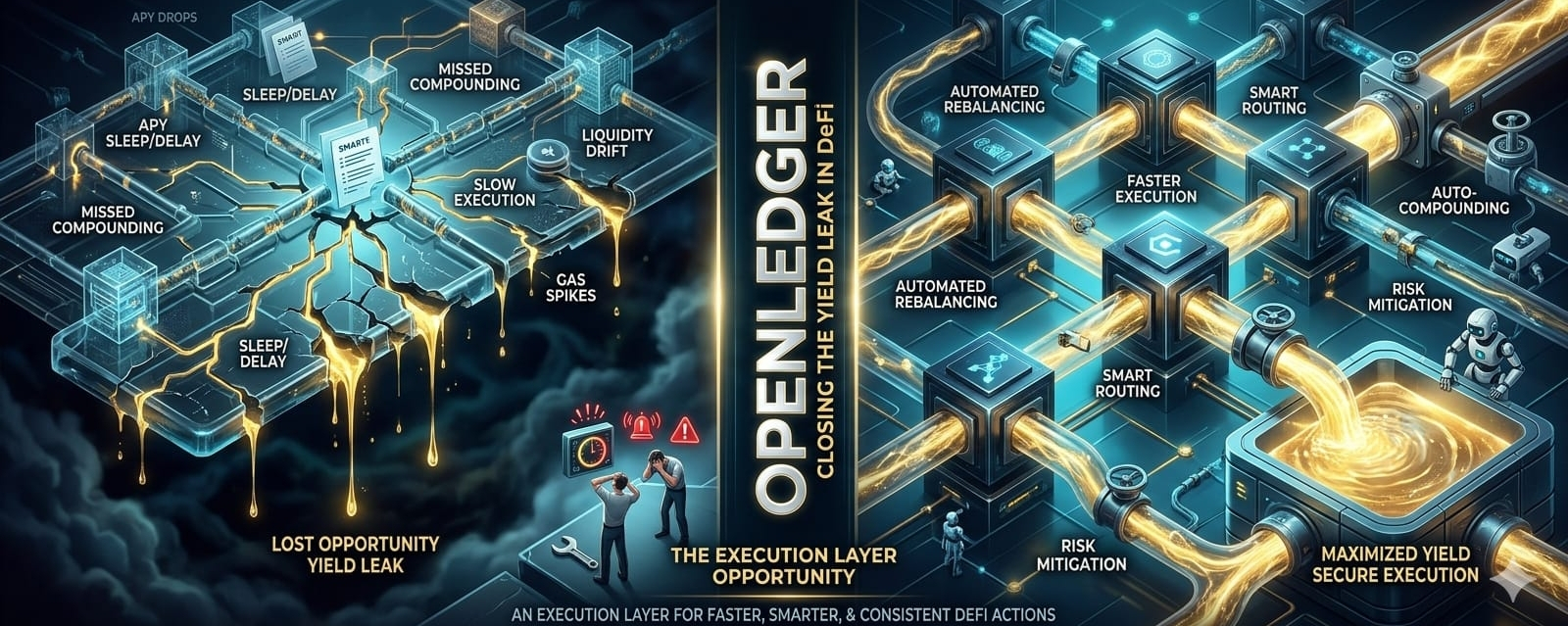
I’ve been thinking about @OpenLedger, and honestly, the more I look at it, the more I feel they are touching a problem deeper than just “better yield.”
In DeFi, people often talk about yield leak.
Simple meaning?
Money you could have earned… but didn’t.
Not because you were dumb.
Not because you didn’t know the opportunity existed.
But because you couldn’t act fast enough.
And that’s the part most people don’t talk about.
A lot of DeFi users already know where the higher APY is, which pools are active, and which chains are getting attention.
But knowing is one thing.
Executing at the right time is a completely different game.
You sleep, APY changes.
You wait, liquidity moves.
You miss one alert, collateral risk increases.
You delay compounding, yield slowly slips away.
That’s where the leak happens.
And this is why OpenLedger feels interesting to me.
It’s not just about finding yield.
It’s about closing the gap between seeing an opportunity and actually acting on it.
Because let’s be real, no human can monitor DeFi 24/7.
APYs change. Positions need rebalancing. Rewards need compounding. Liquidity needs moving. Liquidation risks need watching.
Doing all of this manually sounds possible in theory.
In real life?
It’s exhausting.
So maybe the future of DeFi is not only about who knows the most.
Maybe it’s about who executes better.
That’s the angle I think OpenLedger is pushing: an execution layer that can help users act faster, smarter, and more consistently.
But I’m not blindly hyped either.
This kind of idea sounds great until it meets real DeFi problems: gas fees, bridge delays, bad routing, smart contract risk, market chaos.
So for me, the question is simple:
Can OpenLedger make this execution layer actually work smoothly?
If yes, then yield leak becomes a real infrastructure opportunity.
If not, it stays as a strong narrative with weak execution.
Right now, I’m somewhere in the middle.
Not fully convinced.
But definitely paying attention.
Because sometimes the biggest DeFi opportunities are not the loudest ones.
Sometimes they are hidden in the boring problems everyone got used to ignoring.
