
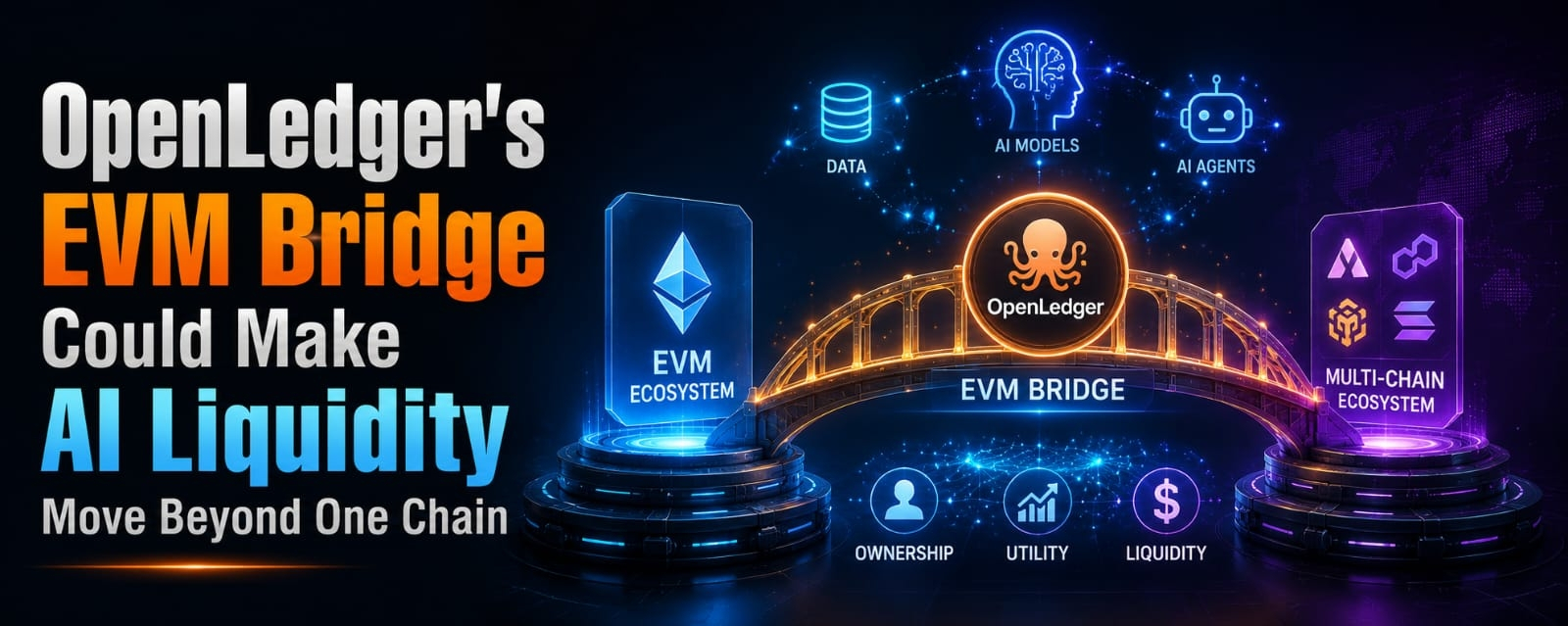
In Web3, liquidity has always been one of those quiet forces that decides which ecosystems grow and which ones slowly fade away. But I think the way we talk about liquidity is still too limited. Most people hear the word and immediately think about tokens, exchanges, trading pairs, or capital moving from one chain to another.
That is part of it, yes.
But maybe not the full picture anymore.
The next stage of liquidity may not only be about money moving around. It may also be about data, AI models, agents, and the hidden value created behind digital intelligence. That is why OpenLedger’s EVM Bridge feels interesting to me. Not because Web3 needs another bridge just for the sake of having one, but because this one sits inside a much bigger conversation.
AI is becoming more powerful every day, but the value behind AI is still not very open. A model gives an answer. An agent performs a task. A system becomes smarter. But behind all of that, there are data contributors, developers, users, model builders, and small improvements that usually disappear into the background.
That part bothers me.
Because if people, data, and agents are helping intelligence become better, then there should be a clearer way to track that value, connect it, and make it useful across different ecosystems. Right now, much of that value stays stuck inside closed platforms or isolated systems. It is created somewhere, used somewhere, and then often forgotten.
Web3 is supposed to change that.
But even Web3 has its own problem. The ecosystem is still fragmented. One chain has liquidity. Another chain has users. Another has developers. Another has infrastructure. And when an AI-focused blockchain tries to build something new, it does not only have to move tokens. It has to move trust, attribution, data value, model utility, and agent activity.
That is a much harder job.
This is where OpenLedger’s EVM Bridge becomes more than just a technical update. OpenLedger is already focused on unlocking liquidity around data, models, and AI agents. So when it connects with the EVM ecosystem, the idea becomes more meaningful. It is not only about making assets transferable. It is about making AI-related value easier to access, easier to use, and potentially easier to build around.
And that matters because the EVM world still has one of the strongest developer and user bases in crypto. Wallets, apps, protocols, liquidity networks, and communities already understand how to work inside that environment. If OpenLedger can connect its AI-focused system with that wider EVM space, it may reduce a lot of friction.
Developers do not want to start from zero every time.
Users do not either.
What makes this more interesting is the possibility that AI liquidity could become something larger than a project-specific feature. Data, models, and agents could slowly become cross-chain assets in their own way. Not exactly like normal tokens, but as valuable resources that can move, connect, and create utility across different blockchain environments.
That is the shift I am watching.
A model should not have to stay useful in only one place. A data-backed contribution should not remain invisible forever. An AI agent should not be trapped inside one small ecosystem if its function can serve users somewhere else. If Web3 can make these pieces more portable, then AI liquidity becomes a real infrastructure story, not just a trend.
Still, I would not overhype it.
A bridge alone does not prove adoption. It does not magically create users. It does not guarantee that developers will come or that real demand will appear. Execution will decide everything. Security will matter too, especially because bridges have always been one of the most sensitive parts of crypto infrastructure.
So the real question is not only, “Does OpenLedger have an EVM Bridge?”
The better question is, “Can this bridge help AI value move in a way that people actually use?”
That is where the story becomes important. If OpenLedger can make AI contributions more visible, more connected, and more liquid across chains, then this is not just another infrastructure update. It becomes a small sign of where Web3 may be heading next.
Not just toward more chains.
Not just toward more tokens.
But toward a system where intelligence itself, and the value behind it, can finally move with more freedom.
