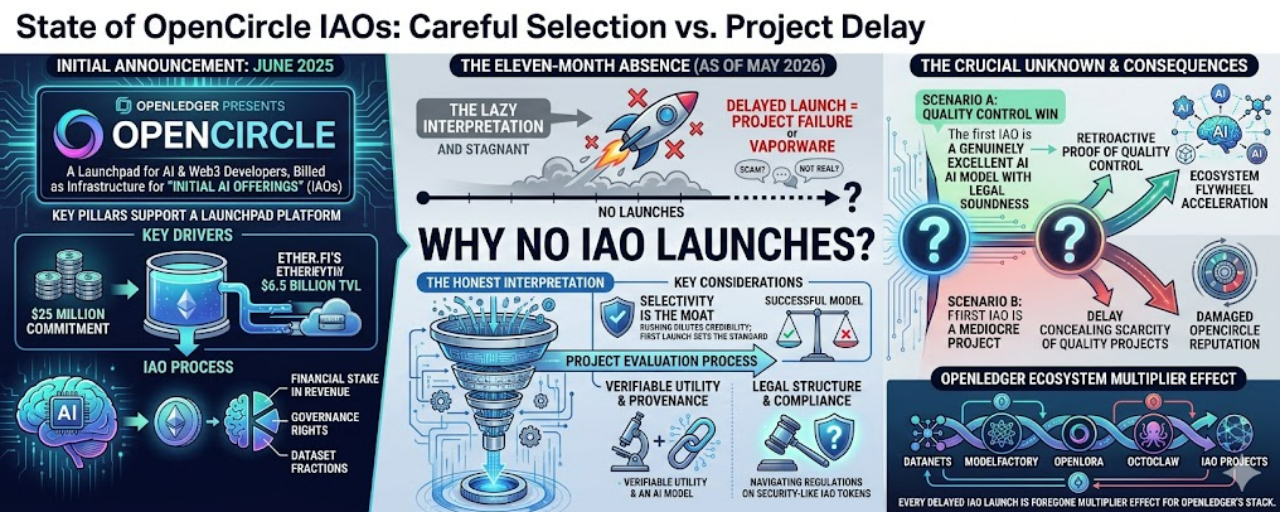
In June 2025, OpenLedger announced OpenCircle: a launchpad for AI and Web3 developers building decentralized AI protocols, backed by a $25 million commitment and Ether.fi's $6.5 billion TVL providing liquidity depth and institutional credibility. The announcement positioned OpenCircle as the infrastructure that would enable Initial AI Offerings, the IAO feature, a mechanism for tokenizing AI models into tradeable assets that can be funded, governed, and traded by communities. It was one of the more intellectually interesting product announcements in the decentralized AI space in 2025. And as of May 2026, eleven months after the announcement, no public Initial AI Offering has launched through OpenCircle. Nothing. Not one.
I want to think carefully about what that absence means, because the lazy interpretation and the honest interpretation are quite different, and I think most of the crypto community has defaulted to the lazy one.
The lazy interpretation is: delayed launch equals project failure or vaporware. The team promised something, it didn't ship, therefore the thing isn't real. I've seen this applied to OpenCircle in community forums and it's an oversimplification that ignores how launchpads work in practice.
The honest interpretation requires understanding what makes a launchpad successful. The quality of what launches on a launchpad determines whether the launchpad itself is trustworthy. A launchpad that rushed to get its first IAO live with a low-quality project, because the team needed something to point to, would damage OpenCircle's credibility for every future launch. The first IAO on OpenLedger's platform sets the standard. It will be the reference point that every subsequent project evaluation uses. If the first one is mediocre, the entire IAO mechanism gets associated with mediocrity. If the first one is genuinely excellent, an AI model with real domain utility, verifiable training data provenance, and a credible team behind it, it establishes a standard that attracts better projects over time.
This is the same dynamic that shaped the credibility of Binance Launchpad versus the dozens of launchpads that launched simultaneously and are now dead. Binance was selective. The projects it chose to support had real teams and real products. That selectivity, which often looked like slowness in the short term, became the moat that made the Binance Launchpad brand valuable. OpenLedger has publicly committed $25 million to OpenCircle. Organizations with $25 million committed to a launchpad don't benefit from rushing a bad first launch. They benefit from getting the first one right.
The Ether.fi partnership backing is the specific credibility signal I find most meaningful about OpenCircle's long-term viability. Ether.fi's $6.5 billion TVL represents genuine liquidity that could be directed into OpenCircle launches. When institutional-grade liquidity providers are involved in a launchpad, the quality bar for what gets launched rises automatically. The projects that participate in OpenCircle know they're being evaluated by institutional eyes, not just retail speculators. That filter is a feature, not a bug, even when it means slower launches.
The IAO concept itself deserves more attention than the launch delay question, because it's genuinely novel in ways that most crypto AI project coverage misses. Tokenizing an AI model is not the same as issuing a utility token for a platform. A tokenized model creates specific rights: governance over the model's development direction, financial participation in the model's inference revenue, and potentially a stake in the model's training data as it expands. These rights are concrete and bounded in a way that many utility tokens are not. You're not buying a token that might someday be useful on a platform. You're buying a stake in a specific AI product that generates measurable, on-chain verifiable revenue through inference fees.
The regulatory question around IAOs is real and probably a significant part of why the first one hasn't launched yet. Depending on jurisdiction, a tokenized AI model with revenue rights looks very much like a security. OpenLedger's structure gives holders governance rights and participates them in inference revenue. That's not obviously distinguishable from an investment contract in the eyes of financial regulators. OpenLedger hasn't published any legal framework analysis for how it intends to structure IAOs in a compliant manner. This is the information gap I find most significant in the OpenCircle story: the legal structure of the IAO mechanism is opaque, and getting it wrong could expose both OpenLedger and IAO participants to regulatory risk that the current documentation doesn't address.
The relationship between OpenCircle and OpenLedger's broader ecosystem is worth mapping carefully. OpenCircle is supposed to launch AI protocols built on OpenLedger's stack. These protocols would use OpenLedger's Datanets for training data, ModelFactory for fine-tuning, OpenLoRA for deployment, and OctoClaw agents for task execution. Every successful OpenCircle launch adds another project to the ecosystem that generates inference fees, contributes to Datanet demand, and creates new use cases for OPEN staking. The launchpad is not just a fundraising mechanism. It's a planned multiplier for the entire OpenLedger economy.
That multiplier effect makes the absence of a first launch more consequential than it might appear in isolation. OpenLedger's ecosystem flywheel, the loop from Datanet contributors to model builders to inference users to OPEN rewards, needs multiple projects running on it to generate enough volume to make each component self-sustaining. OpenCircle was supposed to accelerate that flywheel by adding new demand-side projects continuously. Eleven months of planning without a first launch is eleven months of foregone multiplier effect.
I come away from this analysis uncertain about whether the OpenCircle delay reflects careful selection, regulatory navigation, or slow execution. All three are consistent with the observable evidence. What I'm confident about is that the first IAO launch matters enormously for OpenLedger's ecosystem development, and that every month it doesn't happen extends the period during which the ecosystem flywheel is running below its designed capacity.
The uncomfortable version of this analysis: if OpenCircle's first IAO launches with a genuinely excellent AI model, verifiable provenance, strong team, and a legally sound structure, the delay will be understood retroactively as evidence of quality control. If it launches with something mediocre, the delay will look like it was concealing a scarcity of good projects willing to use the platform. Right now, the community can't distinguish between those two scenarios from the outside.
@OpenLedger $OPEN #OpenLedger $BSB