
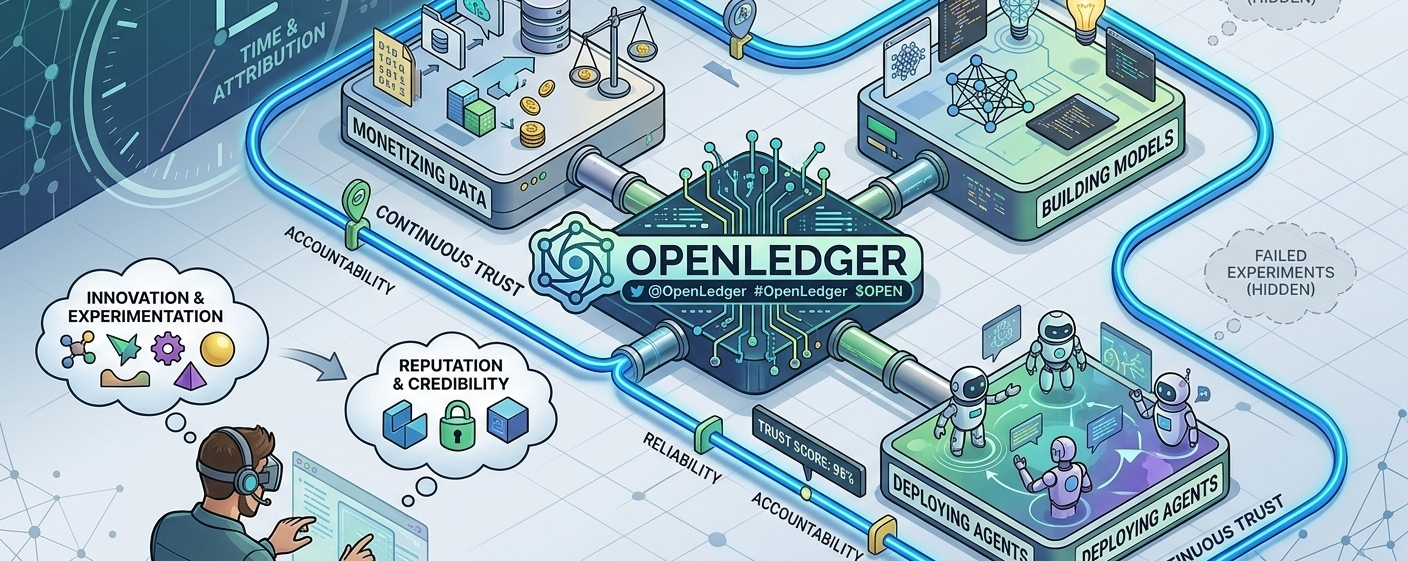
I kept staring at one part of OpenLedger’s description longer than I expected.
The project talks about monetizing data, models, and agents. At first glance, it sounds straightforward. Useful AI contributions finally get liquidity around them. Builders earn. Networks grow. Everybody wins.
But after sitting with it for a while, I think another pressure slowly appears underneath that story.
The pressure of staying continuously trusted.
And honestly, I do not think people are discussing that side enough yet.
Because once AI contribution becomes economically visible, the environment changes.
A builder is no longer just creating something useful.They are maintaining a position inside a live economic system.
That sounds subtle.I do not think it is.
Normally, developers can disappear for months. Researchers can experiment quietly. Bad ideas fail privately. Strange experiments happen without immediate consequences.
But attribution-based systems behave differently.
Once value starts attaching itself to contribution history, people naturally become more aware of how they are perceived over time.
I stopped there mentally because this is where OpenLedger started feeling less like a simple AI infrastructure project and more like a long-term credibility machine.
Different dynamic entirely.
The interesting part is that the project does not even need to force this behavior directly.
The structure itself creates it.
If data, models, and AI agents are all connected to monetization and attribution, then contribution history starts carrying economic meaning.
And economic meaning changes behavior faster than ideology does.
People begin protecting reputation.Protecting consistency.Protecting reliability.
Sometimes even before they realize it themselves.
I think this especially matters for AI agents.
Because agents are persistent by nature. They keep interacting, adapting, producing outputs over time. If economic value remains connected to that behavior history, then stability starts becoming financially important.
That creates a quiet tension.
The market may slowly reward contributors who feel safe to depend on, not necessarily contributors taking the biggest technical risks.
And systems optimized for reliability do not always produce the same energy as systems optimized for experimentation.
That is the part I keep circling back to.
The AI world still talks mostly about intelligence.Better outputs.Better models.Better reasoning.
But OpenLedger indirectly points toward another competitive layer:maintaining economic trust over time.
That is heavier than it sounds.
Because trust maintenance consumes behavior.
People become more careful with updates.More selective with experimentation.More aware of failure visibility.
And attribution systems remember longer than normal tech culture does.
In most software environments, failed experiments disappear quickly. Teams move on. Products pivot. Nobody keeps score forever.
But systems tied to persistent contribution visibility work differently.
Historical contribution trails remain economically relevant for longer periods.That changes incentives completely.
I am not even saying this is necessarily bad.
Maybe stronger attribution creates healthier accountability.Maybe it improves AI coordination.Maybe it filters low-quality participation.
But it also creates a world where builders may spend increasing amounts of energy managing credibility instead of purely chasing technical breakthroughs.
And once markets start rewarding long-term trust persistence, behavior shifts quietly before the narrative around it catches up.
That is why I keep feeling OpenLedger is touching something bigger than simple AI monetization.
It may slowly push AI development toward a system where remaining economically trusted becomes just as important as building something intelligent in the first place.
