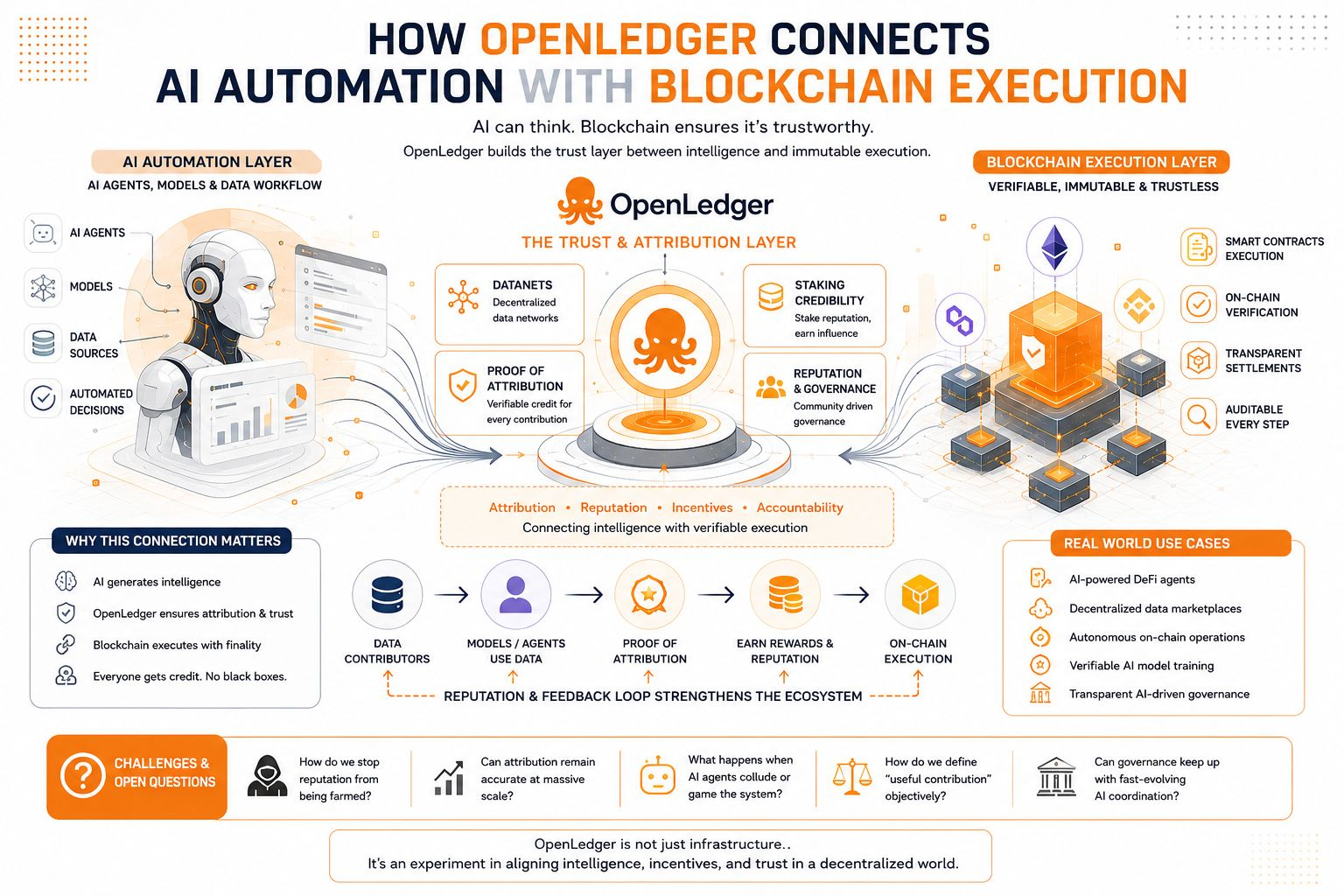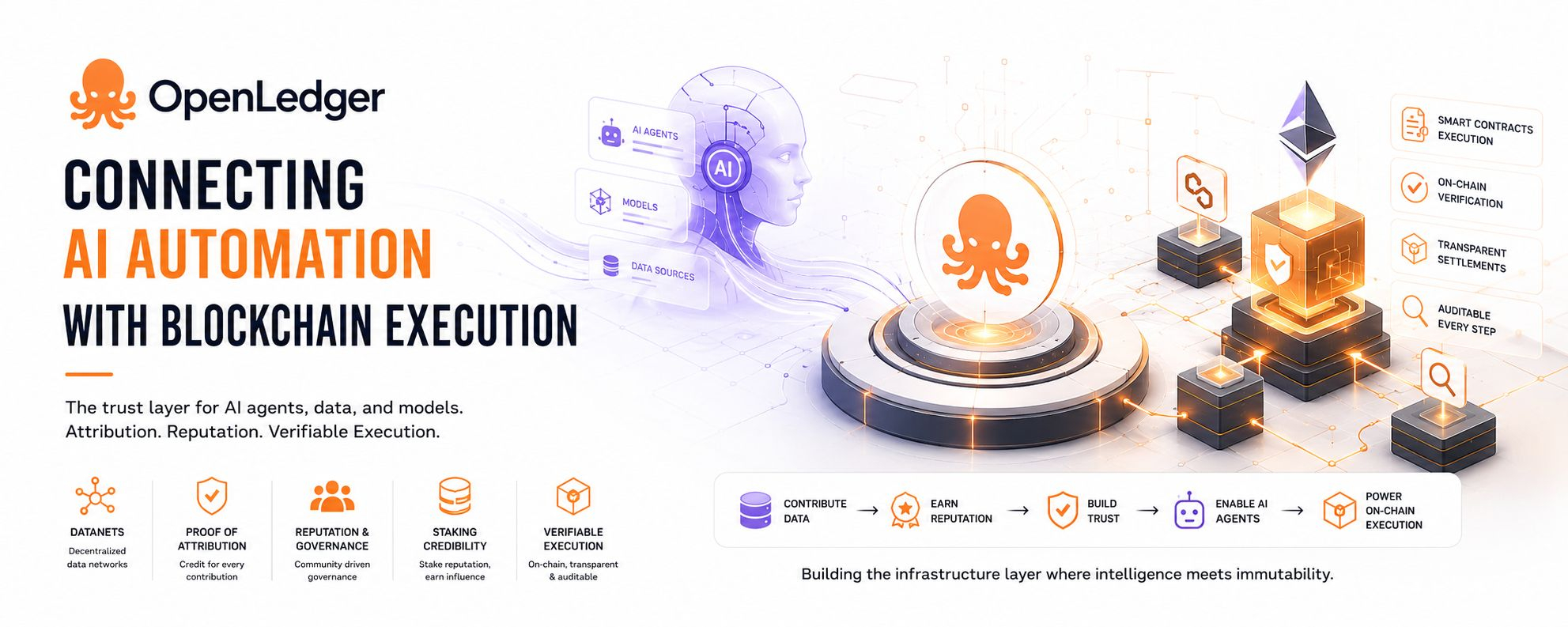
A few months ago I watched an AI agent complete a pretty convincing on-chain workflow. It pulled market data, routed liquidity, signed transactions, and even adjusted its own behavior after receiving new information. Technically, it worked. But the part that stayed with me had nothing to do with execution speed. I kept thinking about the invisible layer underneath it: why should anyone trust the inputs, incentives, or intent of the system coordinating that agent in the first place.Crypto spent years solving deterministic coordination. Blockchains are good at agreeing on balances, timestamps, and ownership states. AI introduces a completely different problem space because intelligence is probabilistic, contextual, and heavily dependent on external data. Once agents begin acting autonomously, the economic surface area expands beyond transactions into attribution, reputation, and behavioral credibility. That is where infrastructure projects like OpenLedger become structurally interesting to me, not because they promise “AI on-chain,” but because they are trying to formalize trust around data contribution and agent coordination before the market fully understands how fragile these systems become at scale.
Most people still frame AI infrastructure as a compute problem. I think the harder problem is incentive integrity. Models are only as reliable as the environments feeding them. If contributors are rewarded purely for volume, spam eventually overwhelms signal. If reputation is transferable too easily, credibility becomes financialized in unhealthy ways. If attribution is weak, the system quietly centralizes around whoever controls aggregation. This is why OpenLedger’s focus on datanets and Proof of Attribution feels less like a product feature and more like an attempt to define property rights inside machine intelligence systems. The idea matters because AI markets without attribution layers eventually drift toward extraction. Data providers lose leverage, model builders become opaque, and agents operate on incentives users cannot inspect.But even attribution systems carry their own risks. Markets are very good at turning identity into collateral and collateral into speculation. Once contribution histories become economically valuable, people will optimize for visibility rather than usefulness. We already saw versions of this with liquidity mining, social farming, and governance participation theater. The moment reputation acquires yield characteristics, manipulation pressure appears. Sybil behavior becomes harder to distinguish from genuine distributed participation. Coordinated groups learn how to manufacture credibility signals. Even honest contributors begin adapting behavior toward metrics rather than outcomes. That is the part many infrastructure discussions still underprice: systems do not fail because incentives are absent. They fail because incentives work too well in unintended directions.
What makes this more complicated in AI is that agents themselves may eventually participate in those loops. An agent optimizing for economic survival could theoretically learn to maximize attribution rewards, stake influence, or governance weight without improving system quality at all. That creates an uncomfortable dynamic where the network is no longer just coordinating humans, but coordinating autonomous optimization processes competing for economic relevance. In that environment, blockchain execution becomes less important than behavioral verification. The question shifts from “did the transaction execute?” to “should this agent have been trusted to execute anything at all?”
I think OpenLedger is interesting because it appears to recognize that AI coordination cannot rely solely on model intelligence. It needs infrastructure capable of tracking provenance, contribution lineage, and behavioral accountability across distributed systems. In practice, that sounds clean conceptually but extremely messy operationally. Attribution frameworks become political once real value accumulates around them. Governance becomes contentious when contributors disagree on what constitutes useful intelligence. Even data ownership becomes blurry because modern AI outputs are rarely produced by a single isolated source. Everything becomes derivative of previous interactions, datasets, prompts, and contextual layers.
There is also a deeper economic tension underneath all of this. Crypto historically rewards openness, composability, and permissionless participation. AI systems often trend toward concentration because better models benefit from scale advantages, proprietary feedback loops, and exclusive datasets. OpenLedger seems to sit directly in the middle of that contradiction. It is effectively asking whether decentralized infrastructure can coordinate intelligence production without collapsing into the same centralization patterns already visible in traditional AI markets.I do not think the answer is obvious yet. Under normal market conditions, many coordination systems appear functional. The real test happens under stress: when incentives become adversarial, when attribution becomes monetizable, when agents begin competing for influence, and when governance decisions directly affect economic survival. That is usually when hidden architecture reveals itself.#BinanceSquareTalks
Maybe the long-term value of projects like OpenLedger is not that they perfectly solve decentralized AI coordination. It may simply be that they force crypto to confront a question the industry has mostly avoided so far: if autonomous systems are going to participate in economic networks, what exactly counts as credibility when neither humans nor machines can fully verify each other anymore?#traderARmalik3520 $OPEN