
I was randomly thinking about AI agents last night, and honestly, the more I think about it, the more it feels like people are focusing on the wrong layer.
Everyone is obsessed with making AI “smarter.”
Smarter models.
Smarter agents.
Smarter automation.
But almost nobody is seriously talking about memory.
And I don’t mean simple chat memory.
I mean the type of memory enterprises would actually trust.
Questions like:
— Where did this information originally come from?
— Who uploaded it?
— Was permission properly verified?
— Did anyone modify the data later?
— Can the AI actually prove why it made a decision?
That’s where things start getting interesting.
Because most AI systems today still sit on top of extremely messy infrastructure underneath.
People imagine AI running on perfectly organized data environments, but inside real companies it’s usually chaos:
Old files everywhere.
Departments protecting isolated datasets.
Permissions nobody updated in years.
Random documents still existing long after they should’ve been removed.
Now imagine autonomous AI agents operating on top of all that.
That’s where the real risk begins.
An AI agent can sound incredibly intelligent while quietly relying on outdated, unverified, or poorly permissioned information in the background.
And this becomes a much bigger issue once AI agents start handling real operational workflows instead of simple chatbot tasks.
The moment agents begin coordinating systems, touching financial processes, managing enterprise operations, or interacting across organizations, trust suddenly becomes more important than raw intelligence alone.
At that point companies won’t just ask:
“How smart is this AI?”
They’ll ask:
“Can this system actually verify itself?”
That’s the layer I think the market still underestimates.
The infrastructure behind AI memory could become far more valuable than people currently realize.
Not just storing information…
but proving ownership,
tracking provenance,
managing permissions,
recording changes,
and controlling participation across the network itself.
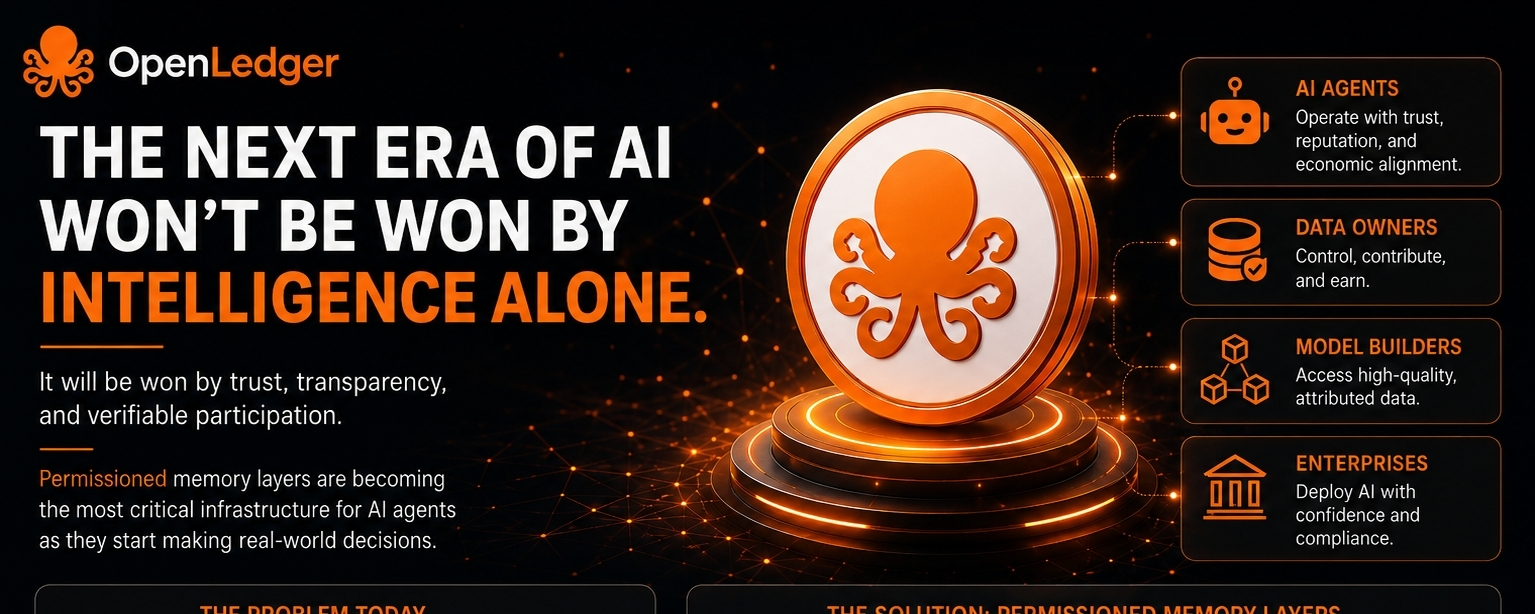
That’s partly why OpenLedger keeps staying on my radar lately.
Not because of the usual “AI + blockchain” hype people throw around.
What actually feels interesting is the concept of permissioned memory layers for AI systems.
The more autonomous AI becomes, the less enterprises can afford unverifiable intelligence operating inside critical environments.
And honestly…
I wouldn’t be surprised if trusted AI memory becomes one of the biggest infrastructure markets of the next cycle.