

I’ve been watching the AI narrative in crypto for a while now, and something keeps nagging at me. Everyone is obsessed with bigger models, faster inference, and smarter agents. But very few are asking the uncomfortable follow up question: when that intelligence actually creates real economic value, who ends up owning it?
Right now the honest answer is still the same big centralized platforms. They control the data pipelines, the training runs, the distribution, and the user interfaces. The people feeding the system, researchers, data curators, everyday users providing feedback, rarely see meaningful upside.

That’s exactly why OpenLedger stands out to me. It isn’t trying to win the raw intelligence race. It’s building the layer that decides who gets rewarded when intelligence is used.
At the heart of it is their Proof of Attribution (PoA) system. Every piece of data contributed, every model fine tuned, and every inference generated gets cryptographically tracked on chain. Using techniques like influence functions and gradient attribution, the protocol can measure exactly how much a specific dataset or refinement impacted the final output, then automatically route $OPEN rewards back to the contributors. No middleman, no black box.
This changes the experience completely. Instead of donating your data for free to some closed model, you become a real stakeholder. You can contribute to community owned Datanets (specialized, high quality datasets), fine tune models through the no code Model Factory, or deploy agents via OctoClaw and every step is traceable and payable.
The technology feels grounded rather than flashy. It’s an EVM compatible AI native chain built on top of proven infrastructure (OP Stack roots), focused on making attribution verifiable at the protocol level. That transparency isn’t just nice to have, it directly attacks the “black box” problem that still plagues most AI systems.
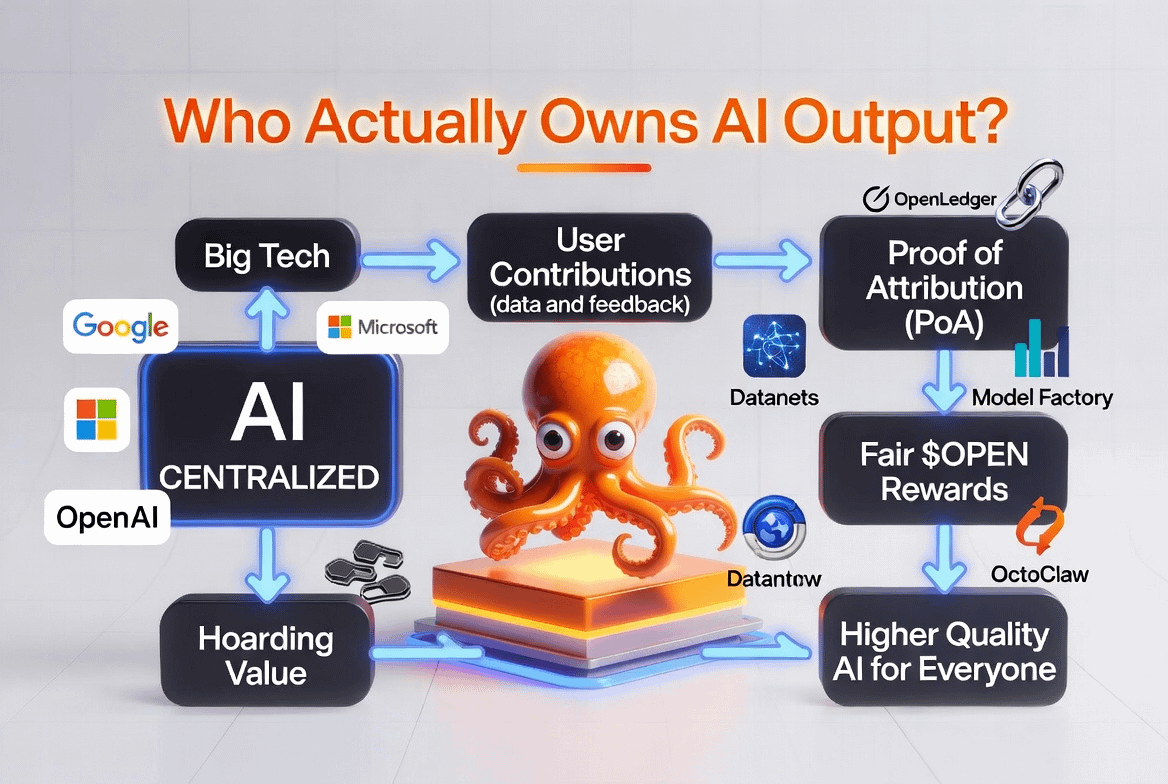
For the broader crypto community, this could be quietly revolutionary. It turns passive participants into active value creators. Developers get better data because contributors are properly incentivized. Users start caring about provenance because they can actually earn from it. Over time, it creates a flywheel where higher quality contributions lead to better models, which leads to more usage, which leads to more rewards.
Of course, it’s still early. Centralized AI currently wins on speed, polish, and convenience. Most people won’t care about ownership until something forces them to. But as AI becomes infrastructure for everything from trading agents to content tools to enterprise workflows, that “who owns the output” question is going to matter more than most realize.
@OpenLedger isn’t selling hype. It’s selling accountability in a world racing toward intelligence abundance.
And in the long run, accountability might be the scarcest (and most valuable) resource of all.
