

I noticed it when I changed a sentence before sending it to an AI tool.
It wasn’t wrong. It just sounded too much like me. Too uneven. Too emotional. Too unfinished. So I cleaned it up. Made it clearer. Easier for the machine to understand.
Then I stopped for a second.
Because I realized I wasn’t only asking the system to adjust to me. I was adjusting myself to the system.
That small moment stayed with me longer than it should have. Maybe because this is how technology usually enters our lives. Not loudly. Not all at once. It changes us through tiny habits we barely notice. The way we search. The way we write. The way we ask. The way we explain ourselves to machines.
At first, it feels harmless. You give a prompt. You correct an answer. You try again. You teach the system what you meant.
But after a while, it starts to feel strange.
Every correction becomes a small contribution. Every preference becomes a signal. Every interaction leaves something behind. The system improves, the network becomes more valuable, and you walk away with one useful answer.
That exchange feels normal until you think about what actually compounds.
You get the result.
The system gets better.
That is the part I can’t stop thinking about.
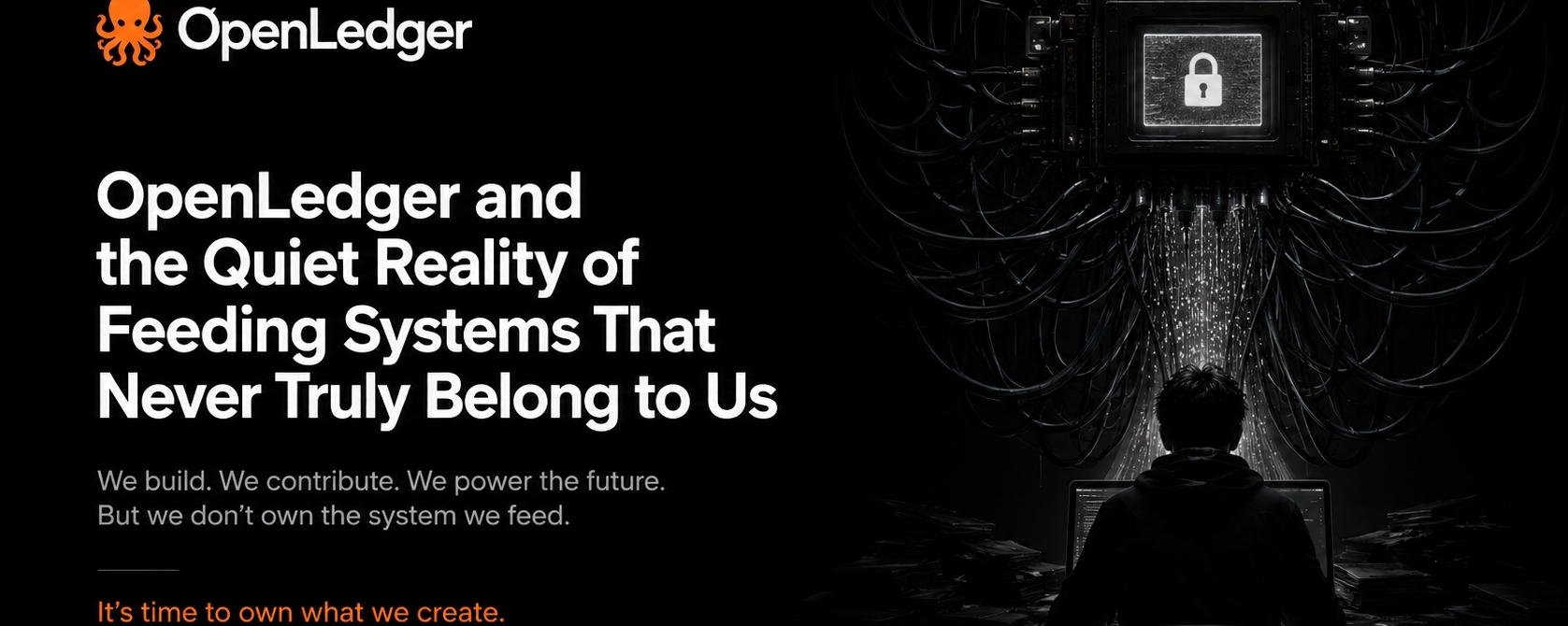
OpenLedger caught my attention because it sits close to that discomfort. Not just AI as a tool, but AI as something built from millions of invisible human inputs. Prompts, corrections, habits, reactions, taste, attention, trust. All the small things people give without calling it work.
And maybe that is the real question.
Who owns the value created by people quietly shaping these systems every day?
Crypto has always talked about ownership, but AI makes the idea feel more personal. Because this is not only about coins or networks or infrastructure. It is about the parts of ourselves we keep feeding into machines we do not control.
Still, I don’t want to pretend OpenLedger solves everything just because the question is important.
Crypto does that too often. It finds a real problem, wraps it in big language, adds incentives, and acts like the human side is already fixed. But people are complicated. Incentives change behavior. Once contribution becomes measurable, people start performing for the measurement. They optimize. They farm. They learn how to look useful.
So the problem becomes deeper.
The machine learns from the human.
Then the human learns how to behave for the machine.
That loop feels small at first, but I think it matters.
Because AI is not just changing work. It is changing how we speak, how we think, how we package ourselves, how we trust outputs, how we depend on systems we barely understand.
OpenLedger feels interesting to me because it points toward something we have not fully dealt with yet: if intelligence becomes an economic layer, then contribution cannot stay invisible forever. Someone has to ask who created the value, who captured it, and who was quietly trained along the way.
I don’t know where this ends.
Maybe decentralized systems create fairer ownership.
Maybe they only make the illusion of ownership feel more advanced.
I’m still unsure.
But I keep returning to that small moment before I sent the prompt. Me, sitting there, rewriting myself into a cleaner shape for a machine.
And wondering how much of the internet already works like that.
Not stealing from us loudly.
Just teaching us, slowly, to give ourselves away.
