
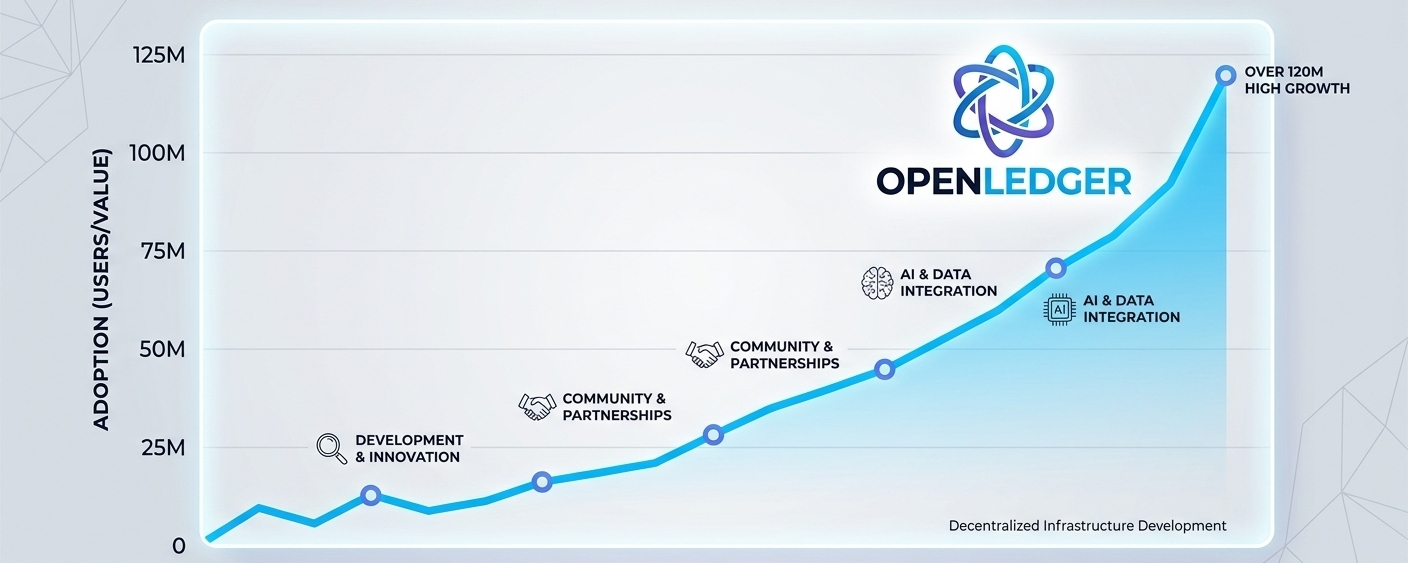
I keep noticing how certain ideas never completely disappear, even after the excitement around them fades. OpenLedger is one of those names that continues to appear quietly in conversations about AI, blockchain, and digital infrastructure. Not in an aggressive way, and not with the kind of attention that tries too hard to dominate the space. It feels more like a steady presence that stays somewhere in the background. I’ve been watching it for some time now, trying to understand whether it represents something genuinely lasting or whether it is simply another vision people want to believe in for a while.
Over the years, I’ve become more cautious with projects that sound too certain about the future. I’ve seen many platforms arrive with strong narratives, large communities, and promises about changing the way the world works. For a while, they seem impossible to ignore. People discuss them constantly, investors repeat the same optimistic language, and every update is treated like proof that something historic is happening. Then slowly, the attention weakens. The conversations become smaller. What once sounded revolutionary starts feeling distant.
That experience changed the way I look at technology now. I pay less attention to announcements and more attention to behavior. I focus on whether people continue returning to a system naturally, without needing constant reminders about why it matters. Because real infrastructure usually becomes part of daily life quietly. People stop talking about it once it becomes useful enough.
That is partly why OpenLedger stands out to me in a different way. It does not seem built entirely around noise. From what I observe, it is trying to create a space where AI models, data, and contributors can exist in a more open environment instead of remaining under the control of a few centralized systems. The idea itself is not difficult to understand. If people contribute information, activity, or intelligence into digital systems, then maybe they should also share in the value that comes from it.
At the same time, I still find myself questioning the distance between an idea and real adoption. That gap matters more than people often admit. Many technologies sound meaningful when described in theory, especially when they reflect frustrations society already feels. In places where economic uncertainty exists or where people already distrust large institutions, decentralized systems naturally sound attractive. They seem to offer independence, fairness, or participation in something larger than traditional structures.
But belief alone is never enough.
I think that is one of the biggest lessons the technology world keeps teaching us. People may admire an idea, discuss it online, and even support it emotionally, yet still never fully integrate it into their routines. Human behavior changes slowly. Most people continue using systems that already feel familiar, even if those systems are imperfect. Convenience usually shapes society more than ideals do.
When I look at OpenLedger through that perspective, I become less interested in whether the vision sounds ambitious and more interested in whether it can quietly become practical. Because systems only matter over time when they stop feeling experimental and start feeling normal. Roads matter because people rely on them every day without thinking about them. Electricity matters because its absence immediately affects life. The strongest infrastructure eventually becomes invisible.
Crypto projects often struggle with that transition. They remain highly visible because they are still trying to prove their importance. Communities continue repeating the same narratives because the systems themselves have not yet settled into ordinary life. Sometimes that visibility leads to long-term relevance. Other times, the conversation becomes bigger than the actual usage.
I think OpenLedger currently exists somewhere inside that uncertain space between possibility and reality. The timing around it is interesting because the world itself is shifting. Artificial intelligence is expanding quickly, digital economies are changing, and concerns about ownership and control are becoming more serious. People are beginning to ask who benefits from AI systems and who gets left outside them. In that environment, projects connected to decentralized infrastructure naturally attract attention because they seem to offer another direction.
Still, attention alone means very little in the long run.
The systems that survive are usually the ones people quietly return to over time, without pressure or persuasion. Not because they were convinced by marketing, but because the system slowly became useful enough to fit into ordinary behavior. That kind of relevance cannot be forced. It grows through repetition, trust, and routine.
And maybe that is the thought I keep returning to whenever I observe OpenLedger. Not whether it sounds futuristic or ambitious, but whether it can eventually become ordinary in the truest sense. Because in the end, real infrastructure is rarely remembered for its promises. It is remembered for becoming part of life so naturally that people stop noticing it altogether.
