
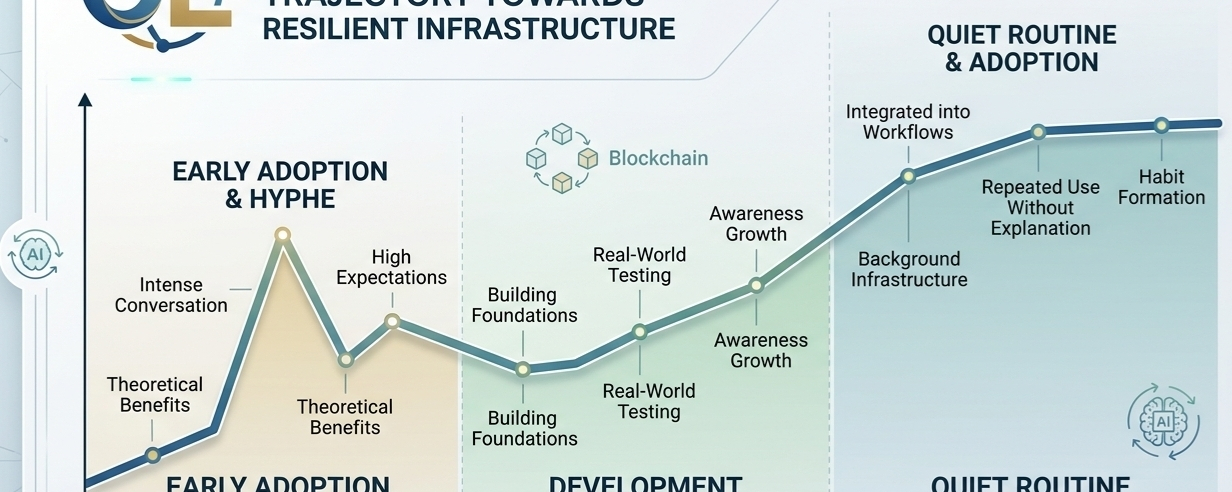
I am writingthat how certain systems remain in the background even after the noise around them starts to fade. I’m waiting, not for announcements or new claims, but for something quieter to reveal itself over time whether people actually return to these systems without being reminded, without being persuaded again. OpenLedger is one of those names I keep noticing from time to time in conversations about AI and blockchain. It doesn’t fully settle into attention, but it also doesn’t disappear. I’ve seen enough cycles in this space to understand how quickly an idea can rise, and how quietly it can vanish once attention moves elsewhere. So I find myself focusing less on what is being said and more on what continues to be used when no one is talking about it anymore.
There was a time when I would have taken systems like this almost as a natural step forward. If something brought together artificial intelligence and decentralized networks, it already felt like it belonged to the direction technology was heading. The language around it was enough to create confidence. Words like ownership, transparency, contribution carried their own weight. It felt like once the idea was framed correctly, adoption would follow almost automatically.
But that sense has changed. Over time, I’ve noticed how often systems remain alive in conversation far longer than they exist in practice. People continue discussing them, building expectations around them, repeating what they might become, while their actual presence in everyday behavior stays small. The space between what is imagined and what is actually used feels much more visible now than it used to.
OpenLedger sits for me inside that space. Not as something complete or settled, but as something still forming. At its simplest, it seems to be trying to connect AI systems, data, and contributors in a shared environment instead of leaving everything locked inside a few centralized platforms. The basic idea is easy to understand: if people help generate value—through data, interaction, or participation—they shouldn’t be completely separated from what that value becomes later.
It sounds fair when you say it plainly. Almost self-evident. But experience has taught me that what feels clear in theory rarely translates cleanly into real behavior. A system doesn’t matter because it makes sense in explanation. It matters when it becomes part of routine without needing explanation at all.
That’s why I keep returning to infrastructure as a reference point. Real infrastructure doesn’t stay in focus for long. Electricity is not something people constantly talk about; it’s simply expected. Roads are not discussed every time they are used; they just exist in the background of movement. The more a system becomes part of everyday life, the less it needs language around it. That quiet shift into routine is what gives it stability.
Crypto projects often struggle with that kind of transition. They remain surrounded by explanation for too long. Always being described, always being defended, always being projected into the future they might create. At times, the conversation around them feels more active than the actual systems people are using. I’ve started seeing that as a subtle signal—not necessarily of failure, but of something still incomplete. If a system constantly needs to be explained, it may not yet have become part of behavior.
With OpenLedger, that question still feels open. I don’t see it as fully established, but I don’t dismiss it either. It feels more like something sitting within a larger shift that is still unfolding. AI is expanding quickly, and with it comes a growing awareness of how much value is created through data and participation that people rarely feel directly connected to. In many places, especially where economic pressure is already present, that awareness feels sharper. Ideas about infrastructure and ownership don’t remain abstract for long in those environments.
Still, awareness alone doesn’t change habits. Most people don’t move to new systems just because something better exists in theory. They move when something becomes easier, more natural, less disruptive than what they already use. Convenience quietly outweighs intention more often than it is acknowledged. That pattern repeats across almost every shift in technology.
So I keep returning to the same question, not loudly but consistently. Not whether OpenLedger is a strong idea on paper, but whether it will ever stop being something discussed and start becoming something used without thought. Whether it will move from explanation into routine.
Because in the end, systems don’t prove themselves through how they are introduced or described. They prove themselves through repetition that no longer requires justification. Through habits that form slowly, without attention. Through usage that becomes so normal it no longer feels like a decision.
And maybe that is the only thing that really decides what lasts—not how loudly something appears in the beginning, but how quietly it continues when no one is paying attention anymore. @OpenLedger #OpenLedgar $OPEN
