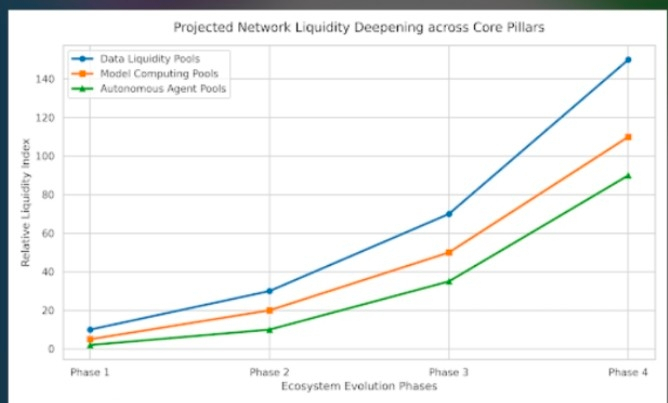
 The Quiet Awakening: OpenLedger and the Liquid Future of IntelligenceIn the soft hush before dawn, when the world still lingers between dreams and decisions, a new kind of value is stirring. It does not roar like markets of old. It flows—gentle, persistent, and alive. This is the promise of OpenLedger, a blockchain built not merely for transactions, but for the quiet commerce of intelligence itself. Here, data, models, and autonomous agents find their voice, their worth, and their freedom to move.For years, artificial intelligence has grown in shadowed gardens. Brilliant minds and vast datasets bloomed behind closed doors, creating immense power yet remaining strangely illiquid. Creators poured their genius into training models only to watch potential value remain trapped, inaccessible, untradeable. Data that could heal, teach, or inspire sat locked away. Agents capable of independent thought and action waited for permission that rarely came. OpenLedger steps into this stillness with a different vision—one where intelligence itself becomes part of the economic bloodstream of our time.At its core, OpenLedger is an AI-native blockchain designed to unlock liquidity for the building blocks of tomorrow’s intelligence economy. It recognizes something profound: in the age of AI, value no longer resides only in scarce physical goods or traditional financial instruments. The most precious resources are now ephemeral yet powerful—datasets that capture human experience, models that distill knowledge into action, and agents that operate with increasing autonomy. By creating transparent, secure, and efficient markets for these assets, OpenLedger transforms them from static treasures into living capital.Imagine a researcher in a small laboratory who has spent months curating a unique medical dataset. In the old world, this dataset might remain confined to one institution, its broader potential unrealized. On OpenLedger, that same researcher can fractionalize, tokenize, and offer portions of the dataset to the network. Buyers—perhaps pharmaceutical innovators or AI research collectives—can purchase access or ownership rights with confidence, knowing the blockchain ensures authenticity, provenance, and fair compensation. The data begins to flow, rewarding its steward while accelerating discovery elsewhere. This is liquidity not as abstract finance, but as human progress given economic wings.The same principle extends to AI models. A developer who has crafted a specialized language model for climate prediction no longer needs to choose between open-sourcing it freely or guarding it jealously. Through OpenLedger’s infrastructure, the model can be licensed, shared, or traded under programmable terms. Usage can be metered. Contributions to its improvement can be tracked and rewarded. The model becomes a living asset—evolving, generating returns for its creators, and serving a wider ecosystem simultaneously. What was once a solitary achievement becomes part of a collaborative symphony.Then there are the agents—those increasingly sophisticated digital entities capable of planning, negotiating, and executing tasks on behalf of their owners. OpenLedger envisions a future where these agents carry their own economic identities. An agent designed to optimize supply chains could license its strategies, rent its processing capacity during idle periods, or even form temporary alliances with other agents to tackle larger problems. Liquidity here means freedom of movement and opportunity. An agent is no longer confined to one wallet or one purpose. It participates in the marketplace of intelligence.What makes this possible is OpenLedger’s thoughtful architecture. Built with AI at its foundation rather than bolted on as an afterthought, the chain incorporates features tailored to the unique needs of intelligent assets. These include advanced privacy-preserving computation that allows data to be used without full exposure, verifiable inference mechanisms that prove a model’s output came from specific inputs, and decentralized governance models that evolve alongside the intelligence they support. The blockchain doesn’t just record transactions; it creates the conditions in which trust can scale at the speed of innovation.This approach carries deep emotional resonance in our current moment. We stand at a crossroads where technology feels both miraculous and alienating. Many fear that AI will concentrate power in ever fewer hands. OpenLedger offers a counter-narrative—one rooted in openness and shared prosperity. By democratizing access to the raw materials of intelligence, it invites creators from every corner of the world to participate. A student in Karachi, a researcher in São Paulo, an engineer in Seoul—all can contribute their unique perspectives and be fairly rewarded when their work finds its place in the network.The implications stretch far beyond individual success stories. As data, models, and agents become liquid, entirely new economic patterns emerge. Insurance markets for AI performance. Futures contracts on model capabilities. Decentralized venture funds that invest directly in promising agents. Education platforms where students earn tokens by improving shared models. The boundaries between technology and finance begin to dissolve, creating something richer: an economy that values creativity and insight as much as capital.Of course, this path is not without its challenges. Questions of intellectual property, ethical data usage, and the environmental impact of blockchain infrastructure remain important. OpenLedger’s team appears mindful of these realities, emphasizing sustainable design and community-driven evolution. True progress rarely arrives without careful stewardship, and the project’s focus on transparency suggests a willingness to address these issues openly as the network grows.There is something poetic about this moment. For centuries, human knowledge advanced through the slow exchange of letters, books, and whispered conversations across distances. The internet accelerated that exchange but often failed to reward the creators properly. Now, with blockchain and AI converging, we have the chance to close that loop—to ensure that every meaningful contribution to collective intelligence can find its rightful place in the flow of value.OpenLedger does not claim to solve every problem in AI or crypto. Rather, it offers a graceful bridge between two worlds that desperately need each other. Artificial intelligence provides the vision and capability. Blockchain provides the trust and economic foundation. Together, they create something greater than either could achieve alone: a living marketplace of minds.As the sun rises on this new chapter, one feels a quiet hope. The intelligence we are building need not remain trapped in silos of code and servers. It can breathe. It can move. It can reward those who nurture it while serving the wider human story. In OpenLedger’s vision, the future is not a zero-sum scramble for dominance but a gentle, powerful current carrying all of us forward.The data whispers. The models dream. The agents stir. And for the first time, the blockchain listens—and answers with liquidity, dignity, and possibility.

Artikel
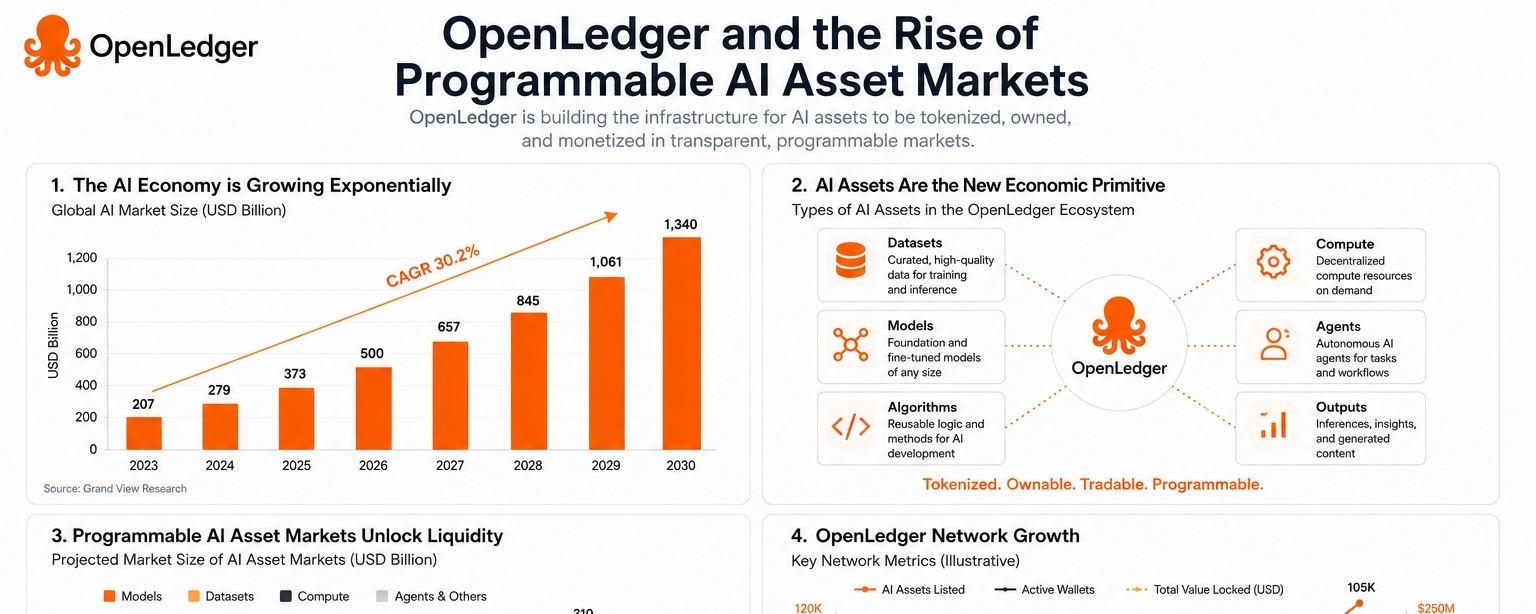
OpenLedger and the Rise of Programmable AI Asset Markets
Haftungsausschluss: Die hier bereitgestellten Informationen enthalten Meinungen Dritter und/oder gesponserte Inhalte und stellen keine Finanzberatung dar. Siehe AGB.