
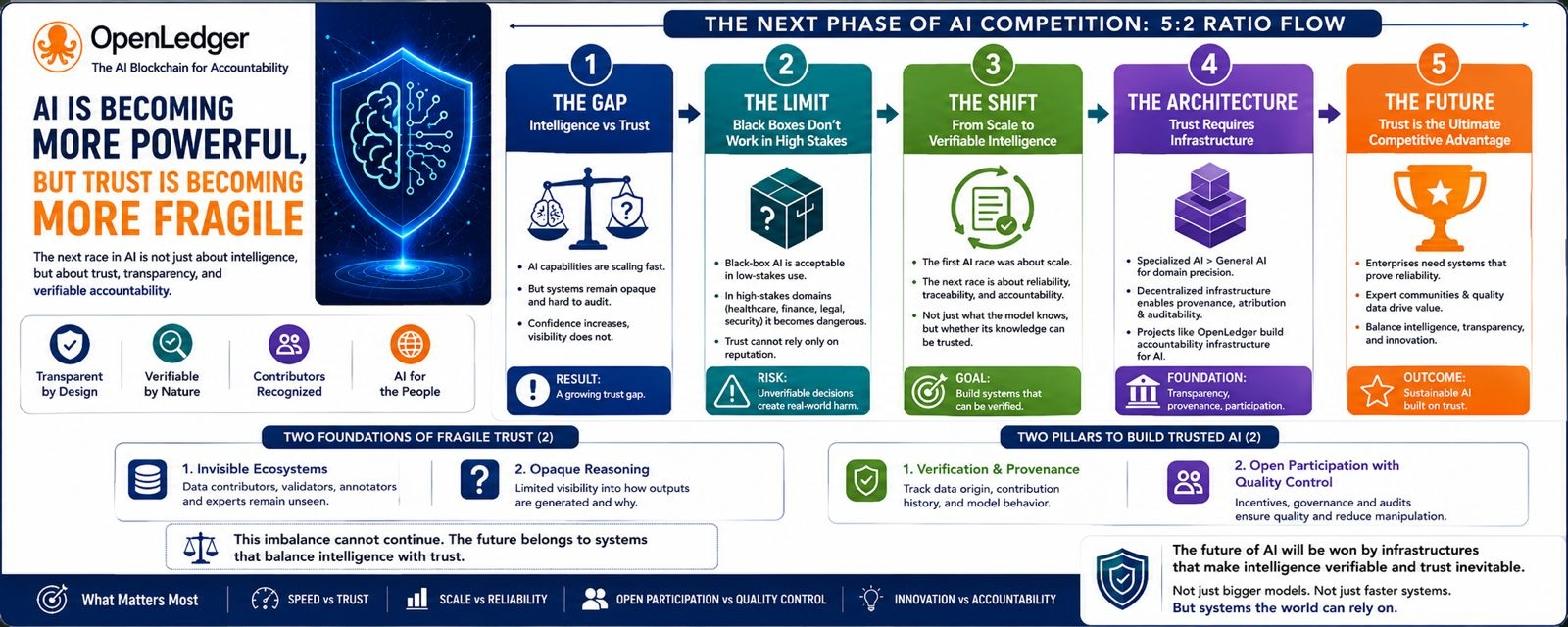
The most interesting shift in AI right now is not how intelligent the systems are becoming. It is how uncertain people are becoming about trusting them.
For years, the AI industry focused almost entirely on capability. Better models, larger datasets, faster inference, more natural interactions. Progress was measured by performance benchmarks and scaling curves. And to be fair, the results were extraordinary. AI systems can now write code, summarize research, generate media, automate workflows, and assist with increasingly complex reasoning tasks.
But capability and trust do not scale at the same speed.
That gap is starting to matter.
What I keep noticing is that many AI systems sound increasingly confident while remaining structurally opaque. They generate outputs with remarkable fluency, yet users often have limited visibility into where the information came from, what data influenced the response, whether the reasoning process can be verified, or how biases entered the system in the first place.
The intelligence improved faster than the accountability layer around it.
That creates a strange tension. AI is becoming more integrated into serious environments such as healthcare, finance, cybersecurity, research, logistics, and legal operations, yet many of the systems still function like black boxes. People are expected to trust outputs they cannot fully audit.
In low-stakes environments, that uncertainty is manageable. In high-stakes environments, it becomes dangerous.
A recommendation engine suggesting movies is one thing. A model assisting medical decisions or financial analysis is something else entirely.
This is why I think the next phase of AI competition will look very different from the first. The earlier race was about scale. The next race will be about reliability, traceability, and verifiable intelligence.
Not just what the model knows.
But whether its knowledge can be trusted.
That distinction changes the architecture conversation entirely.
For a long time, the dominant assumption in AI was that larger general-purpose models would naturally absorb most practical use cases. Bigger systems appeared stronger because they could perform across many domains simultaneously. But practical deployment has exposed the limits of that assumption. General intelligence performs impressively in broad environments while often struggling with domain-specific precision.
Theory and practice started diverging.
In real-world systems, specialized context matters more than generalized fluency. Financial compliance requires consistency. Healthcare requires explainability. Industrial systems require predictable behavior. Legal environments require evidence trails. In these areas, trust is not a branding exercise. It is operational infrastructure.
And operational trust requires verification.
That is one reason decentralized AI infrastructure has started gaining attention beyond purely ideological blockchain circles. What stands out to me is not the simplistic narrative of “AI on-chain,” which is often exaggerated, but the growing attempt to build systems where data provenance, contribution history, model behavior, and validation layers become more transparent and auditable.
Projects like OpenLedger are interesting because they are approaching AI from the perspective of accountability infrastructure rather than pure model hype. The focus is shifting toward specialized AI networks, verifiable datasets, contributor attribution, and transparent coordination between participants building intelligence systems.
That direction feels more aligned with where the industry is naturally heading.
Because one of the least discussed problems in AI is that modern models are deeply dependent on invisible ecosystems. Data contributors, validators, annotators, infrastructure operators, domain experts, and feedback loops all shape model behavior indirectly. Yet most users only see the final interface layer. The system appears singular even though it is built collectively.
This creates a trust paradox.
The more complex AI systems become, the harder it becomes to understand how decisions are actually formed. And once understanding disappears, trust starts relying on institutional reputation rather than technical visibility.
That may work temporarily. It does not scale forever.
I think we are entering a period where verification itself becomes a competitive advantage. Not because every user wants to inspect raw infrastructure, but because organizations increasingly need systems capable of demonstrating provenance, reliability, and accountability under scrutiny.
Especially in enterprise environments.
A model that produces slightly weaker outputs but offers transparent validation may become more valuable than a more powerful black-box system operating without explainability. That trade-off is becoming increasingly real.
Speed versus trust.
Scale versus reliability.
Open participation versus quality control.
These tensions are shaping the next layer of AI architecture far more than most public conversations acknowledge.
What makes this difficult is that verification is not free. Transparency introduces complexity. Auditing systems slows coordination. Open ecosystems attract noise alongside innovation. Incentive structures can improve contribution quality while also encouraging manipulation if designed poorly.
There is no perfect system.
And I think mature discussions around AI need to acknowledge that reality more honestly. Too much of the industry still treats trust as a branding problem when it is actually an infrastructure problem.
The systems themselves must become more legible.
That does not necessarily mean fully open models or radical decentralization everywhere. Some degree of centralization will likely remain necessary for coordination, security, and performance optimization. But opaque intelligence systems governing increasingly important decisions will create long-term friction with regulators, enterprises, and users alike.
Eventually people ask harder questions.
Where did the training data come from?
Who validated the outputs?
What incentives shaped optimization?
Can the reasoning process be audited?
Can manipulation be detected?
These questions are no longer theoretical concerns for researchers. They are becoming business requirements.
What also fascinates me is how this shift changes the economics of expertise. Specialized AI systems depend heavily on high-quality domain-specific data and validation. That means smaller expert communities may become disproportionately important in shaping future AI infrastructure. The value may no longer sit only with whoever owns the largest compute cluster.#OpenLedger
It may increasingly sit with whoever builds the most trusted knowledge systems.
That is a very different market dynamic.
And honestly, I think it is healthier.
Because intelligence without trust eventually creates instability. Systems become more powerful while confidence in them weakens. Outputs spread faster while verification lags behind. Automation expands while accountability becomes harder to locate.
That imbalance cannot continue indefinitely.
The future of AI will probably not belong exclusively to the biggest models, the loudest companies, or the fastest systems. It may belong to the infrastructures capable of balancing intelligence with transparency, specialization with reliability, and innovation with verifiable trust.
That balance is difficult to build.
But increasingly, it is the part that matters most.