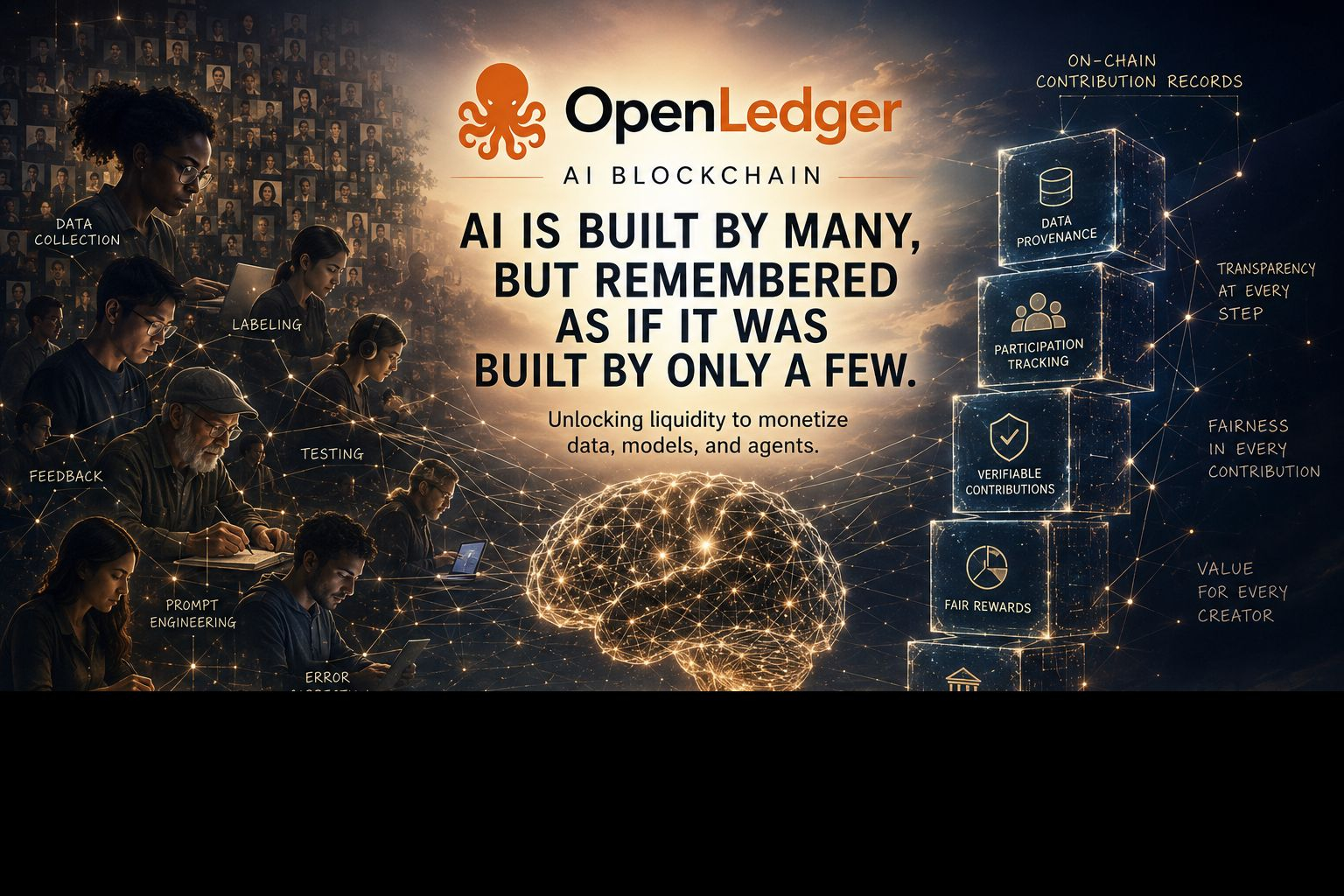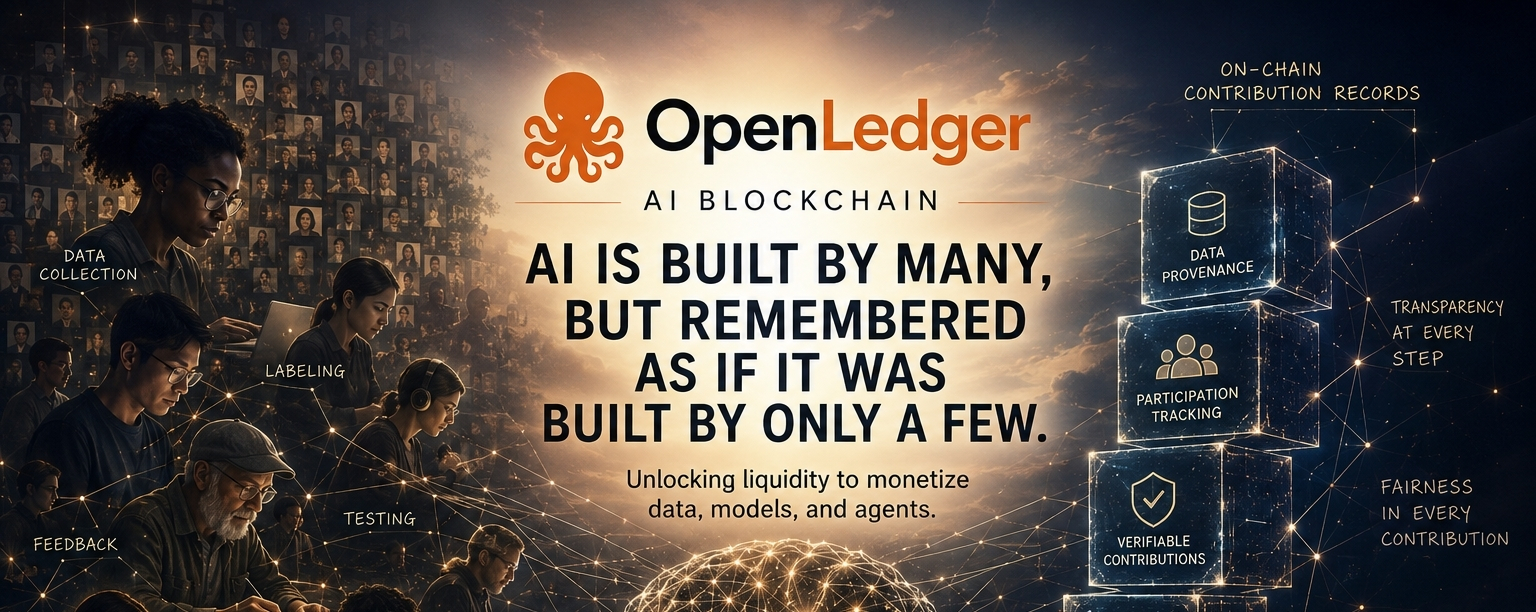
The internet had founders. Social media had platforms. Crypto had visionaries. Artificial intelligence now has its own collection of names people repeat endlessly, as if history always moves through a small handful of recognizable figures standing under conference lights.
But the closer you look at AI, the less that story feels honest.
Modern AI is not built by a few people. It is assembled slowly through the labor, correction, behavior, language, reactions, preferences, frustrations, and invisible participation of millions. Sometimes billions. Most of them will never be acknowledged. Many do not even realize they are contributing.
That may become one of the defining tensions of this decade.
Because the real question around AI is no longer only about intelligence. It is about memory. Specifically: who gets remembered as having created value.
For years, the imbalance stayed mostly hidden because centralized systems made it feel normal. Large companies controlled the data pipelines, the models, the interfaces, the storage, the distribution, and eventually the narratives around innovation itself. The public mostly saw the finished product. A polished chatbot. A powerful image generator. A coding assistant. Something seemingly complete and self-contained.
What remained invisible was the enormous layer beneath it.
The datasets cleaned by underpaid contractors. The countless people labeling edge cases for hours at a time. Users correcting bad outputs without compensation. Communities stress-testing models through everyday use. Writers unknowingly feeding linguistic patterns into future systems. Artists watching styles become training material. Moderators filtering harmful outputs. Developers refining prompts until models behaved coherently. Human feedback loops quietly shaping machine behavior one interaction at a time.
AI became better because people continuously adjusted it.
Not famous people. Mostly ordinary ones.
And yet the economic structure surrounding AI rarely reflects this reality. The intelligence appears centralized even though the process of creating it is deeply distributed.
That contradiction matters more than many people realize.
Because contribution without recognition eventually becomes friction. Then resentment. Then resistance.
You can already feel the cultural shift beginning. A few years ago, people interacted with AI systems out of curiosity. Now there is growing awareness that participation itself has value. Every correction improves future responses. Every interaction becomes behavioral training data. Every preference signal helps optimize systems further.
Companies continue asking for more feedback, more interaction, more training material, more collaboration. But contributors are starting to ask a quieter question in return:
Who benefits from all this accumulated intelligence?
That question becomes harder to ignore as AI systems grow more economically important.
Historically, industrial economies rewarded ownership of physical infrastructure. Digital economies rewarded ownership of platforms and networks. AI economies may reward ownership of cognition itself — the ability to aggregate and refine human contribution at massive scale.
Which means attribution suddenly becomes more than a philosophical concern. It becomes economic infrastructure.
And this is where blockchain becomes interesting again, though perhaps not in the way many people expected during earlier crypto cycles.
For years, most blockchains optimized around financial activity. Transactions. Speculation. Asset transfers. DeFi protocols. NFTs. Markets built around scarcity and ownership. Some of those experiments mattered. Many did not. But most were never designed for the collaborative nature of AI systems.
AI introduces a different problem entirely.
Not just ownership of assets, but traceability of contribution.
Who provided the data? Who improved the outputs? Who validated results? Who participated in refinement? Which communities helped train specific behaviors? Which contributors shaped the usefulness of a model over time?
Traditional systems struggle to answer these questions transparently because the architecture was never designed to preserve contribution history in a meaningful way. Most AI ecosystems still operate like black boxes. Inputs go in. Products come out. Attribution disappears somewhere in the middle.
Blockchain, at least conceptually, offers something different: persistent memory.
Not memory in the human sense. Not emotional memory. Structural memory.
A ledger capable of recording participation, provenance, governance decisions, contribution trails, and collaborative activity across distributed systems. In theory, this creates the possibility of AI ecosystems where value creation becomes more visible instead of less.
That does not automatically solve fairness. Technology alone rarely solves human imbalance. But visibility changes incentives. And incentives shape systems over time.
Projects like OpenLedger sit inside this emerging conversation in a way that feels more structurally important than speculative. Not because they promise another token economy or because “AI + blockchain” suddenly became fashionable again, but because they are attempting to focus on a deeper coordination problem underneath AI itself.
The interesting part is not hype. It is the premise.
If AI increasingly depends on distributed human contribution, then future infrastructure may need mechanisms capable of tracking and rewarding those contributions with far greater transparency than centralized systems currently allow.
That idea sounds simple on paper. In practice, it challenges the assumptions modern AI ecosystems quietly depend on.
Because once contribution becomes measurable, questions of ownership become unavoidable.
Who owns collective intelligence?
Who deserves compensation when models generate enormous value?
Can participation itself become an economic layer?
Should contribution histories remain portable across ecosystems rather than trapped inside corporate platforms?
These are uncomfortable questions because centralized AI benefited enormously from asymmetry. Users contributed value continuously while companies retained nearly all visibility into how that value compounded.
But people are becoming more aware now. Not radically. Not all at once. Just gradually.
Enough to recognize that invisibility is no longer neutral.
The internet trained people to give away data in exchange for convenience. Social media trained people to give away attention in exchange for visibility. AI may become the moment people start questioning what they are actually contributing — and whether systems should remember them for it.
There is also something deeply human beneath this entire debate.
People do not only want compensation. They want acknowledgment. Evidence that participation mattered. That their corrections, ideas, refinements, creativity, or labor were not simply absorbed into a machine that permanently erased their existence afterward.
History has a habit of simplifying collective effort into singular narratives. We celebrate inventors while forgetting workers. Platforms while forgetting communities. Products while forgetting contributors.
AI risks amplifying that pattern at unprecedented scale.
Because unlike previous technologies, AI continuously learns from interaction itself. Its intelligence emerges from accumulation. Which means forgetting contributors is no longer an accidental side effect of the system. It becomes part of the architecture.
And architectures shape culture.
The next phase of AI may ultimately depend less on producing smarter models and more on building fairer systems around them. Systems capable of remembering where intelligence actually came from. Systems that recognize intelligence as collaborative rather than isolated. Systems that preserve contribution instead of quietly extracting it.
That may be the real infrastructure challenge ahead.
Not only compute. Not only scale. Not only speed.
But memory.
The ability to build technological systems that remember the many people who helped create intelligence in the first place, instead of rewriting history as though it appeared from nowhere.